Russian Tabloids Are Thriving In Changing Media Environment
"Komsomolskaya pravda" editor in chief Vladimir Sungorkin proofs the paper before it goes to press.
MOSCOW -- Brawling oligarchs and lethal football hooliganism are high on the agenda as journalists for the mass-circulation tabloid "Komsomolskaya pravda" gather for their daily editorial meeting.
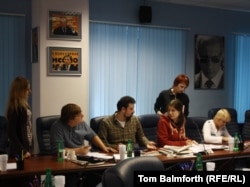
Beneath an imposing portrait of Prime Minister Vladimir Putin decked out in dark sunglasses, reporters and editors discuss the day's top story: a televised brawl between tycoon Aleksandr Lebedev and fellow billionaire businessman Sergei Polonsky that erupted on a talk show. The fact that Polonsky’s underpants were reportedly torn in the melee elicits more than a few chuckles.
Vladimir Sungorkin, the paper's editor in chief, then moves the discussion to more somber content.
“Nice job on this,” he says, pointing to the previous day's lead story from star reporter Rinat Nizamov, a gritty piece on the fatal stabbing of a Russian football fan by an Azerbaijani.
"Komsomolskaya pravda," or "KP" as it is widely known, soundly beat the competition on that explosive story. The paper's editors dug up a photo of the murdered fan raising his arm in a Nazi-style salute, while reporter Nizamov cited a source as saying that the Azeribaijani man was actually trying to protect a Russian friend during the attack.
Forging A Niche
Speaking to RFE/RL in his office in northern Moscow, Sungorkin says it's these kinds of hard-hitting reports on sensitive ethnic issues that have helped "KP" forge a niche for itself among Russia’s burgeoning tabloid landscape.
“We’ve got the most print presses in the world of any newspaper," Sungorkin says. "['Komsomolskaya pravda'] is printed in about 75 different cities and in each city they have their own content. It’s like a massive factory where 75 cities -- each with its own editorial office -- takes care of about half the content.”
Founded in 1925 as a broadsheet affiliated with the Communist Party youth league in the early years of Stalin's rule, "Komsomolskaya pravda" reinvented itself as a tabloid in the 1990s.
The shrewd business move preempted the global embrace of the tabloid format, which has gained particular traction in Russia. Several publishers have transformed once dry Soviet-style broadsheets into hip and racy tabloids in a bid to grab market share and broaden their appeal, while largely sidestepping Russia's treacherous political landscape.
Despite drawing resentment from some quarters of the intelligentsia, Russia’s thriving tabloids have worked on the assumption that as long as they stay out of politics, they can be as scandalous as they want.
'Massive' Demand
Boris Timoshenko, an analyst at the Glasnost Defense Foundation, says this shift in the media landscape was helped along by the public’s growing dissatisfaction with monotonous one-sided political reporting.
"There’s demand [for tabloid entertainment] and that demand is pretty massive," Timoshenko says. "It is this demand that is driving these publications to chime in with tabloids. People are less and less interested in serious publications. It’s the same thing that happened with television, which ceased being about mass media and more about mass entertainment.”
Ekaterina Lebedeva became a reporter in the Moscow bureau of "Komsomolskaya pravda" six years ago and has been hooked on the pressure and exhilaration of the work ever since.
She smiles as she remembers her scoops, including one where she discovered an entire Moscow market illegally trading in food that had passed its sell-by date. When she returned to do a follow-up on the repercussions faced by the market in the wake of her exclusive, she said an angry vendor came out and threatened her with an ax.
“Thankfully, as you can see, I made it out,” she jokes.
Deputy political editor Andrei Barabanov says "KP" has a daily circulation of between 600,000 and 700,000, while its Sunday edition has a print run of 2.5 million, making it Russia’s most circulated daily newspaper. The weekly "Argumenti i Fakti" has a print run of 3.1 million.
Not Simple Scandal Sheets
"Komsomolskaya pravda's" impressive numbers are a far cry from the daily circulation run of 22 million it enjoyed in the early 1990s, a decline the paper's editors attribute to a shrinking global appetite for print media.
But "KP's" numbers still dwarf those of influential Russian broadsheets such as "Kommersant" and "Vedomosti," which hover around 100,000.
Like "KP," "Moskovsky komsomolets" transformed itself from a dry Soviet mouthpiece into a tabloid now specializing in crime reporting. Both, however, stress that they still do serious reporting and have not become simple scandal sheets.
Beneath an imposing portrait of Prime Minister Vladimir Putin decked out in dark sunglasses, reporters and editors at "Komsomolskaya pravda" discuss the day's top story.
"Izvestia" and "Tvoi den" are pillars of a growing tabloid empire being amassed by Aram Gabrelyanov, an Azerbaijani entrepreneur often billed as Russia’s answer to Rupert Murdoch.
National Media Group, a vast conglomerate controlled by businessman Yury Kovalchuk, a close Putin ally, owns the empire masterminded by Gabrelyanov. "Tvoi Den" and "Zhizn," Gabrelyanov’s weekly, are modeled after Murdoch's "The Sun" and specialize in a heady mix of muckraking, crime, and sex scandals.
They have gained a reputation for paying for controversial content. The Life News website, the online arm of Gabrelyanov’s empire, published a picture of the severed head of the suicide bomber after an attack at Domodedovo airport in January. It also bought and published the CCTV footage of journalist Oleg Kashin being beaten with metal rods by assailants in the courtyard of his apartment block in November 2010.
Legendary 'Izvestia'
In 2008, the National Media Group bought "Izvestia" and soon realized there was only one way of turning around circulation figures that had fallen to below 250,000 amid what critics described as its monochrome, state-friendly coverage. After 94 years as a staple broadsheet for the Soviet and Russian intelligentsia, the legendary “Izvestia” brand name was remodeled as a tabloid in June 2011.
Meanwhile, Barabanov says "KP" has remained a leading paper because it rapidly adapted to online multimedia and expanded into radio as well as online and cable television.
The "KP" website received almost 900,000 unique visitors on October 4, the day Nizamov’s story about the football violence ran, making it the second most visited Russian website on that day. Nizamov’s investigation into the football fan’s murder also scored well with online readers.
But Sungorkin says Russia’s state-saturated media landscape is a constant challenge.
“We aren’t beating the competition. We, unfortunately, are just maintaining our corner of the market where we have our own audience and earn money on that," he says. "The lion’s share of mass media is taken up by channels that have real investment from the state. ... This is unique to Russia.”
Some analysts believe the situation may not be as static as Sungorkin suggests, however.
Timoshenko of the Glasnost Defense Foundation says that, “bizarrely,” several tabloids in the regions have begun moving toward serious reporting. He points to the “Prospekt” tabloid of Nizhny Novgorod, as well as other papers from the Province’s Publishing House that were in line to win prizes in the Sakharov Prizes in 2009 for a series of reports on human rights.
“If at one time we started taking note of the process by which serious publications such as 'KP' started moving in the direction of tabloids, then now -- as strange as it may seem -- we are actually seeing an inverse of this," he says. "That is to say that papers that started out as tabloids appear to be moving toward serious reporting. This is very curious, given the conditions of the Russian press. And it will interesting to see how this develops.
"It isn’t a cause for joy – that’s going too far. But it’s a cause for hope.”