Thursday, June 20, 2013


Bosnia

Sarajevo Notebook: For Journalists, The Story Of Their Lives

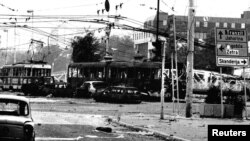
Burned trams and cars in the center of Sarajevo after heavy shelling by Bosnian Serb forces in May1995

Related Articles

Sarajevo, 20 Years Later: The Baby In The Picture, All Grown Up

Sarajevo-born photographer Rikard Larma is responsible for capturing some of the most memorable images from the nearly four-year siege of the Bosnian city. Now, as Sarajevo marks the 20-year anniversary of the start of the siege, RFE/RL speaks to 21-year-old Skender Basic, the subject of one of Larma’s most famous photographs.
TEXT SIZE - +
By Daisy Sindelar
SARAJEVO – Between them, the journalists gathering this week in the Bosnian capital for the 20th anniversary of the start of the siege have covered dozens of conflicts: Afghanistan. Beirut. Chechnya. Iraq.

But amid the drinks and chatter of a correspondents’ reunion at the city’s Holiday Inn -- which served as the main base for foreign journalists covering the war -- it soon becomes clear that there is only one Sarajevo. It’s a war that schooled an entire generation of reporters on the best and worst that humanity had to offer, the power of laughter over tears -- and ultimately, the fact that there is only so much journalists can do to change history.

“We were reporting, reporting, reporting. And it took so long for anyone to react,” says Emma Daly, who covered the 44-month siege for Britain’s “Independent” and who now works as communications director for Human Rights Watch. “It was very frustrating. We said at the time that the best we could hope for is that [former British Prime Minister] John Major would never be able to claim later on that he didn’t know what was happening.”

“I remember going back to London and people asking me, ‘What’s it like being shot at?’ says Janine di Giovanni, the American-born journalist and renowned foreign correspondent, who covered the siege for Britain’s “Sunday Times” and describes Sarajevo as her most wrenching assignment. “That was the best they could do. Bosnia simply had no strategic value -- no oil, nothing of use.”

See Special Section "The Siege Of Sarajevo" For RFE/RL's Full Coverage

Remy Ourdan, the long-standing war correspondent for France’s “Le Monde,” recalls spending much of the war struggling to tame his retelling of the horrors he was experiencing.

“I covered a bombing of a school. Sometimes the mortar fire was just random, landing here and there, but this was targeted,” he says. “They knew they were firing at a school. There was a child whose head had been split in two. You could see his brains splattered on the chalkboard. I was so angry -- I wrote a very angry piece. When I filed it” – Ourdan was a freelance radio reporter at the time -- “the producer fainted, listening to me. And my editor rejected it.”

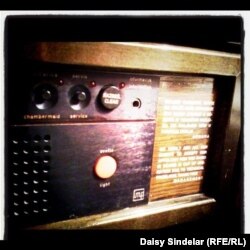
A radio in Sarajevo's Holiday Inn, the main base for journalists who were covering the warA radio in Sarajevo's Holiday Inn, the main base for journalists who were covering the war
x
A radio in Sarajevo's Holiday Inn, the main base for journalists who were covering the war
Since then, Ourdan -- who has gone on to report from Rwanda, Congo, and Afghanistan, among other places -- says he tries to keep his language “quiet,” although occasionally the old anger slips out.

“Who notices how many people are dying in Afghanistan?” he says. “Sometimes you have to get personal. You can’t do it every day, but sometimes you have to tell what war is about.”

'I Was Really Moved'

Several of the journalists had earlier made their way downtown to attend the day’s anniversary commemorations and to take in the silent row of empty red chairs stretching down the length of the city’s Marshal Tito Street to represent the 11,541 people killed in the siege. Some correspondents confess to having doubts about the chair project, which had become the fodder for teasing by the local media, not least because they came from Serbia.

“I really thought it would be over the top. I wasn’t even planning to go,” says one Bosnian journalist, who spent his war years as a correspondent with the city’s legendary Radio Zid. “But then I came down, and I was really moved. I thought about the people I lost -- my father, my uncle. I was worried that I would run into someone I knew, because I literally didn’t think I’d be able to speak.”

“Nobody shed a tear during the war,” says Sabina Cosic, who was a 22-year-old Sarajevan with better-than-average English when she was brought in as a fixer for Reuters, and whose eventual partner, war correspondent Kurt Schork, was later killed in Sierra Leone. “This week, we’ve been weeping uncontrollably.”

And laughing as well. Many of the correspondents say they savored their time in Bosnia for the black humor that sustained many of the locals. “You know what they say, if you didn’t laugh you would never stop crying,” says Daly. “But they are also extremely funny people.”

Alison Smale, the executive editor of the “International Herald Tribune,” who coordinated coverage of the war for The Associated Press, repeats one particularly grim joke passed on by a local at the worst of the siege’s privations.

“What’s the difference between Sarajevo and Auschwitz? In Auschwitz, they had gas.”

Ourdan, who spearheaded efforts to organize what one journalist called the week’s “Sarajevo high-school reunion,” says the Bosnian war will always be different from other conflicts because, both geographically and spiritually, it was a “war at home.”

“I don’t like to say that, but it’s true. When the war started, I drove here in my car,” he says. “These were people with the same books on their bookshelves that I had on mine. The only difference was, they had to burn their books to stay warm.”

“Bosnians are always special,” he says. “But during the war they were extraordinary.”

This forum has been closed.
Comment Sorting
Comments
     
by: vn from: Belgrade
April 07, 2012 07:06
And it comes from journalists such as Janine di Giovanni of "Sunday Times" (must have some Italian origin) that the Serbs are the to be blamed for the war in Bosnia and Sarajevo: "Bosnia simply had no strategic value - no oil, nothing of use". She was short of saying "people are just worthless piece of news".

For God's sake! Could she go somewhere and have her head examined? Sarajevo was the most Yugoslavian city in ex-Yugoslavia, the cornerstone of the whole European civilization if you will, and a great experiment for fifty years - can three main confessions, plus others, live together side by side and thrive, under the name of a country, not of a nationality? And you'd been spawning the news on prisoners in camps as Muslims, whereas children had been recognizing their Serbian parents. Just plain sick!

Just keep on puffing your favourite stuff.


In Response

by: Regular Joe from: USA
April 12, 2012 21:03
vn - When Janine said, "Bosnia simply had no strategic value -- no oil, nothing of use," she was criticizing Western governments for not intervening, and for seeming not to care about Bosnia. She clearly was not saying that the people were "just [sic] worthless piece of news."

The comments on Bosnia stories on this site always depress me, as they are always filled with hateful, biased rantings pointing out the evils committed by one side (sometimes dating back centuries) as some sort of justification for the evils committed by the other, if even admitting that their side committed any evils. Not a good indication that peace has truly taken root in the Balkan's rocky soil or in the hearts of too many of the region's inhabitants.
In Response

by: vn from: Belgrade
April 13, 2012 16:15
To: Regular Joe

Appreciate your response. If you'd allow a few clarifications:

"the Balkans rocky soil" - is as far from the truth as depicting the US soil in terms of sand-covered and desertlike land of Arizona.

The meaning "short of" is almost, and I agree that in this post the aforementioned journalist did not say "people are just worthless piece of news".

However I do think this statement has been underlied in the reporting in ex-Yugoslavia. Furthermore, if as a non-US citizen I am to understand that Western governments are to be criticized for not intervening because a country "has no strategic value - no oil, nothing of use" then it would follow that West can go ahead with bombing such areas, because they contain, and here comes the point - only PEOPLE. Right?

In that case, how would you explain this latest craze of the West, let's name them NATO, and their unsatiable desire to intervene in countries rich in oil, such as Lybia, Syria, Egypt, ... Maybe they consider these countries peopleLESS?

Please forgive me for probing for some consistency in the US/UK/German logics.

by: david roos from: rotterdam
April 07, 2012 09:49
this is less a story about the war in sarajevo or the plight of the bosnians and more a self-indulgent bit of mutual back-patting that is de rigeur among journalists. while clearly and consistently unable to "change history", they nevertheless inflate their sense of self-worth in any situation... it was true 20 years ago, and inexplicably persists today, despite the new forms of social media making it increasingly clear how tenuous their jobs and mythologized their import. any clear-eyed flashback to the atrocities of sarajevo would have acknowledged that the cadre of journalists reminiscing in cafes were at least as expendable as the subjects (people) they covered.
In Response

by: Jergen from: Maribor
April 12, 2012 16:11
Janine di Giovanni: Madness Visible
Greg Cambell: The road to Kosovo
Simon Winchester: The Fracture Zone
Rodger Cohen: Hearts Grown Brutal
Peter Maass: Love Thy Neighbor
Tim Judah: War and Revenge

All excellent books written by credible authors who thoroughly researched their materiel. Of course if, through that research, the author portrayed Serbs in anything other than a positive light (read: Truthful) then the likes of "vn" from Belgrade will do all they can to discredit them despite the preponderence of evidence to the contrary.

Try as you might you can't rewrite history.
In Response

by: vn from: Belgrade
April 13, 2012 06:24
To: Jergen

Without meaning to discredit the journalistic aptitude to enter the literary road of novel writing in the fashion of history memoirs, I believe the subject at hand was journalism and reporting in Bosnia/Sarajevo, not the journalists themselves. Sorry, haven't read any of the books for various reasons: not in politics, not a journalist/reporter myself, books in English not available in Belgrade, etc. Would need to get an offer I could not refuse to read them. At the time of 1990s had some difficulties of technical nature in terms of regular life, living, being, existing, looking for raison d'etre, ...

Hopefully they have done the journalists' compulsory reading:

Alija Izetbegovic: The Islamic Declaration, 1990; Izetbegovic of Bosnia and Herzegovina: Notes from Prison; War and Peace in Bosnia and Herzegovina, etc.

The words of introduction in Wikipedia: "In April 1983, Izetbegovic and twelve other Bosniak activitsts (including Melika Salihbegovic, Edhem Bichkacic, Omer Mustafa Spahic and Hasan Chengic) were tried before a Sarajevo court for a variety
of offences, principally hostile activity by Muslim nationalism, association for purposes of hostile activity and hostile propaganda".

If this is history rewriting, sorry for rewriting it for you.
In Response

by: Jergen from: Maribor
April 13, 2012 15:59
vn,

I noted the authors and their books because most them, and most notably Janine di Giovanni who you try to discredit, were also correspondents during the conflict i.e. witnesses to the horror and truth.

I understand your plight during the 1990's as I spent most of that decade in the former Jugoslavia trying to keep your warring factions from killing each other at an unprecedented pace. A task that eventually proved to be too difficult and daunting in the end.

I find it both comical and sad that a person who discredits journalists also uses Wikipedia as a reference. There's a contradiction for ya!
In Response

by: vn from: Belgrade
April 14, 2012 06:00
To: Jergen

Since nobody seems to give a rat's behind or any credit to anything coming from the Serbs, especially to the point of view of somebody who was living in Belgrade throughout all the time of conflicts, and are taking the defense mode to be an offensive one, I have had to resort to Wikipedia which is available to all. Even this is insulting to you.

About the media most horrendous deed: A young woman from ex-Yugoslavia (Bosnia) was working in Germany or Belgium (not really sure which country), she buys a magazine and who does she recognize on the black & white photo with description "Muslims in Serbian kept prison-camp" (I believe it was Omarska) - the old man was her own father, a Serb. So much for the Serbian kept camp. But only the Serbs on the whole planet knew the truth. The photograph, as a form of "saying more than words" and if irresponsibly printed doing more damage in the form of fast consumption news has gone through all the newspapers and magazines in the world (The Time, The Economist, French, Italian, you name it).

Another example is The Time with a photo of disgusting looking bearded creature with checkered amblems, which "responsible, objective, thorough research" thick-headed dudes called a Chetnik. The truth is that the person on the photograph is an Ustasha, a Croatian !!! I was wondering what your checking and proof finding techniques are. He tells you what he is and you write it down under a photo or you ask somebody else as well. How come the media did not write "Prince of Canada"? Are all the journalists, reporters, correspondents drug-addicts or are they simply nauseatingly easy to corrupt? I've also had a case of journalists who asked me three times the basic questions: who told you that, what is the source, when was the news, is the agency a credible one, how do you know that? Now, there is a difference. These blunders did not come from them.

I would say these cases belong to journalistic and media crime.

If you had anything to do with the UN, my thoughts on the organization are extremely negative. You can go back to the UNHCR story. Staffed with half-British (not speaking English) daughters, half-Hungarians and other mixed up blood lines. Now, don't get me wrong, because I'm in danger of even being called a racist. The most annoying thing about the personnel is their lack of education, not being experts in any field but cheap gossip, and loads of mental problems usually being solved by resorting to cigarettes, alcohol and pills. A very sick bunch of people who contributed to nothing but making even more unnecessary chaos. These families are still holding top positions and they say everything is fine with the world.

I cannot understand the UN position with the Dutch troops in Srebrenica. They're saying quite contradictory things most probably in order to cover for these office brats in Belgrade. And Sarajevo UN is not much better. In the beginning of the 90s due to the development of prostitution business they moved to Istria. And this could go on and on ...

A real contradiction per se would be somebody denying the role of Slovenia's violent secession from Yugoslavia, but cannot live without Belgrade, can you?

by: Morten Rasmussen from: Copenhagen
April 08, 2012 19:15
Hope accuracy in reporting was better then. I bet the top photo is not 1995, but 1992 or 1993. Debris like that was long gone by 1995.

by: PI from: uk
April 08, 2012 23:33
would be interesting to see the development if the survivors of the atrocities themselves were assisted to be world-class (and known) reporters - this seems to seldom happen?

by: Wayne from: East Timor
April 09, 2012 08:34
Well, the previous two comments are pretty pathetic. Janine probably knew Sarajevo better than most at the time. She knows of what she speaks.
And of course it is now a story about the seige of Sarajevo. It IS a story of the journalists that were there. That is implicit and explicit in the headline. What did you expect David Roos? Can you not read a headline?
In Response

by: vn from: Belgrade
April 09, 2012 12:35
Regarding the headline: as stated in here "The Story of Their Lives", the context would be: misfortune always happens to journalists, their life of war reporting is a drag, ... (it's a story of my life).
Perhaps the RFL had the intention of conveying the meaning of "once in a lifetime story", "a story to last a lifetime" or something like that ...

Somehow, I think David Roos got it perfectly.

Anyhow, whatever journalists, local and foreign (with some rare but notable exceptions) may think of their own life, by their largely irresponsible reporting they surely contributed to making a mess out of many people's lives in the Balkans, and the credit goes to their publishers and editors as well. They must be very proud of this devil-may-care attitude to reporting and its accomplishments.

Most Popular