Saturday, May 25, 2013


Serbia

Serbian President's Government Appointments Raise Eyebrows, Cause Alarm

Serbian President Tomislav Nikolic (right) and his predecessor Boris Tadic at the inauguration ceremony in Belgrade in June.
TEXT SIZE - +
By Robert Coalson
Serbian President Tomislav Nikolic has been in office for just over two months. But his rule is already raising alarm bells in Washington and Brussels over a number of issues.
 
The latest came this week when parliament confirmed an old Nikolic political ally, Jorgovanka Tabakovic, as head of Serbia's central bank. That move came just days after lawmakers moved to strip away much of the bank's political independence.
 
The U.S. ambassador to Serbia said the process represented "a failure of the rule of law."
 
Peter Stano, spokesman for European Union Enlargement Commissioner Stefan Fuele, echoed the criticisms.
 
"We are concerned about the content of the new amendments to the law on the central bank and also about the process, because it seems that the procedure was quite rushed and the law -- which is a very important piece of legislation -- was not consulted on appropriate levels, including not being consulted with the European Commission," Stano said.
 
Downgrade
 
The Standard & Poor's (S&P) ratings agency on August 7 cut Serbia's sovereign-debt rating to double B minus, partly in response to the changes at the central bank and partly because of the agency's negative outlook on the country's economy as a whole. The Serbian dinar fell to a record low in trading against the euro after the S&P announcement.
 
The new law, which passed on August 4, creates a parliament-appointed supervisory body and gives parliament the power to appoint the bank's top management. Even before the bill passed, National Bank of Serbia Governor Dejan Soskic and Vice Governor Bojan Markovic resigned, complaining that the bank was being politicized.
 
On August 8, three more members of the bank's Council of Governors -- including council President Bosko Zivkovic -- also tendered their resignations.
 
Lawmakers from the ruling coalition defended the measure by saying it was intended to increase coordination between the policies of the bank and those of the government.
 
The legislative changes and the appointment of Tabakovic raised serious concerns that Nikolic is wavering on his stated commitment to European integration.
 
An economist by training, Tabakovic is a senior member of Nikolic's Serbian Progressive Party, a shrewd political insider selected for a post usually assigned to an apolitical technocrat. She was born in Kosovo and has been associated with Serbian nationalist movements throughout her political career.
 
Dragomir Jankovic, a consultant with the Vienna-based European Economic Institute, says the developments send a bad signal to investors and international institutions. "Believe me, all international institutions and creditors will look very badly on this because they will realize that the government will control the monetary system, which means foreign-currency reserves and everything else that the central bank does," Jankovic says.
 
"Second, I am sure this will reflect badly on domestic currency policy, the movement and the stability of prices because the central bank will try to behave in a way that is suitable for the government."
 
Dmitar Bechev, a senior policy analyst with the European Council on Foreign Relations, argues that Tabakovic's appointment to head the central bank reflects the political constraints President Nikolic faces as he tries to fill top posts in the government from supporters in a party that was largely built around his charismatic personality and the single issue of Serbian nationalism.
 
"Tabakovic's appointment is yet another example of this, because here is somebody who was his right hand -- and normally these people should be in the cabinet, not in the central bank," Bechev says. "But it means they are short of anybody really to put in all those commanding positions. So he is ready to sacrifice a top party functionary for a position which normally goes to a technocrat and not really to this type of person."
 
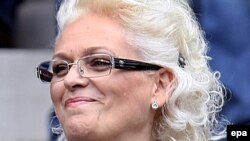
Jorgovanka Tabakovic is the new head of Serbia's central bank.
Tabakovic's selection follows a series of controversial appointments by Nikolic, who assumed the presidency on May 31.
 
In June, Nikolic named fellow nationalist -- and head of the Serbian Socialist Party of former Yugoslav strongman Slobodan Milosevic -- Ivica Dacic as his prime minister.
 
Last month, parliament approved a cabinet that included some surprising choices. Perhaps the most surprising was Culture Minister Bratislav Petkovic, a Belgrade pastry-shop owner who is a theater director by training -- and who holds staunch nationalist views.
 
In September 2011, Petkovic addressed a Belgrade rally in support of ethnic Serbs in Kosovo. "This is not the end of history, you know. We lived through communism and we will live through democracy, so do not despair. We have nothing to lose," he told the rally. "We are at the bottom and our ascent is yet to take place. May God help us."
 
It is still unclear how the hard-line appointments will translate into policy.
 
With the first couple months of Nikolic's presidency behind us, it is still difficult to say with certainty, for example, whether his top priority is trying to reassert Serbian control over Kosovo, a former Serbian province that unilaterally declared independence in 2008, or advancing Serbia's bid for European integration and membership in the EU.
 
EU Hopes
 
Serbia received full candidate-member status in March, just a couple months before Nikolic was elected.
 
Rinna Kullaa, a fellow with the Wilson Center in Washington and a professor of history at Finland's University of Jyvaskyla, attributes the uncertainty to Nikolic's inexperience and to the different constituencies he must address.
 
"Whereas he has expressed a very strong commitment towards EU integration directly to Brussels and to EU leaders, as well as to some other leaders in Europe, sometimes in the domestic press he has expressed views of a different type of commitment towards Kosovo being part of Serbia," Kullaa says.
 
"So there has been a kind of a fluctuation in his statements, which I think shows that he is new to his job, that he has not had very much experience giving international interviews or talking to the press or with the duties of the head of state."
 
Analyst Bechev argues that "nationalist posturing" is a feature of Serbia's political landscape and not automatically a cause for concern. The solid nationalist credentials of Nikolic and his coalition government could give him the flexibility to make compromises on Kosovo that other leaders could not make.
 
"I think that would be really positive because up to now it was mainly the Democrats who owned this pro-European agenda and, of course, the Socialists were in the coalition, but it was very much [former President Boris] Tadic's project," Bechev says. "If the new coalition proves that it is equally committed to being pragmatic on Kosovo in order to move closer to the EU, that would be definitely the positive scenario."
 
In the meantime, Bechev cautions that Dacic's government -- and Tabakovic's central bank -- have their hands full with an economy on the brink of collapse despite a 1 billion euro ($1.2 billion) International Monetary Fund (IMF) loan program that has been frozen since February over IMF concerns about the country's budget deficit.
 
Unemployment is about 25 percent and the economy has contracted for the last two consecutive quarters.
 
"One indicator you might want to look at is the interest rate Serbia is selling short-term bonds on -- it is 13 percent. Which is staggering if you think about the figure," Bechev notes."I mean, for the likes of Spain and Italy, 6 percent is already prohibitive, and here is Serbia trading at 13, which basically tells you what investors think about the economic situation there."
 
Robert Coalson wrote this story based on reporting from Belgrade by RFE/RL Balkan Service correspondents Branka Trivic and Branka Mihajlovic. Rikard Jozwiak contributed from Brussels and Golnaz Esfandiari from Washington

This forum has been closed.
Comment Sorting
Comments page of 2
    Next 
by: vn from: Belgrade
August 08, 2012 11:34
I've read a number of anti-Serbia articles but this one tops the creepy feeling of being disgusted with the EU and Washington leading the terrorizing NGO activities in Serbia. The NATO member countries keep forgeting about being overdue for paying damages for bombing all the civilian infrastructure in Serbia and for murdering civilians (alias collateral damages) in 1999, with the excuse of looking for one man only and helping Kosovo. The collapse of Serbian economy is a direct product of the EU & US mafia operations.

This is not to support anyone in the new Serbian leadership, simply because they're also attached to the same above mentioned mafia structures, but because it would be good to apply some common sense and prudence in reporting on these issuses. We're not all fanatical Muslims and Serbia is not an isolated island in Europe or the world.
In Response

by: Sasha from: Bogetic
August 08, 2012 15:52
Such is life when you lose every war you started for the past two decades. Consider yourselves lucky to not have to pay reparations for the damages your fellow countrymen inflicted on the rest of the Balkans.And when I say countrymen I mean thugs, released prisoners, mental patients, football hooligans and the like.

Naturally it will take a good amount of time to recover financially from disasterous decisions made by your past (sic) nationalistic fervor but blaming everyone else for your woes it getting a little old.

The only thing demonizing the Serbs are the actions of the Serbs themselves.
In Response

by: Jeff from: Skegness
August 08, 2012 19:21
Croatia should pay reparations that would bankrupt them for generations. Serbia is the only country that has paid for any crimes. The disgusting thing about people like you is that you are the most bitter of the lot. No heart, just an empty void. Sick.
In Response

by: Jack from: US
August 08, 2012 17:02
Wow, is that picture an accurate reflection of what Serbian women look like? Remind me never to go there on vacation.
In Response

by: Jeff from: London
August 08, 2012 19:15
Jack - thanks for not coming.
In Response

by: Sasha from: Belgrade
August 08, 2012 20:00
Yup, better go to Thailand for ladyboys.
In Response

by: Mike from: Canada
August 08, 2012 20:01
Yes, and all American women surely look like Madeleine Albright as well.

by: Boris from: Canada
August 08, 2012 13:35
What a terrible article! I thought that demonizing Serbia was a thing of the past. It's obvious that it's alive and well today. This article is written in such a way that it keep's Serbia in somekind of purgatory where the unknown is always related to an 'evil' past. It's disgusting. Yes, Nikolic is the president. But he hasn't done anything at all to deserve such scrutiny. I don't recall reading any headlines about Serbia using depleted uranium or 'saving' Arab nations from regimes.
In Response

by: rm& from: near Ferizaj
August 09, 2012 07:34
Boris, please, read http://www.e-novine.com/feljton/index.1.html it will help you know your government better. It is a Serbian portal, and will be easy acceptable for you, since I see you did not read anything but "Politika" and "RTS".

by: Jack from: US
August 08, 2012 15:20
Serbian people saw the example of the Ukraine which was run down into a hole by a bunch of US and EU-supported "orange revolutionaries". Ukrainians ended up being one of the poorest people on Earth, and forced to migrate to Russia by millions in search of food and work. Serbian people should have looked toward Russia and become one of the republics in Russian federation. This way NATO minions would never have dared to bomb Serbia and kill Christians, and illegal Albanian migrants would have had relocate back to Albania from Kosovo

by: Andy from: Canada
August 08, 2012 17:27
Amazing how the comments are bringing up 1999 and Kosovo and Bosnia and not what is going on today. One wants to join Russia - go ahead move there; one makes collateral damage claims but doesn't mention the massacre of Bosnians or Albanians (legal immigrants or not). Would look great if the western world countries started to eliminate all illegal immigrants. And as for Ukraine being destroyed by Orange Revolutionairies - how about the corrupt politicians that have been in parliament for 25 yrs., how about the current gov't diregarding constitution. Serbians are great people but some just have a huge chip on their shoulder - stop blaming others for your problems.
In Response

by: vn from: Belgrade
August 09, 2012 05:37
Amazing how the article in the part on former governor Dejan Soskic who allegedly resigned on the premise of "the bank being politicized" missed the part of him being devoutedly propped by the NGO sector, the very same people who have been in the same position for 25 years, who caused the NATO action in 1999, who support the separatist Kosovo Albanians and have no intention of moving their stinking heads from Belgrade to Kosovo. Their major concern is saving the Euro and US Dollars in the banks - the money that is supposedly going to Serbia's economy and is not intended for their tax-free salaries. I would wish someone could prove me wrong and say that in the US, Canada or Switzerland the NGO staff stationed there are getting their monthly cash in currencies other than the USD, Canadian dollars or Swiss Francs. And Serbia has hundreds of foreign NGOs with anti-Serb staff - it would be a plain economic inflation flamed disaster for any country in the world, let alone for devastated Serbia.

Oh, and we'll close our eyes to the lucrative arms trade business, the life line for the economies of the US, Germany, Canada, Saudi Arabia, France, UK, etc.

And stop blaming the Serbs only for the events in Bosnia or Kosovo. It's so convenient for the Western countries to memorize one nation only as if the others had nothing to do with the horrendous acts - to repeat - it was all the other nations, especially the Albanians, the Muslims, the nationalist Croats and Slovenians who started the infamous war in ex-Yugoslavia.

by: Mamuka
August 08, 2012 17:27
I doubt that the EU and the west would approve of anything Serbia did, so they might as well do what they think is best for themselves. These nationalists don't seem to have the answer but they were elected by the Serb people and they have the authority to enact their program. They cant do any worse than the rest of the EU at this point.

by: Anonymous
August 08, 2012 17:58
if russia have gazprom as armed arm in external political

USA have rating company

by: Liz
August 08, 2012 18:57
This is a prime example of an article geared to demonizing Serbia and Serbs. Those who know nothing about history and geography, likely eat everything up as the truth. It is so typical to keep repeating 'nationalist' and 'nationalism' when it's about Serbs and Serbia. Yet, those who know the facts, are not fooled. So, Radio Free Europe, let's educate the people about the real hard-core nationalists in the region, i.e. about the Croatian Ustasha and WWII. How's that for starters? Then, of course let's hear a bit about the Muslim nationalists, i.e. the Bosniaks and Albanians. If you're 'Free' as your moniker implies, then be free to tell the truth. As you relay the Western view, let's hear a bit about the rampant nationalism in USA and NATO, and even the EU. How about hearing a bit about the RC nationalism in beatifying a war criminal in 1998. C'mon you can do it, Radio 'Free' Europe / Radio 'Liberty' ! I'd suggest you consult with Simon Wiesenthal Center, because the Jewish people also encountered the 'ultra-nationalists' in the region. Not only the Serbs.
In Response

by: RM&
August 09, 2012 07:59
Liz, please read the following and correct your comment,

http://www.e-novine.com/feljton/51641-Miloevi-Krajinik-budala-Amfilohije-ubre.html

It will, hopefully, give you a new point of view to who is who!!?

by: rm& from: close to ferizaj
August 09, 2012 07:27
Looking from my point of view, Serbia is taking the fast train back in the past. It's government and people (like by: vn from: Belgrade) don't just see what really happened, and have never got the chance to figure that out. This is sad for me, taking in consideration the 4 conflicts Serbia is to blame for. But my real worry would be, is there any analogy between Serbia and Iraq, since they are both going through the same scenario!?

by: Nesh from: Münster
August 09, 2012 09:44
Serbia is pushed back into the reign of brutes and savages – I have no doubts on that. Free nations of the West are shocked and in disbelief, while the Red Bear smiles from the towers of Kremlin because he got a new pawn on the global chess board.
However, all is not lost... yet... If international community wants lasting stability in the region it should strongly support independence movements in Vojvodina, Sandzak and Timok. Only that could cut the power hungry demagogues in Belgrade from resources that they need to push the entire region into never-ending cycles of bloodletting again.
And if international community fails once more, the Serbian pawn will only grow stronger and, in time, the Red Bear will have almost unchallenged access to the heart of Europe.
In Response

by: Jack from: US
August 09, 2012 16:25
Serbia is not pawn. Serbia is minion.
In Response

by: Anonymous
August 11, 2012 02:54
a) What defines pawn and minion?

b) Even if Serbia remains loyal to Russia, there is a limit to how much can be done. How could the Yugoslav wars be repeated? The EU was unsure of itself, and unfamiliar with differences between Balkan nations. Today the EU is confident and growing. Some former Yugoslav nations are now members of the EU, and others intend to accede, including Serbia.

Therefore, "unchallenged access", no. The EU is wise to Serbian choices, and would have no problem sticking Serbia with Belarus-style pariah status. There will be no surprises this time. The EU decided that the former Yugoslav republics are the business of the EU - not Russia and not the USA.
In Response

by: vn from: Belgrade
August 11, 2012 15:32
To: Anonymous

An interesting commentary showing that it is insensitive to the ongoing reality: the EU & USA are working in unison with each other counter the interests of Serbia and overall economic wellbeing in Europe. The statement: "The EU decided that the former Yugoslav republics are the business of the EU - not Russia and not the USA", is contradictory in terms and makes me wonder if by the term "the EU" someone is implying Turkey, Saudi Arabia and the Muslims in Europe.

by: Ben from: London
August 09, 2012 13:33
Serbia needs to realise that it is only a tiny little pawn in the world economy, ruled by rating agencies. The people who are in government now have been too busy plotting the downfall of the Democrats to know how to deal with the current crisis, prop up the ailing dinar and reduce unemployment.

The aging population and low birth rates ensure the OAP voters will always be the driving force behind the elections and since they live in the past and reflect on the good old days of socialism, they think this change in government will turn around Serbia's woes.

There is no quick solution, working through the problems will take years, it is not a process that will happen overnight. Unfortunately the Serbs have no patience and in my mind despite the love for my country, I can't see things improving for a considerable period of time.

The one good thing about any delays in joining the EU will be that our young generation will not have a chance to jump ship as quickly, since the future does indeed look bleak for Serbia.
Comments page of 2
    Next 

Most Popular