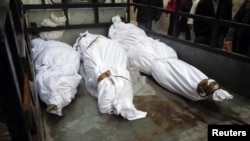
The bodies of what activists say were the victims of shelling by the Syrian Army in the Sunni Muslim district of Bab Amro in Homs on February 8.
The bombardment of the city of Homs by Syrian forces, an offensive that has killed hundreds, is a key part of President Bashar al-Assad's attempt to crush an 11-month-old insurgency against his rule and defeat army defectors who have joined the uprising in the city.
The capital of Syria's largest province, Homs has become the focal point of the insurgency, which some observers believe could soon morph into a full-blown civil war. But what is it about this city of nearly 1.5 million that has made it the epicenter of the battle for Syria?
Part of it is sectarian, analysts say. The city is majority Sunni, while the Assad government largely draws its strength from the minority Alawites, a Shi'ite offshoot sect.
'Indiscriminate Force'
But as Shashank Joshi, a Middle East specialist at London's Royal United Services Institute, explains, the city's importance also stems from a fear among Assad loyalists that the city could turn into a liberated zone -- similar to Benghazi in the Libyan uprising -- that could become home to an alternative government and rival power center where opposition forces could be armed and trained.
"They do not want Homs, an entire city, to get to a point whereby it gets out of the government's hands completely," Joshi says. "So they would rather use indiscriminate force to deny that, [rather] than to sit back and let the situation slip from their grasp."
An image grab taken from a video uploaded to YouTube on February 10 purportedly shows a tank firing in the Baba Amro neighborhood in Homs on February 10.
The city has been a hotbed of rebellion from the early days of the insurgency.
Last spring, Homs' residents flocked to the city's Old Clock Square, just as Egyptians opposed to President Hosni Mubarak's rule had assembled in Cairo's Tahrir Square. But they faced a brutal government crackdown, which turned into a nearly yearlong siege.
This turned Homs into the symbolic hotbed of the revolution and led to it suffering a large proportion of the uprising's nearly 6,000 deaths. The Homs region accounts for approximately one-quarter of all the deaths in the uprising, the most in the country.
But Assad's forces have had a difficult time pacifying the city, which has a difficult topography consisting of winding streets and sprawling neighborhoods.
Moreover, the regime's reliance on indiscriminate force has also increased the likelihood that the conflict could become sectarian. While Homs' majority Sunni Muslim community has been the backbone of the uprising, they share the city with large communities of loyalist Alawites.
Revenge Killings
Some of Homs' staunchest opposition sectors -- such as the Sunni-dominated Baba Amro and Khaldiyeh neighborhoods -- lie adjacent to Alawite districts. This proximity has led to a cycle of revenge killings.
Joshi says Homs is a microcosm of Syria's sectarian divisions.
"[Homs] is exhibiting many of the same dynamics we would expect to see writ large as the civil war expands -- particularly the hardening of confessional fault lines, the hardening of this idea of belonging to different sects," Joshi says. "We are seeing retaliation not on the basis of pro- or antigovernment [sentiments] but often on the basis of whether a particular group is Sunni or Alawite."
Chimaa Youssef, a native of Homs who now lives in Prague, says it has been difficult to contact members of her extended family in Syria. She says her once-peaceful home city has completely changed.
"Now we are unable to find them on the phone. Sometimes we catch them on Facebook. We ask them, how are they? We know that many of them are also participating in the protests," Youssef says. "But they do not speak about its details. They say that they never imagined that we would be living in a situation similar to Iraq."
Abubakar Siddique, a journalist for RFE/RL's Radio Azadi, specializes in the coverage of Afghanistan and Pakistan. He is the author of The Pashtun Question: The Unresolved Key To The Future Of Pakistan And Afghanistan. He also writes the Azadi Briefing, a weekly newsletter that unpacks the key issues in Afghanistan.