




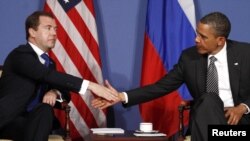
The White House touts its "reset" policy toward Russia as one of its key diplomatic successes. But the Russian authorities were caught off-guard when Washington quietly barred some of their officials from traveling to the United States this week, a move that threatens to undo some of the gains Washington has made boosting ties with Moscow.
The State Department blacklist targets those connected to a scandal that's drawn widespread international condemnation: the death of Sergei Magnitsky, a Russian lawyer jailed in 2009 after accusing police of bilking the government of more than $200 million. A report commissioned by President Dmitry Medvedev himself concluded Magnitsky was denied medical care and probably severely beaten before he died.
Magnitsky's supporters have been lobbying Western countries to ban Russian officials implicated in Magnitsky's death.
But speaking on a talk show on Ekho Moskvy radio, Leonid Slutsky, first deputy chairman of the Russian Duma's Foreign Affairs Committee, said he couldn't believe the United States went ahead and did it, adding the information could have been made up as a provocation to harm ties.
The Kremlin soon reacted more strongly. Medvedev's spokeswoman told the "Kommersant" newspaper the president was preparing retaliatory steps. "We were bewildered by the State Department's action," she said, adding that nothing like it happened "even in the deepest years of the Cold War."
Ironically, the blacklist appears to have been intended to head off an effort to impose even stronger sanctions. A group of U.S. senators is sponsoring a bill that would include more Russian officials, freezing their U.S. assets in addition to denying them visas.
Fyodor Lukyanov, editor of the journal "Russia in Global Affairs," said the nuance seems to have been lost on Russian officials. "Everybody expected the U.S. Senate to act," he said, "but the preventive or preemptive measure by the State Department was quite unexpected."
Other signs of fraying ties emerged this week. Senator Jon Kyl (Republican, Arizona) has called for more investigation into a recent bomb blast outside the U.S. Embassy in Georgia that U.S. intelligence officials say may have been linked to a Russian agent. In Brussels on July 28, the Russian ambassador to NATO dredged up old complaints about plans for a U.S. missile-defense shield in Europe.
Progress Made In Cooperation
While relations between the two sides often appear precarious, the latest developments mark the biggest challenge to President Barack Obama's Russia "reset." The White House says its policy has delivered major gains for U.S. national security, including Russian cooperation over Afghanistan -- for which Moscow is well-paid -- help over sanctions against Iran, and the signing of the new START nuclear-arms treaty.
Another sea change has been much less visible. Under Obama's predecessor, George W. Bush, cooperation between diplomats on various levels all but ended in favor of a direct dialogue between presidents. Much was made of their personal relationship, but when Bush left office, relations stood at Cold War lows.
The bureaucratic ties have since been restored. Russian diplomats say collaboration with their U.S. counterparts is even better now than in the relatively friendly 1990s. If decisions at top levels once took many weeks to implement, now agreements such as a recent deal over U.S. adoptions of Russian children can be put in place more quickly.
But top Russian officials threatened to curtail cooperation on Iran, Afghanistan, and North Korea over the Senate's Magnitsky bill, according to a leaked State Department memo that first made the blacklist public on July 26.
Although the memo argued against stronger measures, political expert Andrei Piontkovsky said he thinks the Russian threats may have had the opposite of their intended effect. "My reading of this development is that people at the very top," he said, "maybe the president himself, were shocked by such [direct] language and decided not to submit to blackmail."
Too Much To Lose
Observers said that although the memo was probably leaked to show the White House to be keen on protecting relations, the blacklist was nevertheless evidence of a significant change in Washington.
Masha Lipman of the Carnegie Center said it poses a challenge to the Russian leadership, shown to be unable to protect loyal officials from punishment abroad. "By now it's well known denying visas to Russian officials is a sensitive spot that could potentially expand to other countries, to Europe," she said, "which may be more important to Russian officials."
The blacklist has been praised by Russian human rights activists and other critics who worry Washington has sacrificed support for Western values in favor of better relations with the Kremlin.
The U.S. action may help usher in a new, potentially rockier phase in the relationship. While the fate of the Senate's Magnitsky bill remains unclear, the Russian parliament has been preparing its own bill in response.
But few believe cooperation over important issues will be affected. The Carnegie Center's Lipman pointed out that previous incidents that could have worsened relations, such as revelations from U.S. diplomatic cables released by WikiLeaks and Washington's expulsion of 10 Russian intelligence agents last year, did not visibly affect ties.
Lukyanov of "Russia in Global Affairs" agreed the blacklist won't change the nature of relations. "Of course it won't contribute to a better relationship," he said, "but I don't think it will damage much because in areas where Russia and the United States cooperate now -- like Afghanistan, nuclear disarmament, even Iran -- both sides are interested in it."
But Lukyanov said that even if relations suffer, Russian and U.S. politicians are focused on presidential elections in each of their countries next year, and will make no significant moves until 2013.
The State Department blacklist targets those connected to a scandal that's drawn widespread international condemnation: the death of Sergei Magnitsky, a Russian lawyer jailed in 2009 after accusing police of bilking the government of more than $200 million. A report commissioned by President Dmitry Medvedev himself concluded Magnitsky was denied medical care and probably severely beaten before he died.
Magnitsky's supporters have been lobbying Western countries to ban Russian officials implicated in Magnitsky's death.
But speaking on a talk show on Ekho Moskvy radio, Leonid Slutsky, first deputy chairman of the Russian Duma's Foreign Affairs Committee, said he couldn't believe the United States went ahead and did it, adding the information could have been made up as a provocation to harm ties.
The Kremlin soon reacted more strongly. Medvedev's spokeswoman told the "Kommersant" newspaper the president was preparing retaliatory steps. "We were bewildered by the State Department's action," she said, adding that nothing like it happened "even in the deepest years of the Cold War."
Ironically, the blacklist appears to have been intended to head off an effort to impose even stronger sanctions. A group of U.S. senators is sponsoring a bill that would include more Russian officials, freezing their U.S. assets in addition to denying them visas.
Fyodor Lukyanov, editor of the journal "Russia in Global Affairs," said the nuance seems to have been lost on Russian officials. "Everybody expected the U.S. Senate to act," he said, "but the preventive or preemptive measure by the State Department was quite unexpected."
Other signs of fraying ties emerged this week. Senator Jon Kyl (Republican, Arizona) has called for more investigation into a recent bomb blast outside the U.S. Embassy in Georgia that U.S. intelligence officials say may have been linked to a Russian agent. In Brussels on July 28, the Russian ambassador to NATO dredged up old complaints about plans for a U.S. missile-defense shield in Europe.
Progress Made In Cooperation
While relations between the two sides often appear precarious, the latest developments mark the biggest challenge to President Barack Obama's Russia "reset." The White House says its policy has delivered major gains for U.S. national security, including Russian cooperation over Afghanistan -- for which Moscow is well-paid -- help over sanctions against Iran, and the signing of the new START nuclear-arms treaty.
Another sea change has been much less visible. Under Obama's predecessor, George W. Bush, cooperation between diplomats on various levels all but ended in favor of a direct dialogue between presidents. Much was made of their personal relationship, but when Bush left office, relations stood at Cold War lows.


But top Russian officials threatened to curtail cooperation on Iran, Afghanistan, and North Korea over the Senate's Magnitsky bill, according to a leaked State Department memo that first made the blacklist public on July 26.
Although the memo argued against stronger measures, political expert Andrei Piontkovsky said he thinks the Russian threats may have had the opposite of their intended effect. "My reading of this development is that people at the very top," he said, "maybe the president himself, were shocked by such [direct] language and decided not to submit to blackmail."
Too Much To Lose
Observers said that although the memo was probably leaked to show the White House to be keen on protecting relations, the blacklist was nevertheless evidence of a significant change in Washington.
Masha Lipman of the Carnegie Center said it poses a challenge to the Russian leadership, shown to be unable to protect loyal officials from punishment abroad. "By now it's well known denying visas to Russian officials is a sensitive spot that could potentially expand to other countries, to Europe," she said, "which may be more important to Russian officials."
The blacklist has been praised by Russian human rights activists and other critics who worry Washington has sacrificed support for Western values in favor of better relations with the Kremlin.
The U.S. action may help usher in a new, potentially rockier phase in the relationship. While the fate of the Senate's Magnitsky bill remains unclear, the Russian parliament has been preparing its own bill in response.
But few believe cooperation over important issues will be affected. The Carnegie Center's Lipman pointed out that previous incidents that could have worsened relations, such as revelations from U.S. diplomatic cables released by WikiLeaks and Washington's expulsion of 10 Russian intelligence agents last year, did not visibly affect ties.
Lukyanov of "Russia in Global Affairs" agreed the blacklist won't change the nature of relations. "Of course it won't contribute to a better relationship," he said, "but I don't think it will damage much because in areas where Russia and the United States cooperate now -- like Afghanistan, nuclear disarmament, even Iran -- both sides are interested in it."
But Lukyanov said that even if relations suffer, Russian and U.S. politicians are focused on presidential elections in each of their countries next year, and will make no significant moves until 2013.