Saturday, May 26, 2012


Features

U.S. Military Waste A Smoldering Afghan Health Issue

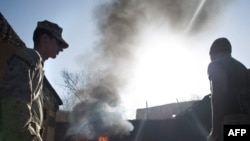
U.S. Marines burn human waste as they clean their lavatories at the Musa Qala base in the southern Helmand Province. Officials say the military is trying to reduce the incineration of solid waste, but many Afghans see little progress.
TEXT SIZE - +
By Frud Bezhan
Rahim spends most of his day selling merchandise to foreign soldiers out of the ramshackle hut he calls his shop. It's a living -- he earns enough to support his wife and four children -- but like many locals he feels his life in Bagram, north of Kabul, is killing him.

"It's the air," Rahim says as he coughs violently and points to the plumes of black and green smoke rising in the distance. "It's making me and my family sick."

Rahim, who provides only his first name, pins the blame squarely on Bagram air base, home to about 30,000 U.S. and coalition forces as well as thousands of foreign and local contractors. Located only a few miles from Bagram city, the base houses a large airstrip, dozens of residential halls, and even a modern shopping mall that boasts a Burger King and a Pizza Hut.

According to Rahim, the source of the smoke is a huge burning pit at the base -- an open dump site the U.S. military uses to dispose of trash at the base. He believes harmful chemicals are released in the burning process, causing various forms of ailments and disease in the areas surrounding the base.

"They're burning TVs, radios, mobile phones, and all sorts of electronics. It doesn't matter how much we have protested, neither the government nor the Americans have listened to our concerns," Rahim says. "They shouldn't do this. Our children are getting sick because the wind is blowing the smoke inside our homes."

Rahim's concerns are shared by other locals. Farhad, who has worked at the air base since 2008, describes the burn pit as the size of "several soccer fields." A bulldozer pushes waste into the pit, located at the outer edge of the base, and it burns 24 hours a day, he says.

"I've witnessed the Americans dumping and then burning electronics like computers and television sets, ...things that are renewed every six months," Farhad says. "The smoke gives off a very bad odor that smells like plastic, which is entering our homes. It is making everyone sick, especially the children. This has been happening ever since the Americans entered Bagram 10 years ago."

Effects Of Pollution

Comparative statistics documenting a rise in cases of illnesses and disease due to exposure to the burning pits are not available. No official study has been carried out, in part due to the lack of proper testing equipment and expertise among health officials in Afghanistan.

But the effects on the local population are readily obvious, according to Dr. Mustafa Siddiqui, a health specialist from Kabul. He says using fuel to burn waste contaminates the air with toxic pollutants such as lead, mercury, and cadmium, and can cause respiratory illnesses, chronic allergies, and various cancers.

"People living near the military base in Bagram are coughing up blood, find it difficult to breathe, and have problems with their kidneys and livers," Dr. Siddiqui says.

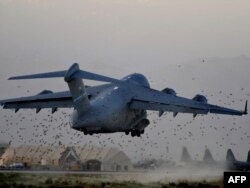
A U.S. Air Force heavy cargo plane takes off from Bagram air base, which sees frequent air traffic.
​​
Steven Markowitz, professor of environmental sciences at Queens College, City University of New York, says U.S. soldiers returning from Afghanistan are also showing significant increases in respiratory problems. He attributes this to the soldiers being exposed to open burn pits at Bagram and other U.S. military bases.

"If we know American soldiers are being affected, then we know it is quite possible for local laborers on bases and the local population to be affected," Markowitz says.

Few Signs Of Progress

The United States has 100,000 troops and thousands more contractors in Afghanistan, with each producing 4.5 kilograms of waste each day, according to the U.S. Department of Defense.

Commander Robert Mulac, public affairs officer for U.S. Forces-Afghanistan (USFOR-A), says burning pits are the most "expeditious way" of getting rid of the waste.

"The reason for the use of burn pits is that, because of the very large volume of solid waste generated by contingency operations, it is impracticable to landfill the waste without first substantially reducing the volume," Mulac says.

Mulac adds that USFOR-A is implementing measures to reduce the amount of open-air burning, including the installation of low-emission incinerators at Bagram air base.

But Ghulam Mohammad Malikyar, who heads Afghanistan's National Environmental Protection Agency (NEPA), says military officials at Bagram have not done enough.

"From what we can see and the reports we receive from the ground, it is clear that this issue has not been taken seriously," Malikyar says. "We have recommended that they use recycling and introduce clean incinerators but nothing has come of it. The process toward changing this practice has been very slow."

Malikyar says that he has met with numerous military officials at the International Security Assistance Force headquarters in Kabul and at Bagram air base over the past two years. "We have told them that burning waste in the open is strictly forbidden under Afghan law," he says. "We have told them that the smoke is making people sick and damaging the environment."

Convincing The Military To Change

Afghan laws forbidding burn pits are not applicable to U.S. and other international forces. But according to Malikyar, the lease agreement at Bagram and other foreign bases denies local investigators permission to access and monitor a military facility.

"These conditions are hampering efforts to overhaul the use of burn pits in other military bases and army facilities as well," Malikyar says. "This problem is occurring in military bases around the country. But it is up to foreign officials to implement the changes; we cannot."

Air pollution in many Afghan cities is a serious health problem.
​​

NEPA, which regulates, monitors, and enforces environmental laws in the country, first received complaints about the U.S. military's use of fire pits in Bagram at the local level in 2009.

"Previously, there was no problem. The policy in Bagram was to sell outdated equipment to local contractors who would, in turn, sell them as second-hand goods," Malikyar says. "But this practice ended two years ago as more waste piled up.... With waste piling up, the fire pits were used by the military more regularly and now they are burning waste all the time."

In the past two years, NEPA's regional office in Bagram has interviewed dozens of locals who say they are suffering from various respiratory disorders, and eye and nasal problems originating from toxic smoke from Bagram air base.

NEPA's local environment-monitoring office in Bagram forwarded the grievances to Malikyar, who in turn notified U.S. authorities.

Nowhere To Turn

Located throughout Afghanistan, the U.S. military's burn pits have compounded the serious environmental and health issues facing Afghanistan. Many cities in the country already suffer from a lack of sewage and sanitation systems, growing slums, crumbling infrastructure, and rapid population growth.

Constant power cuts and the absence of a national natural-gas grid also mean that many households, including Rahim's in Bagram, use wood, coal, and heating oil for cooking and heating.

For Rahim, protecting the country's deteriorating environment is paramount to creating better health conditions for ordinary Afghans.

Consoling his two sick daughters as they lie on his lap, Rahim says his family is experiencing firsthand the detrimental effects of environmental neglect. He considers leaving for good, but therein lies the catch -- by leaving for a healthier life, he would have to give up his family's livelihood.

RFE/RL Radio Free Afghanistan correspondent Homayoon Shinwary contributed to this report
This forum has been closed.
Comment Sorting
Comments
     
by: Ray F. from: Lawrence, KS
October 28, 2011 19:10
Nice report. This toxic pollution is a contributing factor to the awful smog of war, and another reason why US/NATO forces should depart Afghanistan now. Both my son and daughter-in-law (who served for some months in Bagram in 08-09) can attest to the deplorable environmental conditions at this base. Alas, some within the mil-industrial complex continue to profit from the deadly fires of Mordor.

by: Burn Pit Voices from: US
October 28, 2011 20:42
Military Burn Pits and Chronic Health Problems

Open Pit Burning and US Military

The US Military returning from Iraq and Afghanistan may be suffering chronic, long-term health issues as a result of exposure to toxic fumes from open burn pits. Defense contractors have used burn pits at the majority of US military bases in the Middle East as a method of military waste disposal. All kinds of toxic waste have been incinerated in these open burn pits, including human waste, plastics, hazardous medical waste, lithium batteries, tires, hydraulic fluids and vehicles—often using jet fuel as an accelerant.

Since the beginning of the Iraqi war in 2003, countless service members have developed serious health issues. According to the "Afghanistan and Iraq Report", which was released by the US Government Accountability Office, four burn pits on US bases in Iraq are not meeting standards set in 2009 for burn pit operations.

The report, titled "DOD Should Improve Adherence to Its Guidance on Open Pit Burning and Solid Waste Management", goes on to say that some veterans returning from both conflicts have reported pulmonary and respiratory ailments, among other health concerns, that they attribute to burn pit emissions.

Burn Pit Lawsuits

Current and former members of the military have filed lawsuits in federal court in at least 43 states. The burn pit lawsuits, filed against Department of Defense contractors, claim mismanagement of the burn pit operations at several installations in both Iraq and Afghanistan, which resulted in exposure to harmful and toxic smoke and led to adverse health events.

Burn pit lawsuits have been filed against defense contractors KBR and its former parent company Halliburton, claiming the companies endangered the health of US troops and contractors in Iraq and Afghanistan by unsafely burning massive amounts of garbage on US bases.

One lawsuit filed in the United States District Court for District of Maryland (David Jobes v. KBR, April 2010) alleges that prolonged exposure to the pits’ smoke, ash, and fumes caused injuries such as chronic illnesses, risk of illnesses and wrongful death. The suit claims that the defendants—KBR Inc., Kellogg, Brown &d Root Services, Kellogg Brown & Root LLP and Halliburton Company-- had a duty to warn US service members and civilians working and living around burn pit fumes about health and safety issues but failed to properly do so.

The suit also claims that Halliburton and KBR received approximately five billion dollars per year in exchange for promising to provide contractually defined services. KBR apparently built the burn pit upwind from soldiers’ living quarters, in violation of the LOGCAP statement of work and Army regulations, which stated that burn pits had to be built downwind of living quarters. Yet the contractors allegedly ignored this guidance.

by: Aibek
October 31, 2011 16:09
I do not know about the situation near Bagram, but I can tell you that Kabul has terrible air pollution due to climate, terrain, horrific overcrowding, burning of anything people can get their hands on for cooking and heat, and low grade gasoline and diesel in poorly maintained cars.

In Kyrgyzstan people complained about fuel dumping near the US air base. Yet countless smokestacks across the country belched black smoke day and night.

The only difference is they hope to get some money from the US.

by: Senjo
November 03, 2011 04:37
You feel for the locals, who lead miserable lives already and now have to deal with this. Furthermore, US and NATO forces are also exposed to this seemingly irresponsible disposal method. The taxpayer will be paying the bill for their health conditions (as they should) while the lives of these service members are affected for decades to come, all due to this senseless venture that should have ended long ago.

by: Interested Observer from: Bagram AFG
November 24, 2011 20:10
"Located only a few miles from Bagram city, the base houses a large airstrip, dozens of residential halls, and even a modern shopping mall that boasts a Burger King and a Pizza Hut."

I have no disagreement with the general description of the problems of waste disposal at Bagram (known as BAF to anyone in theater) but how about a little balance and accuracy?

To claiming the base has a "modern shopping mall" as well as a Burger King and a Pizza Hut is ridiculous.

Bagram has two, very small stores called a "PX" (Post Exchange) and the largest of them is no larger than 40 feet wide by 65 feet deep. It is surrounded by about a dozen smaller shops run by local nationals who mostly sell fake gems (glass), Lapiz and over priced Chinese junk.

There is a "Pizza Hut" but it only recently re-opened after being closed for nearly two years. They mostly sell pizzas "to-go" as the seating area only holds about 20 people.

There is no Burger King - there might have been one about three years ago but its been closed for some time.
Oh and most folks do not live in "residential halls" but live in large tents and in small plywood shacks called "B-Huts". (Google it.)

Secondly this article is incredibly ONE SIDED!

As far as good practices for waste disposal go... Afghans are just as bad as we are.

They have no 'trash collection" services, no 'recycling programs' and they either burn their own trash (just like we do) or simply toss it outside in a pile and wait for it to blow away or just ignore it.

The 35 million or so Afghans in the country generate far more waste than the coalition does.

"Still, domestic bottlers face a host of obstacles. Just maintaining the sanitary environment needed to produce high-quality bottled water is an enormous challenge, said James Frasche, chief operating officer of Afghan Natural Beverages, which says it is the only company in Afghanistan that bottles spring water. The company produces a brand called Tabiyat.
Afghanistan groundwater is contaminated with high levels of E. coli and other bacteria, as well as industrial and military chemicals. Meanwhile, its air has one of the highest concentrations of fecal matter anywhere on Earth."
http://www.peacedividendtrust.org/en/data/files/download/News/Nov%2026,%202007%20-%20Ottawa%20Citizen%20Bottled-water%20market.pdf

To see a real problem with air pollution look no farther than Kabul, which is just down the road from Bagram (about 40 miles straight line distance) as its polution often blows up into the bowl where Bagram sits.
http://www.afghan-web.com/environment/kabul_air_quality.pdf

How about water quality and pollution?

According to WHO standards satisfactory drinking water should contain not more than 3 coliform per 100 ml ... [and] ... water with even 1 cell of FECAL coliform per 100ml is absolutely undesirable for
human consumption. [However] more than one thousand Fecal coliform per 100 ml make a water unfit EVEN FOR irrigation.

So guess what?

When they tested the Kabul River they found that in, "...14 out of 19 river water samples contained more than 1000 Fecal coliform per 100 ml which makes this river water unfit for irrigation in those areas."

So is that the Coalition or Americas fault?

No, that was tested in 1999. http://jcsp.org.pk/index.php/jcsp/article/viewFile/1739/1193

Guess what? Third world countries, especially ones that are in the middle of a war, are simply dirty.

It's just the reality of the situation.

Our primary issue on Bagram and most military bases is that we simply generate MORE trash than they do.

Please don't worry though... we will all be leaving in a few years and the jobs and economic benefits that our presence brings will go with it and many of the Afghans can go back to farming wheat or opium and fighting their civil wars or whatever.

Regards,

-Interested Observer

Most Popular


Being Discussed Now

Chechen Leader Names New Premier

Latest Comment (5 total)

M: Ingush human rights defender Magomed Khazbiev: "Kremlin needs slaves in the Caucasus":
http://pik.tv/ru/shows/vasha-pravda/video/86/4437 More

Kingsley As Karzai?

Latest Comment (1 total)

M: they put the dictators in power and they make fun of them More

Moldova Sentences 3 On Uranium Charge

Latest Comment (1 total)

Ionas Aurelian Rus:
One should not only salute the capture of these officials by the Moldovan ... More