



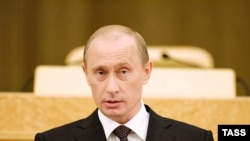
PRAGUE, May 10, 2006 (RFE/RL) -- Some observers thought Putin might use the annual address to rebut last week's speech by U.S. Vice President Dick Cheney.
That speech, made in the Lithuanian capital Vilnius, was strongly critical of the Kremlin and appeared to set the stage for a standoff between Moscow and Washington ahead of Russia's hosting of the annual Group of Eight (G8) summit in St. Petersburg in July.
But Putin declined to pick up the gauntlet. He offered a few thinly veiled critiques of the United States -- and opening remarks that paraphrased the 32nd American president, Franklin D. Roosevelt. But the bulk of his speech -- made before a joint session of the Federation Council and the State Duma parliament chambers -- focused mainly on domestic issues.
Domestic Focus
Chief among them was what Putin called "the main issue" -- the country's demographic crisis.
The Russian president decried the country's annual decline of nearly 700,000 people a year, and presented a detailed plan for improving childcare benefits in order to encourage women to have at least the two children needed to maintain a stable population.
"When planning to have a child, a woman is faced with the choice whether to have a child but lose her job, or not to have a child," Putin said. "This is a very difficult choice. The encouragement of childbirth should include a whole range of measures of administrative, financial, and social support for young families."
His call to address the country's demographic crisis is consistent with Russia's current emphasis on Russian nationhood and cultural traditions. But it also was a sign that Putin is looking with concern at the country's dwindling military ranks.
Military Woes
The Russian president spoke regretfully of the country's military stagnation and pledged to rebuild the Russian armed forces to face this century's global, regional, and local threats.
Putin also said Russia needed a strong military not only to guard against potential attacks, but also to resist political pressure from abroad.
"We should be always ready to repulse potential foreign aggression and acts of international terrorism, we should be able to respond to anybody's attempts to put pressure on Russia in matters of foreign policy in order to strengthen their own positions at our expense," Putin said. "And it must be said openly: the stronger our armed forces, the less temptation there will be to put such pressure on us."
WTO Assession
Among the issues that Putin said the West is using to pressure Russia is the country's bid to join the World Trade Organization (WTO).
Putin said WTO negotiations should not be used to make demands on Russia that are not related to entry into the trade body.
"It is obvious that our economy is already more open than the economies of many members of this respected organization," Putin said. "And the negotiations on Russia's membership in the WTO should not become a subject of bargaining over issues that have nothing to do with the activities of this organization."
Putin said Russia had not succeeded in its original goal of doubling gross domestic product within a decade. But he stressed that the country's overall economic performance had been strong, not least because of the significant growth in energy markets.
(RTR, agency reports)
Russia And The West
(epa)
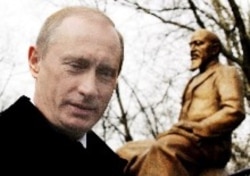
COOPERATION, CONFLICT, CONFRONTATION: Relations between Russia and the West are notoriously volatile. "To see the kind of relationship that presidents Bush and Putin have developed and to see Russia firmly anchored in the West, that's really a dream of 300 years, not just of the post-Cold War era," then-national security adviser Condoleezza Rice said in May 2002.
But observers have increasingly called into question the extent of the shared values between Russia and the West, particularly on issues relating to the transformations going on in other former Soviet countries.
RELATED ARTICLES
Silent Diplomacy Versus Public Criticism
Analysts Say New Arms Race Unlikely
Moscow 'Unhappy' With Outcome Of CFE Conference
Moscow And Washington Spar Over WTO Membership
Russia Gears Up To Improve Its Image Abroad
Experts Urge U.S. To Rethink Relations With Russia
U.S. Official Says Russian NGO Law Part Of Antidemocratic Trend
ARCHIVE
To view an archive of RFE/RL's coverage of Russia, click here; to view an archive of RFE/RL's coverage of U.S.-Russian relations, click here.

SUBSCRIBE
For news and analysis on Russia by e-mail, subscribe to "RFE/RL Russia Report."