




Several days earlier, on June 22, the three allies in the 2004 Orange Revolution -- the Yuliya Tymoshenko Bloc (129 seats), Our Ukraine (81 seats), and the Socialist Party (33 seats) -- signed a coalition deal, following three months of negotiations. Regarding the distribution of top government posts, Yuliya Tymoshenko was to assume the post of prime minister, while Petro Poroshenko from Our Ukraine was to become parliament speaker. The Socialist Party was entitled under the deal to the post of first deputy prime minister.
Some of the would-be coalition partners were visibly unhappy about the June deal to recreate the Orange government that collapsed in September 2005, after then-Prime Minister Tymoshenko accused then-National Defense and Security Council Secretary Poroshenko of corrupt practices and encroaching upon her executive prerogatives. Tymoshenko and Poroshenko, the fiercest enemies in the 2005 feud, were again to assume top government posts, and many saw in this a seed for an inevitable future conflict.
Socialist Party leader Moroz, who aspired to become parliament speaker after the March 26 parliamentary elections, was also apparently unhappy with the fact that this post was offered to Poroshenko.
And there was the Party of Regions, which unsuccessfully tried to strike a coalition deal with Our Ukraine in mid-June. After it became clear that the former Orange allies might recreate their governing alliance, the Party of Regions launched a blockade of the parliamentary hall. The blockade was in protest against what the Yanukovych-led party saw as an unlawful scheme to appoint the prime minister and parliament speaker in a single, open vote, and against the coalition's failure to offer the opposition sufficient positions on legislative committees.
Blockade Lifted
But the Party of Regions agreed to lift its parliamentary blockade on July 6, after reportedly reaching an agreement with the Orange Revolution allies. According to this agreement, the election of parliamentary leadership had to be conducted in a secret ballot, and the opposition -- that is, the Party of Regions and the Communist Party -- were offered leadership positions on 50 percent of parliamentary committees.
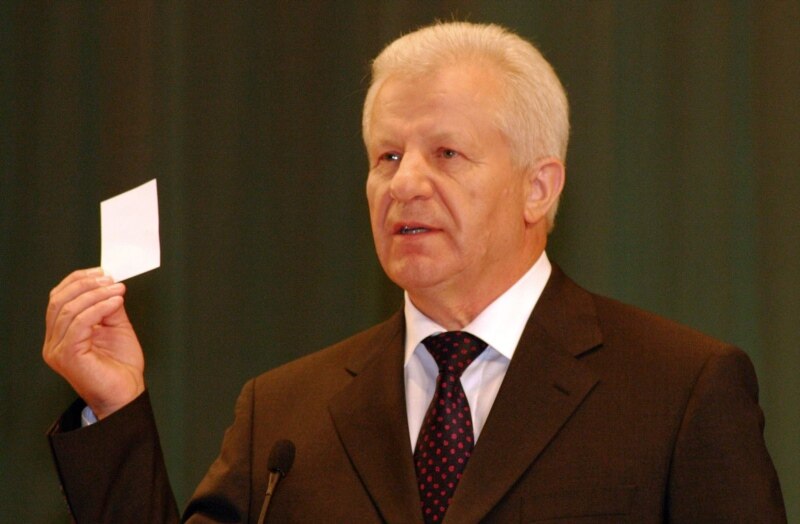
New parliament speaker Oleksandr Moroz (Ukrinform)
"There is a new coalition, let them work, while we will be in opposition," Our Ukraine leader Roman Bezsmertnyy commented on what happened in the Verkhovna Rada on July 6.
Yuliya Tymoshenko did not comment directly on the election of Moroz, adding only that she does not understand what is going on.
West-East Divide
Meanwhile, Moroz explained his election as parliament speaker by his intention to heal the west-east division in Ukrainian society deepened by the 2004 Orange Revolution and the 2006 parliamentary elections. "We must reduce this tension, which has been artificially created, we must end the split we now see in Ukraine. I'm sure we can overcome this problem. I'm even more sure that we can bring together those who see themselves as the victors and those who see themselves as the vanquished," Moroz said.
How Moroz is going to achieve this goal is not immediately clear. The Yuliya Tymoshenko Bloc, with its political-support base in western Ukraine, has repeatedly and firmly declared that it will not enter any governing coalition with the Party of Regions, which is entrenched in eastern and southern Ukraine.
Most likely, Moroz is expecting that a new "grand" coalition would include Our Ukraine along with the Party of Regions and the Socialist Party. Only such an alliance could give some credibility to Moroz's claim about healing Ukraine's west-east rift.
Could Our Ukraine enter a ruling coalition with its fiercest political opponent, the Party of Regions? Such an option was suggested by Our Ukraine itself in mid-June, when the pro-presidential bloc turned to Yanukovych's party to discuss the formation of a new government. There is reportedly a significant group of politicians in Our Ukraine, including caretaker Prime Minister Yuriy Yekhanurov, who prefer running a government with the Party of Regions rather than the Yuliya Tymoshenko Bloc.
New Coalition?
What other options are available for Ukraine?
A ruling coalition could be created by the Party of Regions, the Socialist Party, and the Communist Party. The three parties jointly control 240 votes in the 450-seat legislature. But such a coalition would hardly contribute anything substantial to healing the Ukrainian political split.
If Ukrainian lawmakers fail to approve a new prime minister and cabinet by July 25, President Viktor Yushchenko will have the right to disband the Verkhovna Rada and call for new elections. But last week, Yushchenko ruled out such a possibility. "There will be no repeat elections. It is a too expensive pleasure for the country and an inadequate price for the ambitions of some politicians," he said in a radio address on July 1.
The Verkhovna Rada on July 7 postponed its session until next week, apparently not knowing how to resolve its coalition-building conundrum. It seems that the Ukrainian political elite is now waiting for a word from President Yushchenko. It was he who reportedly advised Our Ukraine in June against forging a coalition with the Party of Regions. Perhaps this time, in order to avoid repeat elections, he will urge Our Ukraine to take this step.
Ukraine's Choice
 Campaign stands on a Kyiv street in ahead of the March 26 elections (RFE/RL)
RELOADED DEMOCRACY: On March 16, Ukrainian Ambassador to the United States OLEH SHAMSHUR held a briefing at RFE/RL's Washington office. Shamshur discussed the political and economic achievements of the last year and the political environment in the run-up to the legislative elections. "Many people would say it was a year lost," he said. "And I would categorically, even definitely, object to that. I think that it was a year not lost; it was a difficult year; it was the learning period when we were learning, or in some instances, relearning to act under the democratic rules and procedures. Some mistakes which were made were avoidable, some were hardly avoidable, but in any case it was very important period for Ukraine as a country, Ukraine as a new, or if you wish, rediscovered, reloaded democracy."
Listen to the complete presentation (about 60 minutes):
Real Audio
Windows Media
 Click on the image for background and archived articles about Ukraine's March 26 elections.

Click on the image to see RFE/RL's coverage of the Ukrainian elections in Ukrainian.