



"It turned out that what we were suspecting was right -- since neither part of the Russian Orthodox Church has ever given up its faith or the Orthodox view of life and thinking, we have been able to sit together, in a friendly atmosphere, and discuss all the topics that have divided us. And it seems that we are actually like-minded," Kirill says.
Mending Historic Split
The two churches split following the 1917 revolution, when the leader of the Russian Orthodox Church, Patriarch Sergei, declared his church's loyalty to the communist government.
To begin with, the breakaway Orthodox Church was based in Stavropol, a southern Russian city then controlled by the White Army.
With the Red Army advancing, the church moved to Ottoman Turkey and then to Serbia, before severing all ties with the Orthodox Church in Russia and officially setting itself up as the Russian Orthodox Church Abroad, headquartered in New York.
The reconciliation was celebrated in May at a lavish ceremony at the Christ the Savior Cathedral in Moscow. The capital's largest cathedral was blown up by Soviet leader Josef Stalin and only rebuilt after the collapse of the Soviet regime.
Observers say the reunion is an important step for Russia in coming to terms with its communist past. But Yakov Krotov, a church historian, says he is skeptical about what the reunification can achieve.
"The speech of Kirill, it seems to me, is made to justify the politics of the Kremlin, because now this is four [sic, it has been about three] months of the unification, and these months have shown that the unification is not going as well as they declared in the spring," Krotov says.
Political Split
In Krotov's view, the reconciliation is based less on religious values than politics. President Vladimir Putin has strongly supported the reunion, and played a prominent role in May's ceremony. Some have welcomed his efforts, while others have accused him of stoking nationalist feelings.
"This unification is more a secular act than a religious act, in the strict sense of the word, because on the side of the Kremlin -- and Kirill represents President Putin on his political line -- this unification is one more attempt to create the Great Russia, Russia as an international empire that unites Russians everywhere," Krotov says.
Nevertheless, church leaders appear to be keen to patch up their long-term differences.
"From a psychological point of view, it won't be easy for people to change the habits they have grown accustomed to, it won't be easy to accept changes in structures that have been built up over a long period of time and that have proven efficient," Kirill says.
"The question arises about whether it is necessary for all this to be changed," he continues. "But there are things that need to be unified and that's why we have picked a five-year period, which can be called a period of transformation."
One contentious issue that will test their new relationship is the growing influence of the church on state institutions. Last month, 20 prominent academicians wrote an open letter to the national newspapers, calling for a reinforcement of the separation of church and state.
In their letter, they lamented the "growing role of clerics in Russian society" and "the church's penetration into all facets of social life." They warned of the dangers of introducing Orthodoxy classes in schools in a country that has as many as 20 million Muslims.
Metropolitan Kirill has called for a "serious dialogue" on the role of the Orthodox Church in society, and invited the authors of the letter to take part in a "private, unpoliticized debate."
A Church Reunited
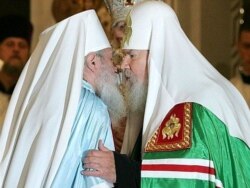
AN ORTHODOX REUNION: Following the 1917 revolution, Russian Orthodox Church Patriarch Sergei declared the church's loyalty to the communist regime. The move led to a split within the church that would last nearly 90 years.
Orthodox believers opposed the regime's religious policies fled -- eventually founding in New York the Russian Orthodox Church Abroad.
The Church Abroad considered itself the voice of Russian Orthodoxy outside the Soviet Union, and an inseparable, spiritually united branch of the Moscow-based church.
In May 2007, during a lavish celebration at Moscow's Christ The Savior Cathedral, the two once again made their historical bond official.
But longstanding differences and new growing pains must yet be overcome before their spiritual reunification can be considered complete.
RELATED ARTICLES
Skepticism Surrounds Reunited Orthodox Church
Russian Orthodox Churches Unite
Orthodox Church Abroad Head Wants Closer Moscow Ties
The Orthodox Church And The Kremlin's New Mission

A thematic webpage devoted to issues of religious tolerance in RFE/RL's broadcast region and around the globe.