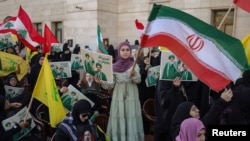
Bessent Says US Extended Russian Oil Sanctions Waiver Due To Requests From Several Countries
Treasury Secretary Scott Bessent says the United States renewed sanctions relief for Russian oil for a month due to requests from several countries that are particularly vulnerable to oil shortages.
Bessent had initially said last week that the waiver allowing certain shipments of Russian seaborne oil to be delivered and sold would not be extended. But the government later reversed itself and extended the waiver for 30 days.
On April 22, Bessent told a US Senate Appropriations subcommittee budget hearing that the change was made after he was "approached by more than 10 of the most vulnerable and poorest countries in terms of energy" during International Monetary Fund and World Bank meetings last week.
"They asked us to extend that [waiver], and it's only for 30 days," he said.
Iran has choked off most traffic through the Strait of Hormuz, the sole sea route out of the Persian Gulf and normally the conduit for about one-fifth of global oil and liquefied natural gas supplies, since shortly after its war with the US and Israel began on February 28. That has driven prices up and increased demand for oil and gas from other sources.
Ukrainian President Volodymyr Zelenskyy has criticized the waiver, saying it helps Russia fund its full-scale war on Ukraine, now in its fifth year.
A report from the International Energy Agency said Russia's revenues from exports of crude and refined oil products rose from $9.7 billion in February to $19 billion in March.
With reporting by AFP and Reuters
Iran's Qalibaf Accuses US Of 'Bullying' And Violating Cease-Fire With Blockade
Iran's lead negotiator criticized the US blockade of Iranian ports amid uncertainty over the prospects for further peace talks with the United States, reiterating Tehran's claim that the restrictions are a violation of a cease-fire the countries agreed to earlier in April.
"A complete ceasefire only makes sense if it is not violated by the maritime blockade and the hostage-taking of the world’s economy," Iranian parliament speaker Mohammad Baqer Qalibaf wrote in a post on X on April 22.
Qalibaf added that "reopening the Strait of Hormuz is impossible with such a flagrant breach of the ceasefire."
Iran's adversaries "did not achieve their goals through military aggression, nor will they through bullying," he wrote. "The only way forward is to recognize the rights of the Iranian nation."
Qalibaf, who led the Iranian delegation in talks with the United States in Islamabad earlier this month that did not produce an agreement, made no direct comment on the prospect for a second round or on US President Donald Trump's decision to extend a two-week cease-fire that was due to expire on April 22.
Iran's president, Masud Pezeshkian, echoed the statement, writing on X that "bad faith, siege, and threats are the main obstacles to genuine negotiation. The world is witnessing your hypocritical empty talk and the contradiction between your claims and your actions."
Iran has effectively shut the Strait of Hormuz, normally the conduit for about one-fifth of global oil and liquefied natural gas supplies, since shortly after the US-Israeli war with Iran began on February 28. The United States imposed a naval blockade on Iran on April 13, and Trump has said that would remain in place until a deal to end the war is reached.
US Warns Its Citizens To Leave Iran
Citing the partial reopening of Iranian airspace, the US State Department has urged American citizens to leave Iran immediately.
The US Virtual Embassy in Iran issued an update on April 21 advising American citizens to contact airlines and follow local media for more information about flights.
The statement noted that Americans can still travel by land to Armenia, Azerbaijan, Turkey, and Turkmenistan. The State Department urged US citizens to avoid traveling via Afghanistan, Iraq, and the Pakistan-Iran border region when leaving Iran.
The department said the Iranian government may prevent American citizens from leaving or charge an "exit fee" to leave Iran. The US State Department has urged dual US-Iranian citizens to leave Iran using their Iranian passports.
Iran Says War Has Cost More Than 700,000 Jobs
Alireza Mahjub, secretary-general of Iran’s Labor House, an influential officially recognized labor organization, has said that more than 700,000 jobs have been lost during Iran's war with the United States and Israel.
Speaking at a press conference in Tehran on April 22, he said 130,000 people were directly made unemployed as a result of the bombing of workplaces, while 600,000 other jobs were lost indirectly.
He also warned that the consequences of unemployment caused by the economic crisis after the war would be far greater than these figures.
During nearly six weeks of conflict before a cease-fire was declared on April 8, some of the country's largest steel and petrochemical production facilities suffered serious damage in air strikes, forcing their production lines to halt. Other commercial and industrial units were also damaged.
Mohammad-Hadi Asgari, a deputy labor minister, also said at the April 22 press conference that the Labor Ministry was identifying and following up on problems facing affected businesses.
He said the government would provide "support packages" to help rebuild damaged facilities, but gave no further details.
Lebanese Official Says Beirut To Seek One-Month Cease-Fire Extension
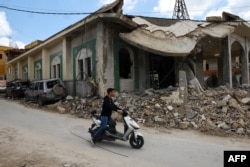
Lebanon and Israel are set to hold a second round of talks in Washington on April 23, with a Lebanese official saying Beirut will seek a one-month extension of a fragile US-mediated cease-fire between Hezbollah and Israel, which is due to expire on April 26.
The official told the AFP news agency that Lebanon would also seek an end to Israeli bombing and destruction in areas where Israeli troops remain and a renewed commitment to the truce.
The 10-day cease-fire has come under strain, with Hezbollah saying they fired rockets at northern Israel this week in response to Israeli violations, while Israel accused the group of breaches and said it killed two militants in south Lebanon.
On April 22, an Israeli strike killed two people in southern Lebanon in a strike on a car, Lebanon's state news agency reported. Hezbollah said it launched an attack drone at Israeli forces in the south.
Hezbollah is a Tehran-backed militant group and political party that controls much of southern Lebanon. It is considered a terrorist organization by the United States, while the European Union has blacklisted its armed wing.
Cross-border hostilities escalated on March 2 after Hezbollah opened fire in support of Iran during the regional war.
The Lebanese government says extending the cease-fire is a prerequisite for broader negotiations covering an Israeli troop withdrawal, the return of Lebanese detainees, and land border demarcation between the two countries.
US Secretary of State Marco Rubio is expected to attend the meeting.
Israeli Foreign Minister Gideon Saar has called the talks a "historic decision" after more than four decades without direct negotiations.
Lebanon and Israel have remained formally in a state of war since Lebanon joined the 1948-49 Arab-Israeli conflict following Israel's creation, though hostilities have flared only intermittently since.
With reporting by AFP and Reuters
Iran's Revolutionary Guards Say They Seized 2 Ships In Hormuz Strait
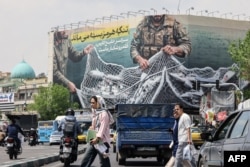
Iran's Islamic Revolutionary Guards Corps (IRGC) says it has seized "two offending vessels" during an alleged "secret attempt to leave" the Strait of Hormuz.
The naval arm of the IRGC said on April 22 that it had detained "two violating ships" that it claimed were attempting a "secret departure" from the Strait of Hormuz.
According to the IRGC statement, the vessels were the MSC Francesca, which it described as belonging to Israel, and the Epaminodes.
The IRGC said they were stopped on accusations that they intended to leave "without permission," while committing "repeated violations," tampering with navigational assistance systems, and endangering maritime security in an attempt to exit the strait "secretly."
The IRGC navy said the vessels had been transferred to Iran's territorial waters for inspection of their cargo and documentation.
The announcement came on a day when Iran's armed forces said they had attacked and disabled three cargo ships off the country's coast, according to state media.
The IRGC, which has closed the strait to ships and oil tankers since February 28, briefly reopened the waterway for one day after a cease-fire in the war with the United States and Israel started on April 8, but shut it again after negotiations between the sides collapsed and a naval blockade of Iranian ports began.
With reporting by dpa
EU Unveils Energy Plan Amid Iran War Shock

European Commission President Ursula von der Leyen has proposed a strategy to address the consequences of the US-Israeli military war with Iran on European energy markets.
"The choices we make today will shape our ability to face the challenges of today and the crises of tomorrow," she said on April 22, announcing a package that included optimizing the distribution of jet fuel among EU member states.
"Our AccelerateEU strategy will bring both immediate and more structural relief measures to European citizens and businesses," von der Leyen added. "We must accelerate the shift to homegrown, clean energies. This will give us energy independence and security, and mean we are better able to weather geopolitical storms."
The effective closure of the key Strait of Hormuz, which accounts for about one-fifth of the global oil trade, has become a central issue of the conflict, putting many exporting countries in the region at risk of a crisis and sharply driving up energy prices.
A separate statement about the initiative, announced by von der Leyen and published on the same day, said the EU has spent an additional 24 billion euros ($28.2 billion) on energy imports since the first days of the war.
"Even if hostilities ceased immediately, disruptions to energy supplies from the Gulf will persist for the foreseeable future," the statement said.
Iran Accused Of Striking Kurdish Opposition Group In Iraq
Drone strikes in Iraq’s autonomous Kurdistan Region wounded three members of an exiled Iranian Kurdish rebel group on April 22, according to the Kurdistan Freedom Party (PAK), which blamed Iran.
The group said four drones targeted its bases in the Khabat district of Irbil province, causing minor injuries.
The reported attack comes during a fragile cease-fire in the US-Israeli war against Iran, which took effect on April 8.
Tehran has repeatedly targeted Iranian Kurdish groups based in Iraqi Kurdistan, which it designates as terrorist organizations and accuses of serving Western or Israeli interests.
Days before the war began on February 28, PAK joined four other exiled groups in a coalition seeking to topple Iran’s Islamic republic and secure Kurdish self-determination.

Kurds are one of Iran’s largest ethnic minorities, accounting for up to 10 percent of the population according to some estimates. They are mostly concentrated in the west of the country along the Iraqi and Turkish borders.
With reporting by AFP
Sunni Cleric Calls For 'Just Agreement' With US
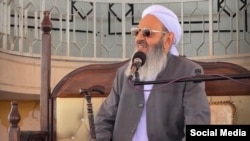
A prominent Iranian Sunni cleric and outspoken critic of the regime has said that Iran’s “skies are under enemy control” and that key infrastructure had been “exposed to destruction.”
In a post on X on April 22, Abdolhamid Esmailzehi also said that the country’s armed forces lacked the necessary tools for air defense and argued that in the current deadlock the only path forward was a “just agreement.”
Abdolhamid sharply criticized hard-liners who he said were blocking such an outcome, asking what answer they would have “before God and this oppressed nation” if their obstinacy resulted in “the ruin of the homeland.”
Esmailzehi's comments appeared to reflect growing public debate inside Iran over the costs of continued confrontation with the US and Israel.
Iran is a Shi'a-majority country, with about 90 percent of the population belonging to that branch of Islam. The Sunni Islam minority is about 5-10 percent, according to recent statistics.
Second Ship Fired Upon In Hormuz Strait, Says Monitor
The United Kingdom Maritime Trade Operations (UKMTO) shipping monitor said an outbound cargo ship reported being fired upon in the Strait of Hormuz early on April 22, about eight nautical miles west of Iran.
The vessel was left "stopped in the water," though all crew were safe and no damage was reported, the UKMTO said on X.
The UKMTO post came hours after it reported another incident in which a container ship said it was fired on by Iran’s Islamic Revolutionary Guards Corps northeast of Oman, suffering heavy damage to its bridge.
Since the US-Israeli war with Iran began on February 28, repeated strikes on shipping have severely disrupted traffic through the strategic Strait of Hormuz, which usually accounts for about one-fifth of the global oil trade.