



Tuesday, February 14, 2012


Features

At Home And Abroad, Turkey Deal A Tough Sell For Armenian President

TEXT SIZE - +
By Brian Whitmore


Video: The Armenian Revolutionary Federation (Dashnaktsutyun), a political party with close ties to the Armenian diaspora, organized a hunger strike in front of the Armenian Foreign Ministry in Yerevan, protesting the agreement between Armenia and Turkey, which is due to be signed on October 10. Participants offered emotional responses to the prospect of an Armenian-Turkish rapprochement. (Video by author)

YEREVAN -- Singing patriotic songs about historic battles against the Turks, dozens of hunger strikers have been camped out in front of Armenia's Foreign Ministry building for weeks.

They are protesting a proposed agreement that would reestablish diplomatic ties between Yerevan and Ankara and open Armenia's border with Turkey, ending a crippling 16-year blockade.

Among the demonstrators is Nashan Ajemian, a man in his 50s with a low, gravelly voice, who returned to Armenia from the United States a decade ago. Standing among the protesters, he is adamant that efforts by the country's president, Serzh Sarkisian, to win support for the rapprochement will never convince Armenians to forget the crimes committed by the Ottoman Empire.

"He's trying to convince everybody that everything is OK. But we know the Turks for the past 800 years. We know who they are," Ajemian says.

"Peace is a good thing. But we're making peace with whom? With a criminal who killed my ancestors?"

Ajemian's comments came as Sarkisian was conducting a whirlwind, four-country tour in a last-minute attempt to persuade the 5.7 million ethnic Armenians living abroad to lend their support to opening ties with Turkey.

The agreement, months in the making, is due to be signed by the Turkish and Armenian foreign ministers on October 10 in Zurich, Switzerland.

Armenians abroad constitute one of the world's strongest diaspora lobbying groups, and Sarkisian has met with skepticism and resentment during his tour of France, the United States, Lebanon, and Russia.

Many in the diaspora reject the proposed rapprochement with Turkey, which they hold responsible for the slaughter of 1.5 million Armenians in 1915. They say a deal with Ankara, which rejects the Armenian assertion that the killings constituted genocide, could represent a disastrous capitulation to a long-standing, and deeply resented, enemy.

They also object to Armenia recognizing its existing border with Turkey, which they say reflects a Soviet-era deal between Moscow and Ankara that handed tracts of Armenian territory to Turkey.

Khachik Khachaturian, another Armenian returnee to Yerevan, says his father was forced to flee his homeland when Ottoman forces massacred Armenians toward the end of World War I.

Armenians marked the 90th anniversary of the Ottoman-era mass killings in Yerevan in April 2005.
"Why does Armenia have a diaspora? Why? How did it happen? These people, most of them, their ancestors are from western Armenia -- Kars, Ardahan, Tikranagert, Van -- these are areas we cannot give up," Khachaturian says.

"The genocide is an issue, and the land is a second issue. There is no way people can forget that. And we will never forgive this president. Governments come and go, but justice remains. All we ask for is justice."

'A Threat To Their Very Identity'

The diaspora's sentiment is gaining a foothold back home, as ethnic Armenians like Khachaturian and Ajemian return to their native land, firm in the conviction that a peace deal with Turkey must be fought at all costs. The ongoing hunger strike is organized by the Armenian Revolutionary Federation, a nationalist party with close ties to the diaspora.

The fierce diaspora opposition to rapprochement with Turkey reflects the political minefield Sarkisian must navigate as he pursues a policy that has the strong backing of Armenia's main foreign allies, including the United States, the European Union, and Russia.

In an interview published in "The Wall Street Journal" on October 7, Turkish Prime Minister Recep Tayyip Erdogan said Yerevan "should not allow its policies to be taken hostage by the Armenian diaspora. It should be up to the government to carry out its policies."

Part of Sarkisian's dilemma, however, lies in convincing the diaspora of the anticipated benefits of the deal. Renewed ties with Turkey have the potential to bring commerce and clout to tiny, impoverished, and landlocked Armenia.

But that incentive has far less sway among the diaspora, who have moved on decades ago to better lives abroad.

"The diaspora has a one-issue identity; it's the genocide and nothing more. They see this whole rapprochement with Turkey as a threat to their very identity. They don't see it in the same context that the Armenian government sees it, in terms of a need to open the border and a need for normal relations," says Richard Giragosian, director of the Yerevan-based Armenian Center for National and International Studies.

"The only benefits that could come will be accrued by the Armenian government and the Armenian population. The diaspora sees nothing but harm and nothing but a threat."

'Don't Betray Us'

In fact, Turkey and Armenia briefly had diplomatic relations in the past. Turkey was among the first countries to recognize Armenian independence after the breakup of the Soviet Union in 1991. But afterwards, when Armenian forces occupied the disputed Nagorno-Karabakh region, which falls within the borders of Turkey's historic ally Azerbaijan, Ankara broke off diplomatic ties with Yerevan and closed its border with Armenia.

Last month, Yerevan and Ankara said they would set aside hostilities and establish diplomatic ties. The protocols to be signed on October 10 sidestep the genocide issue by establishing a joint commission to study the massacres.
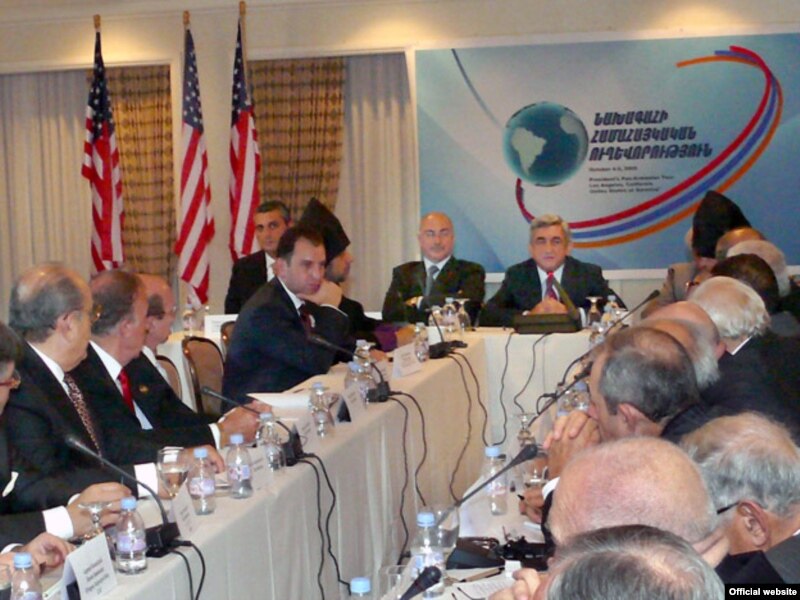
Armenian President Serzh Sarkisian met with representatives of the Armenian diaspora in Los Angeles on October 4.
That step did nothing to mollify the diaspora, however. Violent protests broke out on the first leg of Sarkisian's diaspora tour on October 2 in Paris, where an estimated 200 demonstrators clashed with riot police and shouted "traitor" at the Armenian president.

In the United States, Sarkisian faced angry crowds in both New York and Los Angeles. An estimated 12,000 Armenian-American demonstrators gathered on October 4 outside the L.A. hotel where Sarkisian was staying. Held back by blockades and guardrails, protesters held signs reading: "Don't Betray Us" and "Turkey Accept the Genocide."

The Armenian National Committee of America (ANCA) issued a statement ahead of Sarkisian's visit criticizing the opening to Turkey as "a flawed and dangerous set of protocols that threaten the security of Armenia, surrender the rights of the Armenian nation, and insult the dignity of the Armenian people."

In an interview with RFE/RL in Washington, Aram Hamparian, ANCA's executive director, assailed Sarkisian for presenting the diaspora with a fait accompli, rather than taking their views into account.

"It's not a sincere opportunity for dialogue, but rather a theater, designed to create the impression that there's a back-and-forth. The fact is there is no back-and-forth," Hamparian says.

"The document was negotiated in secret, and the document is not subject to any changes, so the idea that he's coming to have a dialogue on the subject is simply not credible."

White House Support

Not all Armenian-Americans are so staunchly opposed to normalized ties with Turkey. The Armenian Assembly of America joined two dioceses of the Armenian Apostolic Church and the diaspora's largest charity, the Armenian General Benevolent Union, in issuing a statement supporting the rapprochement with Ankara.

Haig Deranian, grand master of the Knights of Vartan, an Armenian-American fraternal organization that does charitable work, also signed on to the assembly's supportive statement. He says diaspora Armenians "come from an emotional position, because we've lived the genocide" since childhood.

"Growing up -- I'm a first-generation Armenian-American -- I heard the gruesome stories from my parents and grandparents about what happened. So I'm very emotional about this issue," Deranian tells RFE/RL.

"But by the same token, you can be emotional but also be objective, and try to do what's good for the Armenians and our country."

While in the United States, Sarkisian received a telephone call from U.S. President Barack Obama expressing support for his pursuit of normalized relations with Turkey.

Back on the road, however, Sarkisian faced fresh resistance. In Beirut on October 6, an estimated 2,000 protesters gathered outside the president's hotel, carrying Armenian flags and signs reading "We Will Not Forget."

Sarkisian is due to visit Rostov-na-Donu in southern Russia before wrapping up his trip.

At 5.7 million, Armenians abroad far outnumber the 3.2 million living in Armenia proper. Due to their lobbying power, remittances, and investments in the Armenian economy, they have historically enjoyed significant influence over the country's politics and foreign affairs.

But observers say the momentum for a Turkish-Armenian rapprochement has become so strong internationally that the diaspora is unlikely to be able to scuttle the deal.

Public opinion in Armenia on the opening with Turkey is difficult to gauge, as no public opinion polls on the subject have been released. Analysts say, however, that most Armenians favor reestablishing ties with Turkey, even as deep historic resentments remain.

"I think the opening of the border will be of benefit to us," says Vahag Galstyan, a 24-year-old man walking through a park in central Yerevan.

"It would be desirable not to forget the past, but to come to terms with it, and live in peace and move forward."

RFE/RL correspondent Heather Maher contributed to this report from Washington; Suren Musayelyan of RFE/RL's Armenian Service contributed to this report in Yerevan
This forum has been closed.
Comment Sorting
Comments page of 4
    Next 
by: Liliane from: Los Angeles
October 07, 2009 17:51
The conditions in the Protocol should come from the Armenians not the Turks! You don't go steel from your neighbor then stipulate conditions in order for that criminal be able to have peace with you.

by: Lori from: Los Angeles, CA
October 07, 2009 19:31
I don't agree with Richard Giragosian that diasporan Armenians don't see the need to open the border. First of all, the decision to illegally close the border was a unilateral one taken by the Turkish Government in 1993. Armenia and Armenians have never been for a closed border. Turkey chose to close the border and blockade Armenia. That is a hostile decision by a hostile neighbor. The man in the video saying his father was a victim of the genocide is my dad. That victim of the Genocide was my grandfather! The wounds are fresh for us do you blame us for being skeptical of our hostile neighbors who massacred our people, took our lands, shut down the border and instituted a blockade?

At these protest all over the diaspora in Argentina, France, America, Lebanon and Armenia the participants have been people who emigrated from Armenia not only people who were born abroad. We have stood side by side with our compatriots from Armenia who still have family there and protested these protocols together.

STOP THE PROTOCOLS!

by: Zareh from: Canada
October 07, 2009 23:11
Where are Armenia's safe-guards in these protocols.

Where does it mention the right to self determination, whereas Turkey successfully inserted "anti-Terrorism" article. Remember Azerbaijan wanting to associate the Artsakh struggle with that of "terrorism" ?

Where does it mention the indisputable fact of the Armenian genocide, whereas the Turkish side successfully inserted the "formation of so-called impartial commission"

Where does it say Armenia does not recognize the Kars treaty, whereas Turkey successfully inserted "recognition of today's existing borders"

Where does it say what is the meaning of "good neighborly behavior", Will Armenia insisting on Genocide be construed as a bad neighborly behavior, will Armenia insisting on Artsakh's right to self-determination or independence be considered as bad neighborly behavior?

Where does it say in these protocols that the Turkish officials should refrain from talking about conditional opening of the borders to be tied to Nagorno-Karabakh solution?

On top of all that Foreign Minister Nalbandian does not seem to be aware that a signing date has already been scheduled, October 10, without his knowledge. And he insists bilateral announcement should be made jointly.

Message to Mr. Nalbandian, you are irrelevant, it seems.

There are ample ways Turkey could sign these protocols and still not open the borders while Armenia has squandered all of its cards and still end up with closed borders.

What brilliant Armenian diplomacy.


by: Vahe
October 08, 2009 03:15
I really admire how Radio Free Liberty attempts to disguise the real issues and mislead its audience. Why doesn't it spell out the FULL terms of this treaty? A joint study of the Genocide! Hasn't the European parliament and the United Nations recognized the 1915 Genocide?
A win win situation for Turkey. What does Armenia get cheap products from Turkey so the Armenian businessmen hated by the population can increase their profits? For 90 years Armenian did fine without Turkey and besides we have open borders with Iran.

When Haig Deranian says “you can be emotional but also be objective, and try to do what's good for the Armenians and our country." he means let's play along and do what’s good for the United States!
Yes, Mr. Deranian, let us be objective and recognize the Sevres Treaty signed by President Woodrow Wilson.
Let's be objective and admit that Serj Sarkissian is not democratically elected by Armenians and if his administration is so confident that he has the support of his citizens, then he should put this to a referendum. Anything signed by Serj is null and void !!!
Secondly, The Armenian organizations who support these protocols are a minority and do not represent the majority of the Armenians in the diaspora.

Vahag Galstyan's comment should be directed to Turkey and her allies. Turkey, come to terms with your past, as Germany did and America, recognize the Sevres Treaty and Karabagh as you recognized Kosovo!

by: peacemaker
October 08, 2009 07:36
It is so funny to heard genocide from Armenians. Touching upon the genocide, they have to mention about genocide in Khodjali. So, if this nation is so fair, and wants justice, first of all they must recognize crime of genocide in Khodjali. After it, we can say that really this “nation” supports justice in the world.

by: Ararad from: Armenia
October 08, 2009 14:29
These protocols are nothing more than US policy failure in the region and the highest proof of the US diplomacy weakness.
Therefore USA and its allies will pay dearly in future for not bringing fairness and justice in the region

Until now Turkey was in hot waters, from Hollywood to EU.. The bad news for Turkey , is with these protocols the Armenian Genocide will be more stronger and relevant........

IT is all bad news to Azerbaijan rulers, they were confused before and now they are sold for a song.

The Armenian Genocide is not decided by Serge or Erdogan or RFE article or Jonnie comes lately.

In the courts the only things matter are the evidence and facts.
In This matter the proposed PROTOCOLS are jokes.

by: Cem from: Istanbul
October 09, 2009 08:29
I have full respect for the feelings of the Armenians.

I, to make it clear in advance, doubt there was a genocide. But that there was a tragedy going on during this time of WWI is quite clear and obvious.

I am strongly convinced that opening the border will benefit both. Armenia and Turkey not only in terms of business, but also in terms of a much more better mutual understanding.

When I read through the comments here I must sadly say that the Armenian diaspora is at least 100 years past of us in terms of their thinking. I believe that they absolutely don't care about their home land Armenia and are fearing that they will loose their last link to their origins, and that this is the main reason for their refusal.

On the other hand I must say, this has little impact towards my positive attidude towards the people of Armenia itself. I am looking forward to the day when there is a highway build between Istanbul and Yerevan on which I can drive to see it.


by: Lucy Smith from: London
October 09, 2009 13:09
The very moment President Sarkisyan signs the protocols, he can consider himself a non-person, like most Armenians already do. His crumbling administration is nowadays in its death throes. By betraying the Armenian people, President Sarkisyan has won a special place in hell, next to Vasag Syunik.

by: RD
October 09, 2009 15:16
Cem, you sound like a reasonably intelligent person. However, having said that, I am a little surprised you doubt Genocide was committed against Armenians in Eastern Anatolia. I am certain it is the missing chapters from the history books thaught at schools in Turkey. Put aside scholars, studies, commissions etc. and think on your own. Ask yourself the question; what happened to the more than 1.8 million Armenians that lived in Eastern Anatolia? Even conservative Turkish records indicate that hundreds of thousands of Armenians lived in Eastern Anatolia, approximately 1.8 million. What happened to them? The answer is they have been driven into the desert, raped, killed or integrated into Turkish society. Furthermore, you fail to understand the concerns of the Armenian Diaspora. No one opposes normalization of relations between Armenia and Turkey. What the Armenian Diaspora opposes are the unfair protocols Armenia is being pressured to adhere to. If two countries want to have friendly relations with their neighbours, they should improve their relations without pre-conditions. The protocols are very similar to the conditions the Palestinians were presented with in Minsk. No one in their right mind would have accepted them and hence peace in the Middle East is still elusive. I have travelled throughout Turkey, and everywhere I have visited, there are signs of an Armenian past and the Turkish Government tyring to cover them up.

by: RD
October 09, 2009 15:23
Peacemaker, I always laugh when I hear Azeris talk about Khojali when it was the Azeri actions in Sumgait and Baku that precipitated the NKR war. Azerbaijan and the U.S.S.R tried to contain peaceful demonstrations by force. You throw Armenians out of balconies, buses and beat them up on the streets of Baku and Sumgait. When war erupts, and backfires on Azerbaijan, you start blaming Armenians. Speaking of Khojali and Shushi, even writers who are biased towards Azerbaijan wrote about how the Azeri army started killing members of its own armed forces and population when they decided to leave Khojali and Shushi at the advance of the NKR freedom fighters. If Azerbaijan treated its Armenian citizens fairly and not like second class citizens, the Armenians of NKR would never has wanted to separate from Azerbaijan.
Comments page of 4
    Next 

Most Popular


Being Discussed Now

China Pledges Help On Eurozone Crisis

Latest Comment (1 total)

Eugenio: In other news on the European Union: the GDP of Greece in 2011 ... More

Turkmenistan's Personality Cult 2.0

Latest Comment (1 total)

Sey: Oh, don't you worry my dear friends! Turks are all like that, they ... More

Reports: Assault On Homs Continues

Latest Comment (4 total)

Eugenio: Why are you saying China and Russia chose not to do anything? These ... More