



News
- By RFE/RL
Thousands Of Refugees Return As Kyrgyzstan Prepares For Referendum

Some 70,000 Kyrgyz nationals have returned so far, they say.
The deputy head of the Kyrgyz border service, Cholponbek Turusbekov, earlier told journalists that more than 10,000 had returned within the previous 24 hours alone.
As many as 100,000 ethnic Uzbeks are estimated to have fled Kyrgyzstan for Uzbekistan in the wake of clashes between ethnic Uzbeks and Kyrgyz in Osh and Jalal-Abad that began on June 10. The official number of dead from the violence has risen to 251, but interim leader Roza Otunbaeva has said that the death toll is probably closer to 2,000.
The number of returnees could not be independently verified, but a spokeswoman for the UN High Commissioner for Refugees (UNHCR) in Uzbekistan, Natalia Prokopchuk, confirmed that "significant numbers of refugees" were returning.
Welcoming Neighbors
Reuters said Uzbek soldiers called names over a loudspeaker as women and children collected their belongings and boarded buses for the short ride from their camps to the border-crossing point.
One returnee who'd fled to Uzbekistan with her three children, 40-year-old Jamilya Khaidarova, spoke to RFE/RL's Kyrgyz Service after coming back to her home in the Jalal-Abad region.
"Now we are staying in our home town of Bazar Korgon, in Kyrgyzstan," Khaidarova said. "Roads are open and our neighbors were very happy to see us; they have been waiting for us. We were 78 people coming together in one bus. We safely came back together with all relatives. Our houses haven't been destroyed and we found that everything is OK here."
Another Bazar Korgon resident, Asanbay ajy Khabirov, said most of his neighbors had come back and that "our life is getting better. We regularly get humanitarian aid such as oil, rice, flour."
"Our family members came back safely home," he said. "Eighty percent of the people have been back to the mahallas [local communities] and only 20 percent remain [away]. The situation is good; all people are friendly to each other."
Another returnee was more apprehensive.
Minura Valiyeva, who was among the refugees returning to their burned-out homes in the city of Osh, spoke to Reuters in the village of VLKSM on the Kyrgyz side of the border.
"[We are returning full of] bitter feelings," Valiyeva said. "We are afraid that the same might happen again; we don't wish anybody anything like this."
She added that she was uncertain of what she would find in Osh.
Jalal-Abad Oblast Governor Bektur Asanov, who visited refugee camps in Uzbekistan's southeastern Andijon region on June 22, told RFE/RL's Kyrgyz Service that assistance would be provided to the returned refugees.
"I can guarantee as governor of the Jalal-Abad region -- please don't trust any provocative statements -- that hopefully everything will be good," Asanov said. "It has been decided from the financial side that all people whose houses were burned down or destroyed will receive compensation money. We've got around 500 tons of food in Jalal-Abad, and we are giving it to all those who are returning. Those people whose houses were burned down are getting tents and mattresses. Next week we will start giving out construction materials and money."
The Toll Of Violence
As refugees begin to trickle back into their ruined neighborhoods, the cash-strapped Kyrgyz government faces the massive cost of reconstruction.
Aid agencies have said up to 1 million people may have been affected by the violence, including 300,000 displaced internally and 100,000 who fled to Uzbekistan.
The United States has announced that it intends to provide a total of more than $48 million to programs for humanitarian relief, reconstruction, and community stabilization in Kyrgyzstan and the border region of Uzbekistan. More than $20 million of that total has been provided or authorized so far.
Large-scale unrest has ceased in the country's south. But Elisabeth Byrs, spokeswoman of the UN Office for the Coordination of Humanitarian Affairs, said on June 22 that insecurity and ethnic tensions were hindering humanitarian operations in southern Kyrgyzstan.
Separately, the Organization for Security and Cooperation in Europe (OSCE) said it was leading talks involving European Union foreign ministers on the possible deployment of a police force in southern Kyrgyzstan.
Kimmo Kiljunen, the OSCE Parliamentary Assembly's special representative for Central Asia, told reporters in Bishkek that an international police operation would create an "atmosphere of trust."
Some fear a constitutional referendum on June 27 could trigger new violence. The referendum, if passed, would reduce the president's powers and strengthen the parliament. But opponents of holding the plebiscite note that many people in Osh will simply be unable to vote.
The OSCE said it will not send short-term observers to monitor the referendum due to "the current security situation." However, it said 13 election experts based in Bishkek and 12 long-term observers deployed across the country would monitor the vote. Kyrgyzstan election commission member Galia Alymbekova said about 100 foreign observers were expected to arrive to monitor the voting.
Reuters quoted Akylbek Sariev, the chairman of the Kyrgyz Central Election Commission, as saying that six ethnic Uzbek women working in preparation for the referendum were briefly held hostage in Osh on June 21 before being released unharmed.
The interim government that took power after President Kurmanbek Bakiev's ouster in April has accused his supporters of fueling the recent violence in an attempt to derail the referendum.
At a press conference on June 23 in the Belarusian capital, Minsk, where he has sought refuge, Bakiev said he had "no intention" of influencing Kyrgyz politics or the referendum.
"In no way am I trying to influence [Kyrgyz] politics, or the referendum, or anything else, or even pass judgments, but still they blame us for everything," Bakiev said. "I'm not going to take any part in what's going on in Kyrgyzstan today."
Bakiev also denied accusations that he funneled money stolen from Kyrgyzstan to Belarusian President Alyaksandr Lukashenka to help pay for Belarus's Russian gas debt.
Kyrgyz authorities announced on June 22 that they were seeking to move parliamentary elections forward by a month to early September in a bid to ease tensions. The deputy head of the interim government, Omurbek Tekebaev, said on national television that "legitimate organs of power must be formed with the least possible delay."
Meanwhile, officials in Kyrgyzstan's southern Jalal-Abad Oblast say they have detained 12 suspected organizers of the ethnic clashes between local Uzbeks and Kyrgyz, according to RFE/RL's Kyrgyz Service.
written by Antoine Blua based on reports by RFE/RL Kyrgyz Service correspondent Gulaiym Ashakeeva and Bohdan Andrusyshyn of RFE/RL's Belarus Service
Kyrgyz Crisis Coverage
Clashes In Kyrgyzstan

Full RFE/RL coverage of the ethnically charged violence that has shaken southern Kyrgyzstan since June 10. More
More News
Iranian Rappers Detained As Government Continues To Squelch Dissent

Iranian rappers Vafa Ahmadpor and Danial Maghaddam were arrested after the release of a music video titled "Standby," which is critical of the authoritarian measures in place in Iran.
Rights groups said the two men were arrested in the city of Shiraz on May 9 and that their current whereabouts are unknown. Iranian officials have not commented.
The pair’s video highlights issues such as repression by security forces, economic hardships, and the activities of the morality police while proclaiming that "we, the people of Iran, remain united and will take over this country."
On May 5 they also posted a video of them paying respects at the grave of slain street protester Arman Emadi.
In the video, Maghaddam says, “We’re one nation. Do you want to kill us all?” Maghaddam said in a post on his Instagram account on May 8 that security agents had appeared outside his residence.
He mentioned that Ahmadpor was with him at the time of the incident.
It’s not the first run-in with law enforcement for Ahmadpor, who had been previously detained in February at his home.
Maghaddam has collaborated with figures like Gholam Koveitipor, Sahar Zakaria, and Saba Kamali to address social issues such as violence against women.
In December, he disclosed that a legal case had been initiated against him, Zakaria, and Kamali in the Culture and Media Court for supposedly "inviting corruption and indecency."
Many Iranian artists and public figures have faced Iran’s judiciary for expressing their support of nationwide protests following the 2022 death of Mahsa Amini while in custody for an alleged hijab violation.
Iran's Minister of Culture and Islamic Guidance has taken a hard-line stance against protesting artists, repeatedly threatening them with a work ban.
Thousands of people, including protesters, journalists, lawyers, athletes, and artists have been arrested and at least 500 people have been killed in Iran's brutal crackdown on the protests.
Written by Ardeshir Tayebi based on an original story in Persian by RFE/RL's Radio Farda
Woman Fined In Russia's Tatarstan For Calls To Learn The Local Language
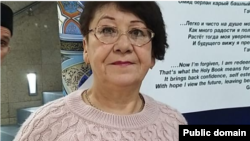
A court in Russia's autonomous republic of Tatarstan has fined a 63-year-old woman for violating Russia's “territorial integrity” after she made an appeal on social media for people to learn the Tatar language. Ruzilya Sharafutdinova, who denied the charges, was ordered to pay 80,000 rubles ($865) for audio messages left in a chat group on Telegram that was dedicated to discussing Tatarstan and the state of learning of the Tatar language. In one audio clip, Sharafutdinova is reported to have said that the Tatar language needed to be studied at home. In court, Sharafutudinova denied calling for Tatarstan's independence or supporting secession. To read the original story from RFE/RL’s Tatar-Bashkir Service, click here.
Armenian, Azerbaijani Foreign Ministers Meet For Latest Round Of Peace Talks
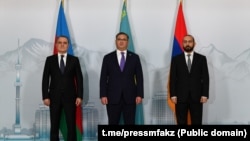
The foreign ministers of Armenia and Azerbaijan began two days of fresh negotiations in Kazakhstan on May 10, focusing on a peace treaty between the two South Caucasus states. They were joined by their Kazakh counterpart Murat Nurtleu at the opening session of the talks held in Kazakhstan’s largest city, Almaty. In his opening remarks, Azerbaijani Foreign Minister Jeyhun Bayramov expressed confidence that he and Armenia’s Ararat Mirzoyan “will work productively in the next two days to find solutions to outstanding issues.” To read the original report from RFE/RL's Armenian Service, click here.
- By Kian Sharifi
U.S. Seeks Shift In Iranian 'Decision-Making Calculus' Through Saudi-Israeli Normalization

The United States wants to force a gradual shift in Iran’s “decision-making calculus” by signing a defense deal with Saudi Arabia and securing the normalization of relations between Riyadh and Israel.
“We continue to work with allies and partners to enhance their capabilities to deter and counter the threats Iran poses, impose costs on Iran for its actions, and seek to shift Iran’s decision-making calculus over time,” a U.S. State Department spokesperson told RFE/RL.
The security package has several components, including a bilateral U.S.-Saudi defense pact aimed at enhancing the Sunni kingdom’s deterrence capabilities. But Washington is adamant that regardless of how close the Americans and the Saudis are to a bilateral agreement, the security package cannot materialize without Saudi-Israeli normalization.
Saudi Arabia has conditioned the normalization of ties with Israel on the establishment of a cease-fire in Gaza and a credible pathway to Palestinian statehood.
The administration of U.S. President Joe Biden sees a three-way deal key to ensuring a sustainable peace in the Middle East, which includes isolating Iran and making it costly for the Islamic republic to maintain its current regional policies.
“Iran’s isolation in the region and in the international community is a result of its own policies,” the spokesperson said in an e-mailed statement to RFE/RL.
A calculus shift will “definitely” happen, but not in the way that the United States wants, according to Hamidreza Azizi, a fellow at the German Institute for International and Security Affairs.
“Any sort of coalition-building would result in Iran going for counter-coalitions,” he added.
But analysts maintain that for Saudi Arabia, isolating Iran is not the core objective of a security pact with the United States.
The Saudis see normalizing relations with Israel as a strategic leverage to help them extract substantial security commitments from Washington, “thereby balancing against Iranian influence without overtly antagonizing Tehran," Azizi said.
Meanwhile, securing a path toward Palestinian statehood could help Saudi Arabia assert its leadership within the Muslim world and effectively end the Arab-Israeli conflict.
Iran has long opposed Arab normalization with Israel and is a staunch critic of the Abraham Accords, which saw Bahrain and the United Arab Emirates (U.A.E.) establish diplomatic ties with Israel in 2020.
On May 1, Iranian Supreme Leader Ayatollah Ali Khamenei implicitly criticized Saudi Arabia for looking to normalize relations with Israel in the hopes of resolving the Palestinian question.
Anna Jacobs, a senior Gulf analyst at the Brussels-based International Crisis Group, argued that the U.A.E. model of balancing relations with Iran and Israel suggests that Saudi Arabia can do the same.
“Riyadh seems confident that normalization with Israel wouldn’t have a major impact on its relationship with Tehran,” she said. “The Saudi strategy with Iran right now is both containment and engagement.”
U.S. Expresses Confidence Ukraine Will Repel Any Fresh Russian Offensive
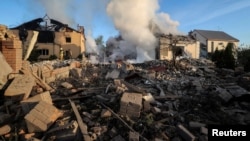
Washington says it expects Russia to intensify a new offensive in Ukraine but expressed confidence in Kyiv and doubted that Moscow will make major territorial gains.
"It is possible that Russia will make further advances in the coming weeks, but we do not anticipate any major breakthroughs, and over time, the influx of U.S. assistance will enable Ukraine to withstand these attacks over the course of 2024," National Security Council spokesman John Kirby told reporters in Washington on May 10.
His comments came hours after Russian troops attempted to open a new front by breaking through Ukrainian lines in the Kharkiv region, a move Kyiv said its forces repelled, though fighting was reported to be continuing.
Kirby also spoke after the White House announced that the United States is preparing a $400 million military aid package for Ukraine, as the country returns to a regular pace of supplying weapons to Kyiv after lawmakers passed a bill that includes $61 billion in assistance for Ukraine.
Earlier in Kyiv at a press conference, President Volodymyr Zelenskiy said that the attack early in the morning on May 10 failed to catch Ukrainian troops by surprise.
Live Briefing: Russia's Invasion Of Ukraine
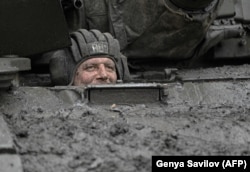
RFE/RL's Live Briefing gives you all of the latest developments on Russia's full-scale invasion, Kyiv's counteroffensive, Western military aid, global reaction, and the plight of civilians. For all of RFE/RL's coverage of the war in Ukraine, click here.
"Ukraine met them there with troops: brigades and artillery," Zelenskiy said, warning that Moscow could send more forces to back its attempted push that military sources said was aimed at establishing a "buffer zone" to prevent Ukrainian forces from shelling Russian territory.
The northeastern Ukrainian region of Kharkiv borders Russia, with the outskirts of its homonymous capital, Kharkiv, only 25 kilometers from the frontier.
Russian troops attacked after hours of heavy artillery fire, the press service of Ukraine's Defense Ministry reported.
"After dark, Russian occupiers stepped up the fire pressure on our defense line with the support of artillery. At approximately 5 a.m., the enemy attempted to break through our defense line under the cover of armored vehicles," the ministry said.
Reserve units have been deployed to strengthen the defense lines, and Ukrainian forces continue to hold back the enemy's offensive, the ministry said, adding that clashes of various intensity are still under way.
Earlier, Oleh Synyehubov, the governor of the Kharkiv region, reported that the town of Vovchansk, some 70 kilometers northeast of Kharkiv and only four kilometers from the Russian border, was coming under heavy Russian shelling.
"All night long, shelling from antiaircraft guns and artillery continued. There were unsuccessful [Russian] attempts...to break through the border," Synyehubov wrote on Telegram.
The Ukrainian Defense Ministry said fighting against Russian sabotage and reconnaissance groups had continued into the afternoon.
With a prewar population of 1.4 million, Kharkiv is Ukraine's second-largest city and one of its most important economic and industrial powerhouses and was one of the initial targets of Russia's invasion, experiencing heavy fighting in the spring of 2022.
A successful Ukrainian counteroffensive in September 2022,liberated most of the Kharkiv region, throwing Russian forces back and allowing the return of a large part of the city's population.
But Russian artillery, drone, and missile strikes on the region and its capital have intensified massively over the past several months as the Ukrainian forces' shortage of ammunition and air defense systems became more and more acute while a desperately needed U.S. military aid package was being held up by political bickering in the House of Representatives.
Many civilians have been killed and infrastructure has been seriously damaged in the region. A day before the May 10 Russian attacks, 21 settlements were hit by Russian artillery and mortar strikes, authorities reported.
Synyehubov said one person had been killed and at least three people had been wounded in that series of attacks.
Elsewhere in Ukraine, three civilians were killed.
One woman was killed in a Russian strike on Sumy region, local authorities reported.
Dnipropetrovsk Governor Serhiy Lysak said two people were killed in Nikopol and eight were wounded. In Donetsk, one person was wounded, regional head Vadym Filashkin said. Oleksandr Prokudin, the governor of Kherson, said one person was wounded in his region.
Separately, an oil refinery caught fire in Russia's Kaluga region after an alleged Ukrainian drone strike.
Kaluga Governor Vladislav Shapsha said the fire has been quickly localized and put out.
Ukraine has not commented on the claim, which could not be independently confirmed.
The Russian Defense Ministry said air defenses downed seven Ukrainian drones early on May 10 in the Moscow, Bryansk and Belgorod regions.
Late on May 10, a suspected Ukrainian strike is reported to have triggered a large fire at an oil storage depot in Ukraine's occupied Luhansk region.
Russia-installed officials in the region said three people had been killed and seven wounded.
Romania Says 11,000 Ukrainian Men Have Illegally Entered To Evade Draft

Some 11,000 Ukrainian men have illegally crossed the border into northern Romania to avoid being drafted since the full-scale Russian invasion on February 24, 2022, Romanian border police said. After crossing, the men, aged 18-60, usually request protection from Romanian authorities, said Florin Coman, the border police chief in Sighetu Marmatiei, a northern city near Romania's border with Ukraine. Coman said 19 men have died trying to cross the border -- 11 drowned in the Tisa River separating the two countries, while the rest died while trying to cross the Carpathian Mountains into Romania without proper equipment. To read the original story by RFE/RL's Moldovan Service, click here.
Senior Iranian Official Threatens Change In Nuclear Doctrine
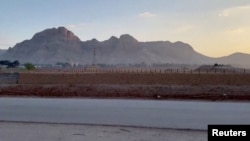
A senior Iranian official has issued a stark warning that Tehran might change its nuclear doctrine and begin to build nuclear bombs if the nation's existence is threatened.
Kamal Kharrazi, head of Iran’s Strategic Council on Foreign Relations and senior adviser to Supreme Leader Ayatollah Ali Khamenei, said in an interview aired on Al-Jazeera Arabic that Iran "has the capacity to produce a bomb," though the country has not taken the actual step of making one.
"Two years ago in an interview with Al-Jazeera, I announced that Iran has the capacity to produce a nuclear bomb. That capacity still exists today, but we have no intention of producing a nuclear bomb. However, if the existence of Iran is threatened, we will have to change our nuclear doctrine," he said.

The comments come at a time of escalating tensions between Iran and Israel, further complicated by the international community's concern over Iran's nuclear ambitions. The Islamic republic has repeatedly claimed that its nuclear program is for civilian purposes, despite possessing the technical capabilities for weaponization.
A nuclear deal in 2015 lifted U.S. sanctions against Tehran, but in 2018, then-U.S. President Donald Trump left the agreement and Washington has since ratcheted up measures against Iran that have choked the country's economy.
Efforts to revive the deal have failed, and Tehran has violated terms of the pact by producing uranium with a higher enrichment threshold.
In March, Bloomberg News quoted a senior U.S. Defense Department official as saying Iran was less than 12 days away from obtaining the fissile material necessary to produce an atomic bomb.
The threat of a shift in doctrine follows an incident last month when Israel is said to have targeted a radar system at a base near the city of Isfahan.
The attack followed an incident on April 13, when Iran retaliated against an Israeli attack on its consulate in Damascus that claimed the lives of seven senior officers from the Quds Force of Iran's Islamic Revolutionary Guards Corps. Iran launched hundreds of drones, ballistic missiles, and cruise missiles at Israel, though almost all failed to hit targets inside Israel.
After Khamenei issued a fatwa, or religious ruling, against nuclear weapons in 2005, officials were adamant that Tehran’s nuclear program was strictly for civilian purposes. But the rhetoric has shifted in recent years.
In the interview, Kharrazi also made reference to potential reactions to any attack on Iran’s nuclear facilities.
"If they want to strike at Iran's nuclear capabilities, it could naturally lead to a change in Iran's nuclear doctrine," he said.
Rafael Grossi, the head of the International Atomic Energy Agency, warned earlier this month that Iran is only weeks away from having enough enriched uranium to produce a nuclear bomb. Grossi has criticized Tehran’s cooperation with the agency as "unacceptable" and called for a significant shift in Iran's nuclear policy.
Kharrazi also hinted at the possibility of Iran withdrawing from the Nuclear Non-Proliferation Treaty (NPT) and potentially moving toward developing nuclear weapons. Iran had previously warned it would leave the NPT if its regime felt threatened.
Written by Ardeshir Tayebi based on an original story in Persian by RFE/RL's Radio Farda
Putin Reappoints Mishustin As Russian PM
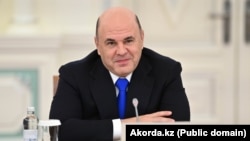
Russian lawmakers approved Mikhail Mishustin as prime minister on May 10, hours after President Vladimir Putin nominated him for reappointment. Of the 432 deputies present in the State Duma, 375 cast ballots in favor of Mishustin, while 57 abstained. The vote was seen as a formality as the Kremlin is firmly in control of both houses of parliament. Mishustin was first appointed premier in January 2020. Putin officially started his fifth term as president on May 7. The government resigned after his inauguration, in line with procedure. Mishustin has one week to present a new government. To read the original story by RFE/RL's Russian Service, click here.
Students Join Protests In Armenia As Pressure Builds On Pashinian
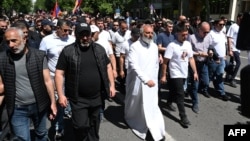
YEREVAN -- Students have joined opposition groups in marches led by an outspoken Armenian archbishop, blocking streets in Yerevan as part of a "day of disobedience" to protest a land deal negotiated by Prime Minister Nikol Pashinian and his government with rival Azerbaijan.
A day after tens of thousands of Armenians packed the capital’s central square, Archbishop Bagrat Galstanian, the leader of the Tavush Diocese of the Armenian Apostolic Church, led the march on May 10, where he called for university students to ratchet up pressure on Pashinian to resign.
"We must continue our civil disobedience actions," Galstanian, who called a new rally at Yerevan’s Republic Square for the evening of May 10, told reporters. "We cannot retreat and back down in any way."
The unrest was sparked by a controversial border-demarcation deal with Baku that cedes control of four villages that were part of Azerbaijan during the Soviet era but which have been controlled by Armenia since the 1990s.
The border agreement has been hailed by the United States and the European Union, as well as by Pashinian, who has been accused by opposition politicians of giving up territory with no guarantees.
"We spoke with the parliamentary deputies. They are ready to continue this process, to complete it legally, and then a candidate for prime minister will be required, and then probably a name will be announced," Galstanian said.
WATCH: Tens of thousands of Armenians rallied in Yerevan on May 9 over a border-demarcation agreement that cedes some land to Azerbaijan. The leader of the protest, Archbishop Bagrat Galstanian, called on Prime Minister Nikol Pashinian to resign over the deal. The outspoken archbishop has vowed to continue leading his peaceful protest in the capital.


On May 9, Galstanian said in a speech to supporters who gathered in Republic Square that Pashinian had one hour to announce his resignation. The deadline passed without any word from the beleaguered prime minister as chants of “Nikol! Traitor!” and “Resign!” emanated from the crowd.
Galstanian has called on his supporters to be patient for “two or three more days” while he explored the possibility of impeaching Pashinian in parliament.
The two opposition groups represented in the legislature have pledged to initiate a parliamentary vote of no confidence in the prime minister. But with the house controlled by Pashinian's Civil Contract party and senior lawmakers representing it insisting that neither they nor any of their pro-government colleagues will back such a motion, it remains unclear whether a vote will ever take place.
Pashinian's political allies and other supporters have verbally attacked Galstanian during protests, which have been peaceful, over the past two weeks.
During an April 30 session of the Armenian parliament, pro-government lawmakers branded Galstanian as a Russian spy, accused him of provoking another war with Azerbaijan, and even called on Armenian border guards to forcibly draft the 52-year-old archbishop.
Pashinian has said the unilateral concessions are necessary to prevent Azerbaijani military aggression against Armenia. The Armenian opposition maintains Pashinian is actually encouraging Baku to demand more territory from Armenia and to use force for that purpose.
Armenia agreed to the handover as the initial step in defining the frontier between the two rival South Caucasus countries.
Armenian Foreign Minister Ararat Mirzoyan and his Azerbaijani counterpart, Jeyhun Bayramov, are scheduled to hold peace talks in the Kazakh city of Almaty on May 10.
Armenia and Azerbaijan have fought two wars in the last three decades over the region of Nagorno-Karabakh, which had been a majority ethnic Armenian enclave since the Soviet collapse and is internationally recognized as Azerbaijani territory.
The region initially came under the control of ethnic Armenian forces, backed by the Armenian military, in separatist fighting that ended in 1994.
In 2020, Azerbaijan took back parts of Nagorno-Karabakh along with seven surrounding districts that Armenian forces had claimed during the earlier conflict.
After Baku took full control over the region as the result of a one-day military operation in September last year, nearly 100,000 ethnic Armenians fled Nagorno-Karabakh to Armenia.
International Rights Groups Urge Georgia To Protect Freedom Of Speech
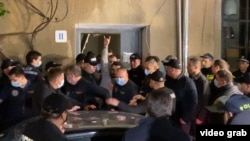
TBILISI -- International media and human rights organizations have appealed to Georgian Prime Minister Irakli Kobakhidze to withdraw a draft law on "foreign agents" and to ensure the safety of journalists and protect the freedom of the press in Georgia.
Weeks of protests against what critics call "the Russian law" -- legislation pushed by the ruling Georgian Dream party, despite widespread anger from much of the country and criticism abroad -- have been met with tough police actions to disperse crowds, while roving bands of thugs have targeted demonstrators.
In a joint letter issued on May 10, the 18 media and rights organizations, including the International Press Institute, said the proposed legislation, which recently passed in its second reading in parliament, "provides the authorities with a powerful tool to discredit, pressure, and eventually silence independent voices, thereby threatening press freedom and freedom of expression."
The groups noted the proposed legislation would not only force independent media and NGOs to be labelled as “organizations pursuing the interests of foreign powers,” but would also empower the Georgian Justice Ministry to conduct probes of these organizations "solely on the basis of a written application alleging ties to a 'foreign power.'"

The appeal was issued after seven people were reportedly detained late on May 9 as they took part in a march on Ilia Chavchavadze Avenue in downtown Tbilisi after Ucha Abashidze, a military expert, blogger, and activist, was arrested at his home in the capital, accused of illegally purchasing and storing weapons.
One of the participants, Tina Vashakidze, told RFE/RL that at least seven people were detained. The Interior Ministry, despite numerous attempts by RFE/RL to obtain an official statement, did not reveal the number of detainees.
Vashakidze, who was detained and then released a few hours later, told RFE/RL she was physically abused during her arrest.
"An elderly man fell on Chavchavadze and my friend and I went to help him. He fell and the police grabbed him. As soon as we bent down, they threw us all to the ground, and seven police officers kicked us in the head and sides. My friend and I were shoved into a vehicle, where I was grabbed by the hair and kicked by their chief. When I asked for a doctor or an ambulance, they kicked me out of the vehicle, just with my phone and without money," Vashakidze said.
WATCH: Several Georgian opposition figures were severely beaten on May 8 amid a government crackdown on mass demonstrations over a controversial bill affecting organizations that receive international funding.
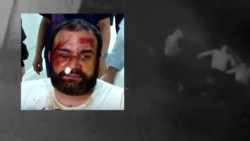
Other detainees were taken to the main building of the Interior Ministry, she said.
Separately, film critic and TV presenter Levan Abdushelishvili said he was released by the police and taken to a clinic for a medical examination.
"I'm fine, my friends, I'm in an ambulance and I'm being taken to the Ingoroqva clinic. I was hit in the head by a security guard," he wrote on Facebook after leaving the police station.
RFE/RL identified a third detainee as Niniko Shengelaya, a young woman who was treated brutally by police and was photographed by journalist Mari Nikuradze as she was detained.
According to reports by her friends, Shengelaya also left the police station a few hours after his arrest.
Separately, three members of Georgian opposition parties were attacked and beaten up by unidentified men. The three are Boris (Chele) Kurua, a member of the Girchi-More Freedom party; Nodar Chachanidze from the United National Movement (UNM); and Georgy Mumladze, also from UNM.
In another incident, a member of the Akhali political association, Georgiy Oniani, reported that unidentified people tried to break into his house, where his 14-year-old son was alone at the time.
The latest attacks came a day after Georgia's Interior Ministry said an investigation had been opened into the assault of three other protesters -- one of whom is an opposition politician -- during a rally against the law in Tbilisi late on May 8.
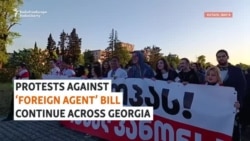
The three are international relations specialist Gia Japaridze, activist Lasha Gvinianidze, and UNM member Dimitri Chikovani.
On May 9, police also announced that six protesters had been detained for alleged public disturbance offenses.
In Washington, U.S. State Department spokesperson Matthew Miller said the United States was deeply troubled by actions taken against those protesting the draft law.
"We are aware of increased reports of harassment and physical assault of civil society and opposition activists and journalists. We condemn this and we call for a full, independent, and timely investigation," Miller said May 9.
Miller said Washington had enjoyed a successful partnership with Georgia for more than 30 years and would like that to continue.
"There is still time to work collaboratively with Georgia, but the Georgian government needs to change course for that to be the case," he said.
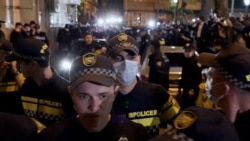
In an indication of dissent inside the Georgian government, the country's ambassador to France, Gotcha Javakhishvili, resigned in protest against the so-called “foreign agent” bill, becoming the first senior official to do so.
In a posting on Facebook on May 9, Javakhishvili said the proposed legislation, which has passed on two readings in parliament already, would steer Georgia away from further integration within Europe.
"I no longer see my role and resources in this direction: the move towards Europe," Javakhishvili said.

The legislation is expected to face a third and final reading that could come as early as May 13, with Georgian Dream and its allies seemingly in control of enough votes to carry the bill and potentially override a veto that has been promised by President Salome Zurabishvili.
The controversial bill says media outlets, NGOs, and other nonprofits must register as "pursuing the interests of a foreign power" if more than 20 percent of their funding comes from abroad.
The government insists the law is in line with EU standards and is only intended to increase "transparency" and prevent "harmful foreign influence" in the country's political scene.
Human Rights Watch rejected that stance on May 9, saying it threatens fundamental rights in the country.
“Georgian parliamentarians and government officials formally defend the bill as providing transparency, but they make no secret of its intended purpose,” said Hugh Williamson, the rights watchdog's Europe and Central Asia director.
“By labeling independent groups and media as serving foreign interests, they intend to marginalize and stifle critical voices in the country that are fundamental for any functioning democracy.”
Germany Says Allies Will Deliver 3 HIMARS Systems To Ukraine

Three more High Mobility Artillery Rocket Systems, or HIMARS, will be delivered to Ukraine by its Western allies, German Defense Minister Boris Pistorius announced on May 9. "They come from U.S. armed forces' stocks and will be paid by us," he said after meeting with his U.S. counterpart, Lloyd Austin, in Washington. HIMARS is a missile launcher mounted on a truck that can fire multiple guided missiles in quick succession. Missiles supplied to Ukraine have a range of up to 80 kilometers. To read the original story by RFE/RL's Ukrainian Service, click here.
Zelenskiy Dismisses Head Of State Guards Amid Alleged Assassination Plot
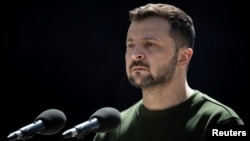
Ukrainian President Volodymyr Zelenskiy dismissed the head of the state guards on May 9, two days after two of its members were accused of plotting to assassinate him. Zelenskiy issued a decree dismissing Serhiy Rud. No successor was identified. Ukraine's Security Service (SBU) said this week that it had caught two men -- colonels in the state guard service -- accused of plotting the assassination of Zelenskiy and other top officials. It said the men were recruited by Russia's Federal Security Service (FSB) who leaked classified information to Moscow. To read the original story by RFE/RL's Ukrainian Service, click here.
Orban Meets With Xi, Calls China 'One Of The Pillars Of New World Order'
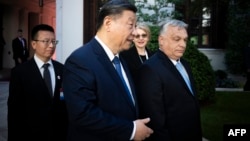
China and Hungary will expand cooperation in several areas, including in the nuclear power industry, Hungarian Prime Minister Vitkor Orban announced in Budapest on May 9 after talks with visiting Chinese President Xi Jinping.
"China is one of the pillars of the new world order," Orban told a press conference in the Hungarian capital.
Xi arrived in the Hungarian capital late on May 8 after meeting with Serbian President Aleksandar Vucic in Belgrade. His European tour started on May 5 in France where President Emmanuel Macron and EU leaders urged him to ease Chinese trade restrictions and to use his influence to press Russian President Vladimir Putin to end his invasion of Ukraine.
Orban said bilateral trade had quadrupled in the past 20 years, transforming relations between Beijing and Hungary into "a strategic partnership."
Orban said Chinese investment was so small in Hungary 20 years ago that a "magnifying glass" was needed to find it. Last year, however, three-quarters of all foreign investment in Hungary was by China, Orban said, adding it provided jobs for tens of thousands of Hungarians.
Orban also said Hungary would support China's peace plan for Ukraine.
Beijing put forward a 12-point paper more than a year ago that set out general principles for ending Russia's war on Ukraine but did not get into specifics. It received a lukewarm reception at the time in both Russia and Ukraine, while the United States said China was presenting itself as a peacemaker but reflecting Russia's "false narrative" and failing to condemn its full-scale invasion.
Speaking alongside Orban at the Budapest press conference, Xi said China will deepen economic, trade, investment, and financial cooperation with Hungary.
Xi, making his third and final stop on a European tour, promised to advance key construction projections, including a high-speed rail link between Budapest and Belgrade.
Xi called Hungary "the No. 1 target in the Central [and] Eastern European region for Chinese investment" in an article he wrote for the pro-government daily Magyar Nemzet.
Hungarian and Chinese officials were expected to sign 16 to 18 new cooperation agreements, one of which could be a large-scale infrastructure project within China's huge Belt and Road project, Hungarian Foreign Minister Peter Szijjarto said earlier this week.
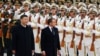
Xi's first trip to Europe in five years is seen as part of his drive to increase Beijing’s influence on the continent’s economic and political affairs.
Orban has forged close relations with China and Russia, while angering Brussels for refusing to join EU sanctions against Moscow or to allow, like other NATO countries, arms shipments to Ukraine.
In Belgrade, the two countries said a Sino-Serbian agreement signed by Xi and Vucic raises the level of their cooperation from strategic partnership to "building the community of Serbia and China with a common future in the new era."
After a series of bilateral meetings, Vucic called it "the highest form of cooperation between the two countries."
Xi said their countries will "jointly oppose hegemony and power politics" in the interest of "fundamental and long-term interests."
Like Moscow, Beijing has supported Belgrade diplomatically in its refusal to recognize former province Kosovo's independence, while Belgrade has supported China's claims to Taiwan. "Taiwan is China," Vucic said on May 8, citing the UN Charter.
Xi's visit was seemingly timed to coincide with the 25th anniversary of NATO's bombing of the former Chinese Embassy in Belgrade in 1999, a deadly incident that has united Beijing and Belgrade in their criticism of Western intervention in the Balkans and around the world.
China has invested some $6 billion in Serbia in the past decade, putting the money into copper mines and a steel mill as well as major highway and infrastructure projects, which have been criticized by some as nontransparent and overly risky deals between governments.
Georgian Ambassador To France Quits In Protest Over 'Foreign Agent' Bill
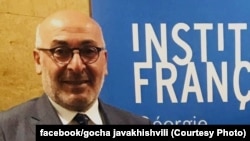
Georgia’s ambassador to France has resigned in protest against the so-called “foreign agent” bill, becoming the first senior official to do so amid ongoing demonstrations in the capital, Tbilisi.
In a posting on Facebook on May 9, Gotcha Javakhishvili said the proposed legislation, which has passed on two readings in parliament already, would steer Georgia away from further integration within Europe.
"The current tensions and climate generated by the revived draft law in our relations with our foreign friends and partners make my mission...extremely difficult," wrote Javakhishvili, who was appointed Georgian ambassador to France in 2022.
He said that while he did not personally know any Georgian officials or diplomats who were "openly pro-Russian," he believed the draft law "may be a kind of tactic to achieve a certain goal."
"I no longer see my role and resources in this direction: the move towards Europe," Javakhishvili said.
Weeks of protests against what critics call "the Russian law" -- legislation pushed by the ruling Georgian Dream party despite widespread anger from much of the country -- have been met with tough police actions to disperse crowds, while roving bands of thugs have targeted demonstrators.
In Washington on May 9, U.S. State Department spokesperson Matthew Miller said the United States was deeply troubled by actions taken against those protesting the draft law.
"We are aware of increased reports of harassment and physical assault of civil society and opposition activists and journalists. We condemn this and we call for a full, independent, and timely investigation," Miller said.
Miller said Washington had enjoyed a successful partnership with Georgia for more than 30 years and would like that to continue.
"There is still time to work collaboratively with Georgia, but the Georgian government needs to change course for that to be the case," he said.
The comments came as reports emerged that Ucha Abashidze, a military expert, blogger, and activist, was arrested at his home in Tbilisi, accused of illegally purchasing and storing weapons.
As police searched Abashidze's home, a crowd gathered outside to protest. An unspecified number of arrests were reported.
Earlier, Georgia's Interior Ministry said an investigation has been opened into the assault of three protesters -- one of whom is an opposition politician -- during a rally against the law in Tbilisi late on May 8.
Interior Minister Vakhtang Gomelauri said on May 9 that the attacks by unidentified assailants on international relations specialist Gia Japaridze, activist Lasha Gvinianidze, and Dimitri Chikovani, a member of the National Movement opposition party, would be investigated fully and that he condemns "all kinds of attacks."
Separately, police announced that six protesters who took part in rallies against the "foreign agent" bill have been detained for alleged public disturbance offenses, police announced at a briefing on May 9.
The six are accused of attacking a police officer and damaging private property, Tbilisi police chief Sulkhan Tamazashvili told the briefing.
The tens of thousands of Georgians who have taken to the streets in Tbilisi and other cities faced violent reprisals by riot police, which included chemical spray and tear gas, water cannons, and the alleged use of rubber bullets on protesters and journalists.
The government has denied the use of rubber bullets, but several protesters have shown wounds consistent with those inflicted by such projectiles.
Tamazashvili told the media on May 9 that one of those detained allegedly threw a blunt object at a law enforcement officer during a protest on April 16, which caused an eye injury. He added that, during the same April 16 protest, one participant allegedly damaged a police vehicle.
Three other people are accused of damaging surveillance cameras during rallies on May 1 and May 2, while another person allegedly damaged the entrance door into parliament and threw a stone into the the parliament's courtyard, injuring a firefighter and a member of the rescue services.
Three more incidents are under investigation, Tamazashvili said, adding that there have been no arrests yet in connection with them.
In the latest protests, Georgians demonstrated in cities across the country on May 8. Following the harsh police crackdown on earlier protests in Tbilisi, smaller rallies in Zugdidi, Kutaisi, and Gori took place without incident.
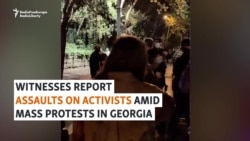
One protest organizer, Zviad Tsetskhladze, said opponents of the bill had created a group that will try to provide financial support to individuals who are dismissed from their public-service jobs over their opposition to it.
The controversial bill says media outlets, NGOs, and other nonprofits must register as "pursuing the interests of a foreign power" if more than 20 percent of their funding comes from abroad.
The government insists the law is in line with EU standards and is only intended to increase "transparency" and prevent "harmful foreign influence" in the country's political scene.
Human Rights Watch rejected that stance on May 9, saying it threatens fundamental rights in the country.
“Georgian parliamentarians and government officials formally defend the bill as providing transparency, but they make no secret of its intended purpose,” said Hugh Williamson, the rights watchdog's Europe and Central Asia director.
“By labeling independent groups and media as serving foreign interests, they intend to marginalize and stifle critical voices in the country that are fundamental for any functioning democracy.”
The legislation is expected to face a third and final reading that could come as early as May 13, with Georgian Dream and its allies seemingly in control of enough votes to carry the bill and potentially override a veto that has been promised by President Salome Zurabishvili.
European Union leaders say implementation of the law would adversely affect Georgia's hopes of eventual EU membership, and condemnation has also come from the United States -- the former Soviet republic's biggest backer in recent years.
With reporting by Reuters
Tens Of Thousands Rally In Yerevan, Demanding Pashinian Step Down Over Border Deal With Baku
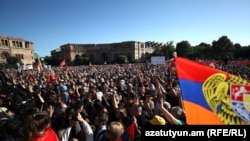
Tens of thousands of Armenians rallied in the center of Yerevan on May 9 amid calls by an outspoken Armenian archbishop for Prime Minister Nikol Pashinian and his government to resign over a land deal with rival Azerbaijan.
Archbishop Bagrat Galstanian, the leader of the Tavush Diocese of the Armenian Apostolic Church, led the protest in the Armenian capital’s central square against the controversial border-demarcation deal with Baku that cedes control of four villages that were part of Azerbaijan during the Soviet era but which have been controlled by Armenia since the 1990s.
The border agreement has been hailed by the United States and the European Union, as well as by Pashinian, who has been accused by opposition politicians of giving up territory with no guarantees.
Addressing thousands of supporters who gathered in Yerevan’s Republic Square, Galstanian gave Pashinian one hour -- until 7:40 p.m. Yerevan time -- to announce his resignation.
“You no longer have any kind of power in the Republic of Armenia,” Galstanian said, using the same phrase that Pashinian addressed to his predecessor, then Prime Minister Serzh Sarkisian, when he successfully challenged him in large-scale streets protests six years earlier.
The archbishop said he was ready, within the next hour, to meet with Pashinian to discuss “all terms of his resignation,” sparking cheers from the crowd and chants of “Nikol Traitor!” and “Resign!”
When the deadline passed with no apparent response from Pashinian, Galstanian said he would spend the night in the square and urged his supporters to again gather at the same place tomorrow.
Galstanian asked his supporters to be patient for “two or three more days” while he explored the possibility of impeaching Pashinian in parliament.
Pashinian's political allies and other supporters have verbally attacked Galstanian during protests over the past two weeks.
During an April 30 session of the Armenian parliament, pro-government lawmakers branded Galstanian a Russian spy, accused him of provoking another war with Azerbaijan, and even called on Armenian border guards to forcibly draft the 52-year-old archbishop.
Pashinian has said the unilateral concessions are necessary to prevent Azerbaijani military aggression against Armenia. The Armenian opposition maintains he is actually encouraging Baku to demand more territory from Armenia and to use force for that purpose.
Armenia agreed to the handover as the initial step in defining the frontier between the two rival South Caucasus countries.
Armenia and Azerbaijan have fought two wars in the last three decades over the region of Nagorno-Karabakh, which had been a majority ethnic Armenian enclave since the Soviet collapse and is internationally recognized as Azerbaijani territory.
The region initially came under the control of ethnic Armenian forces, backed by the Armenian military, in separatist fighting that ended in 1994.
In 2020, Azerbaijan took back parts of Nagorno-Karabakh along with seven surrounding districts that Armenian forces had claimed during the earlier conflict.
After Baku took full control over the region as the result of a one-day military operation in September last year, nearly 100,000 ethnic Armenians fled Nagorno-Karabakh to Armenia.
Ukrainian Gymnast Leads EU Athletes In Paris Olympic Torch Relay

Ukrainian gymnast Maria Vysochanska led a group of 27 athletes from the European Union through the streets of Marseille, France, on May 9 as part of the Olympic torch relay leading up to the Paris Olympics. “It's very hard to put all the emotions into words,'' the 21-year-old from the city of Lviv said. ‘’I feel pride and incredible happiness that Ukraine became the 28th country [to carry the flame with EU countries] and that the captain has honored me by letting me carry the Olympic flame.” To read the original story by RFE/RL's Ukrainian service, click here.
Putin, Pashinian Agree On Withdrawal Of Russian Troops From Some Armenian Regions
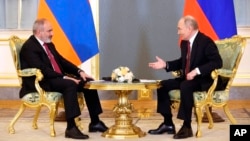
Russian border guards will withdraw from a number of regions of Armenia but will continue to be deployed on the Armenian-Turkish and Armenian-Iranian border following an agreement between Armenian Prime Minister Nikol Pashinian and Russian President Vladimir Putin.
The announcement by the Kremlin on May 9 marks a new step in Yerevan distancing itself from traditional ally Russia following accusations by Armenia that the Russian peacekeepers deployed in and around the region of Nagorno-Karabakh after a bloody war with Azerbaijan in 2020 did not do enough to stop a lightning offensive launched by Baku in September.
Spokesman Dmitry Peskov said the move was discussed and agreed upon at Pashinian's request during talks between the two leaders in Moscow on May 8.
"In the autumn 2020, at the request of the Armenian side, our troops were deployed to a number of Armenian regions. Pashinian said that currently, due to changed conditions, they are no longer needed, so President Putin agreed and the withdrawal of our military and border guards was agreed," Peskov said.
According to the agreement, the Russian border guards and military points located in Tavush, Syunik, Vayots Dzor, Gegharkunik, and Ararat will end their deployment and withdraw from those points.
Some 2,000 Russian peacekeepers have already withdrawn from the Nagorno-Karabakh area that had been for three decades under ethnic Armenian control.
Armenian authorities have accused Russian peacekeepers deployed to Nagorno-Karabakh after the 2020 war of failing to stop Azerbaijan’s new offensive in September.
Russia has rejected the accusations, arguing that its troops didn’t have a mandate to intervene and charging that Pashinian had effectively paved the way for the collapse of separatist rule in Nagorno-Karabakh by previously acknowledging Azerbaijan's sovereignty over it.
Armenia has also asked Moscow to withdraw the Russian border guards that had been deployed at Yerevan's main airport starting from August 1.
In March, Pashinian said in an interview with the France 24 television channel that his country had also frozen its membership in the Collective Security Treaty Organization (CSTO).
The CSTO has been at the heart of Armenia's turn away from Moscow, with Pashinian's government having long criticized the Russia-led security grouping for its “failure to respond to the security challenges” facing Armenia.
Pashinian declined to attend a CSTO summit in Minsk in November and said in a televised Q&A session then that any decision about Yerevan’s continued membership in the grouping -- which includes Belarus, Kazakhstan, Kyrgyzstan, and Tajikistan -- would be based on Armenia's "own state interests."
Ukrainian Ex-Military Commander Officially Becomes Envoy To U.K.
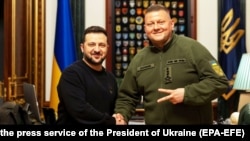
Ukrainian President Volodymyr Zelenskiy officially made Valeriy Zaluzhniy Kyiv’s ambassador to the United Kingdom, after the general was removed from his position as commander in chief of Ukraine’s military earlier this year. The 50-year-old Zaluzhniy’s removal from his military post was part of Zelenskiy’s announced “reboot” of Ukraine’s government and military, his most consequential shake-up since Russia’s February 2022 invasion. According to a decree published on the website of the Office of the President on May 9, Zaluzhniy is now officially the ambassador. A second decree from a day earlier dismissed him from military service on health grounds with the right to wear a military uniform. To read the original story by RFE/RL's Ukrainian Service, click here.
Ukrainian Civilians Killed, Energy Infrastructure Hit In Russian Strikes
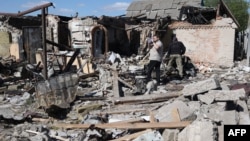
Fresh Russian attacks on Ukrainian civilian and infrastructure targets overnight killed two people and caused serious damage to Ukraine's already battered energy infrastructure, regional officials and the military said on May 9.
Live Briefing: Russia's Invasion Of Ukraine
RFE/RL's Live Briefing gives you all of the latest developments on Russia's full-scale invasion, Kyiv's counteroffensive, Western military aid, global reaction, and the plight of civilians. For all of RFE/RL's coverage of the war in Ukraine, click here.
Russian shelling killed a 62-year-old man and a 65-year-old woman in the southern city of Nikopol, wounding another two and causing damage to houses and roads, Dnipropetrovsk regional chief Serhiy Lysak said on Telegram.
Russia has been frequently shelling Nikopol and other Ukrainian cities from across the Dnieper River, and starting from October 2022, it has systematically attacked Ukraine's energy infrastructure, causing serious damage and electricity shortages for civilian and industrial users.
Ukraine's Ukrhydroenerho operator said on May 9 that two hydropower plants have been severely damaged by Russian attacks and were taken out of operation, without naming the two units.
Before the war, Ukraine's 10 hydropower plants produced some 10 percent of its electricity. Russia last year blew up the gigantic Kakhovka hydropower plant. Currently, only seven hydropower plants are still in operation and have a largely diminished capacity.
"To date, all hydropower generating capacity has suffered devastating damage. Destroyed equipment requires considerable efforts to repair, restore and significant financial resources. Today, the support, help, and decisive action of the international community are more important than ever," Ukrhydroenerho said in a statement on Telegram.
The Energy Ministry said it plans to double electricity imports on May 9 to make up for the losses caused by the latest wave of Russian attacks on its infrastructure.
The imports are expected to rise to 16,699 megawatt hours compared to 7,600 on May 8, the Ministry said.
Ukraine's air force, meanwhile, said that Russia had launched 20 drones at targets in the southern region of Odesa, and 17 of those drones had been shot down by its air defense systems.
Separately, an informed source who spoke on condition of anonymity told RFE/RL on May 9 that Ukrainian drones struck two oil depots in the village of Yurivka near the city of Anapa in Russia's Krasnodar region.
The claim could not be independently verified immediately.
Hours later, an informed security source, also speaking to RFE/RL on condition of anonymity on May 9, said that a Ukrainian attack drone had struck a Russian oil refining plant in the Russian region of Bashkortostan after flying a "record" distance of 1,500 kilometers in an operation conducted by the SBU security service.
The claim also could not be verified independently.
In Kyiv, Ukraine's parliament, the Verkhovna Rada, voted on May 9 to dismiss Agriculture Minister Mykola Solskiy and the deputy prime minister for reconstruction, Oleksandr Kubrakov.
Last month, Solskiy was released on bail after being taken into custody over accusations that he had illegally acquired land worth about 291 million hryvnias ($7 million).
He had subsequently tendered his resignation. Kubrakov leaves as the government looks to break apart his ministry, which currently oversees wartime reconstruction efforts amid Russia's full-scale invasion.
Days After Ordering Nuclear Drills, Putin Warns Of Rising Global Risks
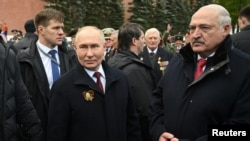
Just days after announcing military exercises involving tactical nuclear weapons, Russian President Vladimir Putin has warned of the rising risk of a global conflict.
Speaking on Moscow's Red Square on May 9 to mark Russia's victory over Nazi Germany in World War II -- a ceremony shunned by Western leaders but attended by the heads of Belarus, Kazakhstan, Kyrgyzstan, Tajikistan, Turkmenistan, Uzbekistan, Cuba, Laos and Guinea-Bissau -- Putin criticized the West for being "arrogant" and warned that Russia "will not allow anyone to threaten us."
The Russian leader, who was inaugurated for a fifth time on May 7, has used such rhetoric before to justify his full-scale invasion of neighboring Ukraine in February 2022. He says the West has used Ukraine to interfere in what is an area traditionally part of Russia's sphere of influence.
Kyiv and the West, which has backed Ukraine with military equipment and financial aid, say the war is simply a move by Putin to take land it once ruled over during the Soviet era.

In 2014, Russia launched an invasion of Ukraine's Crimea, taking control of it through a referendum deemed illegitimate, while since February 2022, Moscow has also claimed four regions inside Ukraine, meaning it now controls just a bit less than one-fifth of Ukraine's internationally recognized territory.
Russia's Defense Ministry on May 6 announced drills involving tactical nuclear weapons for the first time since it launched its aggression against Ukraine more than two years ago.
Russia said it was running the military exercises because of "unprecedented" and "provocative" statements from Britain and France that Moscow said showed their growing involvement in the war in Ukraine.
Putin said on May 9 that there was "nothing unusual" about the exercises, which the European Union has called a "continuation of Russia's irresponsible behavior."
A spokesman for EU foreign policy chief Josep Borrell said the move was further "proof that the Kremlin is only interested in further escalating the situation which was caused by its illegal aggression against Ukraine."
Belarus, where Russia currently locates some of its tactical nuclear weapons, said it will check the preparedness of its nuclear forces as well.
Russian Constitutional Court Registers First Lawsuit Against Government Climate Policy

Russia's Constitutional Court has registered its first lawsuit against the government over its climate policy. According to media outlet Kedr, environmental activists are demanding that several laws be declared inconsistent with the constitution, which says all citizens have the right to a healthy environment. The activists say the Kremlin and the government have failed to implement policies to meet goals set out to provide protection from climate change and that people are suffering the consequences. Environmentalists tried a similar move in 2022, claiming the government was not doing enough to "realistically combat global warming." The Supreme Court rejected that lawsuit. To read the original story by RFE/RL's Russian Service, click here.
Beatings, Arrests In Georgia As Protests Against Controversial Law Continue

Georgia's Interior Ministry said an investigation has been opened into the assault of three protesters -- one of whom is an opposition politician -- during a rally against the so-called "foreign agents" law in Tbilisi late on May 8.
Interior Minister Vakhtang Gomelauri said on May 9 that the attacks by unidentified assailants on international relations specialist Gia Japaridze, activist Lasha Gvinianidze, and Dimitri Chikovani, a member of the National Movement opposition party would be investigated fully and that he condemns "all kinds of attacks."
Weeks of protest against what critics call "the Russian law" -- legislation pushed by the ruling Georgian Dream party despite widespread anger from much of the country -- have been met with tough police actions to disperse crowds, while roving bands of thugs have targeted demonstrators.
"An attack took place, people were injured, unfortunately," Gomelauri said.
Separately, police announced that six protesters who took part in rallies against the so-called "foreign agents" bill have been detained for alleged public disturbance offenses, police announced at a briefing on May 9.
The six are accused of attacking a police officer and damaging private property, Tbilisi police chief Sulkhan Tamazashvili told the briefing.
The tens of thousands of Georgians who have taken to the streets in Tbilisi and other cities faced violent reprisals by riot police, which included chemical spray and tear gas, water cannons, and the alleged use of rubber bullets on protesters and journalists.
The government has denied the use of rubber bullets, but several protesters have shown wounds consistent with those inflicted by such projectiles.
Tamazashvili told the media on May 9 that one of those detained allegedly threw a blunt object at a law enforcement officer during a protest on April 16, which caused an eye injury. He added that, during the same April 16 protest, one participant allegedly damaged a police vehicle.
Three other people are accused of damaging surveillance cameras during rallies on May 1 and May 2, while another person allegedly damaged the entrance door into parliament and threw a stone into the the parliament's courtyard, injuring a firefighter and a member of the rescue services.
Three more incidents are under investigation, Tamazashvili said, adding that there have been no arrests yet in connection with them.
In the latest protests, Georgians demonstrated in cities across the country on May 8. Following the harsh police crackdown on earlier protests in Tbilisi, smaller rallies in Zugdidi, Kutaisi, and Gori took place without incident.
One protest organizer, Zviad Tsetskhladze, said opponents of the bill had created a group that will try to provide financial support to individuals who are dismissed from their public-service jobs over their opposition to it.
The controversial bill says media, NGOs, and other nonprofits must register as "pursuing the interests of a foreign power" if more than 20 percent of their funding comes from abroad.
The government insists the law is in line with EU standards and is only intended to increase "transparency" and prevent "harmful foreign influence" in the country's political scene.
Human Rights Watch rejected that stance on May 9, saying it threatens fundamental rights in the country.
“Georgian parliamentarians and government officials formally defend the bill as providing transparency, but they make no secret of its intended purpose,” said Hugh Williamson, the rights watchdog's Europe and Central Asia director.
“By labeling independent groups and media as serving foreign interests, they intend to marginalize and stifle critical voices in the country that are fundamental for any functioning democracy.”
The legislation is expected to face a third and final reading that could come as early as May 13, with Georgian Dream and its allies seemingly in control of enough votes to carry the bill and potentially override a veto that has been promised by President Salome Zurabishvili.
European Union leaders say implementation of the law would adversely affect Georgia's hopes of eventual EU membership, and condemnation has also come from the United States -- the former Soviet republic's biggest backer in recent years.
Ukrainian Lawmakers Vote To Dismiss Agriculture Minister, Key Reconstruction Figure
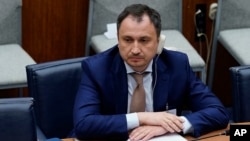
Ukraine's parliament, the Verkhovna Rada, voted on May 9 to dismiss Agriculture Minister Mykola Solskiy and the deputy prime minister for reconstruction, Oleksandr Kubrakov. Last month, Solskiy was released on bail after being taken into custody over accusations that he had illegally acquired land worth about 291 million hryvnyas ($7 million). He had subsequently tendered his resignation. Kubrakov leaves as the government looks to break apart his ministry, which currently oversees wartime reconstruction efforts amid Russia's full-scale invasion. To read the original stories by RFE/RL's Ukrainian Service, click here. and here.
North Macedonia's Right-Wing Nationalists Win Both Presidential And Parliamentary Polls
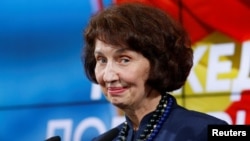
SKOPJE -- North Macedonia’s right-wing nationalist VMRO-DPMNE party has won a clear victory in both presidential and parliamentary elections, raising concerns of colder relations with Balkan neighbors and more difficult membership negotiations with the European Union.
VMRO-DPMNE-backed candidate Gordana Siljanovska-Davkova, 70, became the country’s first woman president, handing a resounding defeat to pro-Western incumbent Stevo Pendarovski, backed by the ruling Social Democrats (SDSM), in the run-off vote for the largely ceremonial post.
With 99.8 percent of votes counted, Siljanovska-Davkova, who also won the first round, garnered 65.1 percent of the votes, prompting Pendarovski, who obtained 29.2 percent, to concede defeat, saying that "the results are clear. I want to congratulate victory to those who won."

In a simultaneous parliamentary vote, the VMRO-DPMNE received 43.2 percent of the vote and will have 58 seats in the 120-seat parliament,
bringing to an end SDSM's seven-year stint in power.
VMRO-DPMNE leader and expected future Prime Minister Hristijan Mickoski said his party and the Vredi block of Albanian opposition parties, which won 13 seats, would form the government. SDSM has won 18 mandates.
"I congratulate our political opponent VMRO-DPMNE for this victory in the elections,” said SDSM leader Dimitar Kovacevski, a former prime minister.
"The result is disappointing and this is a big blow to SDSM," he added.
Following the election, Siljanovska-Davkova -- who is expected to be inaugurated on May 12, said she would be the "president of all citizens, to all ethnic groups, to party members, to those who are not in parties, because a president cannot -- especially if she is a woman -- unite and search for unity if she holds to party lines."
North Macedonia's sluggish progress on its EU path, poverty, and corruption were major themes of the campaign.
Constitutional Changes?
The next government's priorities are expected to grapple with the pledge to change the constitution to clear a path to opening chapters of North Macedonia's EU negotiations.
The VMRO-DPMNE campaigned on the idea that the EU negotiation framework can be changed.
Macedonians have had EU candidate status since 2005 but their accession efforts ran into a drawn-out name dispute with Greece, which was resolved in 2019. With Pendarovski as president, North Macedonia joined NATO in 2020.
However, their EU integration efforts were also stalled by neighbor and bloc member Bulgaria's veto, which is continuing despite the 2022 compromise requiring an amendment to the preamble of the Macedonian Constitution.
Siljanovska-Davkova has criticized the pledge to amend the constitution to establish minority status for the country's ethnic Bulgarians, but has acknowledged she won't block it in the event that a two-thirds majority can be mustered to approve it.
Siljanovska-Davkova has also said she will "respect" the name change that removed the Greek veto "but I will not use it," a reference to the name North Macedonia that has since appeared in all official settings.
She told RFE/RL's Balkan Service that if parliament -- which has so far failed to amend the constitution to recognize the Bulgarian minority -- approves the constitutional amendment she will respect that decision.
A constitutional amendment requires a two-thirds majority that neither side appears likely to win, and the VMRO-DPMNE has consistently blocked the move.
VMRO-DPMNE supporters celebrated past midnight in Skopje's Macedonia Square, signing and waving banners and flags.
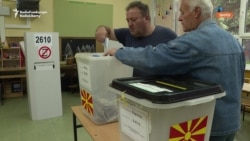
Election officials said turnout was 46.31 percent in the presidential election, surpassing the required 40 percent level to make the vote valid. Turnout in the parliamentary election was 53.3 percent at the same time, officials said.
Aleksandar Dashtevski, chief of the State Election Commission, told a news conference late on May 8 that “we have had successful, fair, and democratic elections.”
"All citizens had equal voting rights [and] they voted based on their own free will,” he added.
Political analyst Marko Tosanovski told RFE/RL's Balkan Service that voters appear frustrated that the governing parties have been unable to pull the country out of economic doldrums, high inflation, and pervasive corruption.
"Failures occurred at several levels, but even more so because the citizens didn’t see a quick reaction to correcting these conditions," Tosanovski said.
World Bank forecasters say North Macedonia and its 2.4 million residents are likely to end 2024 as the worst economic performer and with the biggest budget deficit among the so-called Western Balkan Six, which also includes Albania, Serbia, Kosovo, Montenegro, and Bosnia-Herzegovina.
- By AP
Gunmen Kill 7 Barbers In Pakistan's Volatile Balochistan Province
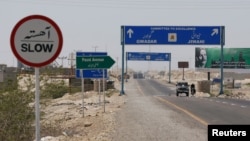
Attackers fatally shot seven barbers before dawn on May 9 in a home in a volatile province in southwestern Pakistan, police and a government official said. The killings occurred near the port city of Gwadar in Balochistan Province, according to police official Mohsin Ali. All of the barbers were from Punjab Province and lived and worked together. Provincial Interior Minister Ziaullah Langau condemned the killings and said police were investigating who was behind the attack. There was no immediate claim of responsibility. Police said they believe the attack on the barbers was not related to their jobs. To read the original story by AP, click here.
RFE/RL has been declared an "undesirable organization" by the Russian government.
If you are in Russia or the Russia-controlled parts of Ukraine and hold a Russian passport or are a stateless person residing permanently in Russia or the Russia-controlled parts of Ukraine, please note that you could face fines or imprisonment for sharing, liking, commenting on, or saving our content, or for contacting us.
To find out more, click here.
Editors' Picks







Top Trending
Exclusive: The TikTok Trail Of The U.S. Soldier Arrested In Russia Left By His Russian 'Wife'
2Kazakh Billionaire Buys English Soccer Club
32 U.S. Citizens, Including Soldier, Join List Of Americans Being Held In Russia
4Russia Claims Control Over Eastern Ukrainian Town, As Rocket Strikes Kill 3
5Kazakh Ex-Minister Insists In Court He Had No Intention To Kill Wife
6North Macedonia Ruling Party Concedes As Opposition Wins Dual Votes
7Chinese-Made Surveillance Cameras Are Spreading Across Eastern Europe, Despite Security Concerns
8All 5 Central Asian Leaders To Attend Victory Day Parade In Moscow
9North Macedonia's New President Prefers The Country's Old Name
10What Is Behind Serbia And China's 'Ironclad Friendship'?
Subscribe

