



Monday, February 13, 2012


Montenegro

Serbia And Montenegro: The Politics Of Burying Milosevic

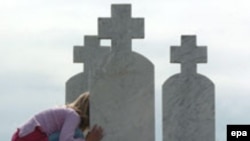
A cemetery in Bratunac with the graves of victims of Srebrenica (file photo) (epa)

The question of where to bury former Serbian and Yugoslav President Slobodan Milosevic has implications for Serbian politics. It is not clear when or how the matter will be settled.

TEXT SIZE - +
By Patrick Moore

The body of the former Serbian leader is expected to be "turned over to his family" by the Hague-based war crimes tribunal on March 13, but it is not clear exactly what the court means by this formulation. Of Milosevic's immediate family, only his daughter, Marija, is completely free to travel, because she alone does not face an arrest warrant of some kind. Milosevic's wife, Mirjana (aka Mira) Markovic, and their son, Marko Milosevic, are believed to be hiding in Russia to avoid Serbian arrest warrants on criminal charges. They are there under the protection of Slobodan's brother, Borislav, who is Belgrade's former ambassador to Moscow. He has also looked after the family's reportedly considerable "business interests."


Burial In Belgrade?


Slobodan Milosevic's lawyer, Zdenko Tomanovic, said in Belgrade on March 13 that Marko will collect his father's remains soon for a funeral in the Serbian capital, but there has been no official confirmation of Tonamovic's remarks.


Mira Markovic told the press that she wants her husband buried in their Serbian hometown of Pozarevac but knows she faces possible arrest if she goes to The Hague to collect his body or returns to Serbia. For that reason, some media reports have suggested that she and her son would really prefer to have the body sent to Moscow for burial. Daughter Marija, however, wants her father buried in the family's Montenegrin ancestral home of Lijeva Rijeka.


Milosevic and his family have little political influence in Serbia these days, and only 100 or so mainly elderly people turned out to sign the condolence book at the Belgrade headquarters of his Socialist Party of Serbia (SPS). That party, however, has political weight because its support is essential for the survival of Prime Minister Vojislav Kostunica's minority government.


A Fragile Coalition


The SPS wants Milosevic buried with full state honors in a prominent Belgrade cemetery and has threatened to leave the parliament if it does not get its wish. President Boris Tadic of the reformist Democratic Party has already ruled out such a burial for the war crimes indictee. Tadic notes that Milosevic is anathema to the international community, upon whose support Serbia's political and economic future ultimately depend. He has also ruled out an amnesty to enable Mira Markovic to attend her husband's funeral in Serbia.


Bogoljub Karic addresses supporters in Belgrade in January (epa)

Kostunica and his cabinet are potentially vulnerable to pressure from the SPS because a walkout by that party could lead to the legislative defeat of the governing coalition and the collapse of the government. No one in the coalition wants early elections because polls suggest that only one of its members, Kostunica's Democratic Party of Serbia (DSS), is likely to exceed the 5-percent hurdle. Even then, the DSS is likely to finish fourth and with less than 10 percent of the vote.


Polls indicate that the ultranationalist Serbian Radical Party (SRS) of Vojislav Seselj and Tomislav Nikolic would get the most votes in early elections, followed by Tadic's Democrats and oligarch Bogoljub Karic's relatively new Force of Serbia party. Karic is believed to be hiding abroad to avoid arrest on bribery and tax-evasion charges, but his party and influence remain.

RFE/RL Balkan Report

 

SUBSCRIBE

 For a regular review of politics, media, and RFE/RL broadcasts in the western Balkans, subscribe to "RFE/RL Balkan Report."

You Might Also Like

The Truth-Teller: Natasa Kandic, Urging Serbs To Face The Past

More than a decade has passed since the end of the Balkan wars, where international observers say ethnic Serb fighters were responsible for the bulk of atrocities in the region, particularly Bosnia-Herzegovina and Kosovo. But despite the handover of major war-crimes suspects like Radovan Karadzic and Ratko Mladic, Belgrade remains reluctant to face the sins of the past. Lawyer Natasa Kandic has built an unpopular and often dangerous career out of pushing her country to face the truth about its history. More

In Bosnia-Herzegovina, One Family, Three Armies, And A Lost Generation

Zoran Laketa knows what it's like to fire a gun and wonder if the soldier on the other side of the front line just might be his brother. Or his father. More

Jolie Earns Serbian Scorn For War Film

She’s known internationally as one of Hollywood’s highest-paid actresses; she’s won praise from governments and NGOs across the globe for her work as a goodwill ambassador for the United Nations; and she’s often reckoned to be the world’s most beautiful woman. But Angelina Jolie has been going by a few other titles lately in the Balkans nation of Serbia, where prominent media outlets have taken to describing her as an American propagandist and all-around "jerk." More

Most Popular


Being Discussed Now

U.S. Hearing On Balochistan Raises Hackles, Awareness In Pakistan

Latest Comment (1 total)

akram: It shows why pakistanis mistrust americans,US has plan for balkanization of pakistan and ... More

Jolie Earns Serbian Scorn For War Film

Latest Comment (86 total)

Abdulmajid: Well said, e.t., and I appreciate very much your qualifying 1992-95 as the ... More

Iran To Make Nuclear Announcement

Latest Comment (13 total)

Ivan: @ Jack from Upper Siberia, he only Official connection is Russia=Syria=Iran=Hamas=Hizbolla More