



News
- By RFE/RL
Greek Right Holds 'Slim' Poll Lead

Wearied by their country's long-running political and economic crisis, Greek voters have been casting their ballots in elections for the national assembly that could decide their future in the eurozone.
Exit polls suggest that the country is nearly evenly split between the left-wing Syriza party, headed by Alexis Tsipras, and the conservative New Democracy party of Antonis Samaras.
New Democracy is projected to receive between 27.5 percent and 30.5 percent of the vote while Syriza is said to be hot on its heels with 27-30 percent of the vote.
However, it is unlikely that either party will win a clear majority, meaning that a coalition will have to be formed with smaller parties. According to final exit polls, New Democracy and the traditional socialist Pasok party may have just enough seats to form a pro-bailout coaltion.
This will come as a blow to Tsipras, a 37-year-old former student activist, who had pledged that the 130-billion-euro bailout deal Greece negotiated with European partners earlier this year will be "history" if his party was able to form a majority coalition.
Samaras is also seeking to renegotiate the bailout deal, but less radically.
'A New Start'
After casting his ballot on June 17 in his hometown of Pylos, Samaras said the elections would "usher a new start for Greece."
In Athens, Tsipras said Greeks have "conquered fear" and will keep their place as an "equal member" of Europe.
He also claimed victory for his party would "open a path to hope, to a better future."
Opinion polls show that about 80 percent of Greeks want to remain within the eurozone.
Greece has relied on rescue loans since mid-2010 when high interest rates locked it out of credit markets following revelations of years of reckless spending and the falsification of financial information.
Earlier this year, Greece agreed to a 130-billion-euro bailout package, plus a debt write-off of 107 billion euros, in exchange for sharp spending cuts and other reforms.
Tsipras has tried to convince voters he can renegotiate the European rescue deal without Greece being compelled to leave the eurozone.
Merkel Urges Greeks
Nevertheless, his proposals -- including nationalizing banks, reducing privatizations, and rolling back austerity measures -- have alarmed European leaders.
On June 16, a day ahead of the elections, German Chancellor Angela Merkel urged Greeks to stand by their government's commitments.
"It is extremely important that tomorrow's Greek elections lead to a result in which those who form the government say, 'Yes, we want to keep our commitments,'" she said.
Also on June 16, Jean-Claude Juncker, Luxembourg's prime minister and the leader of the eurozone finance ministers' group, said that if Tsipras wins the election "the consequences for monetary union are unpredictable."
Elections on May 6 proved inconclusive, as neither party was able to form a government.
With reporting by AFP, Reuters, and AP
More News
Iran Sentences Renowned Filmmaker To Flogging, Prison Sentence
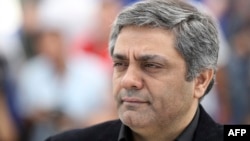
Iran’s judiciary has sentenced filmmaker Mohammad Rasoulof to flogging and eight years in prison. His lawyer, Babak Paknia, said in a social media post on May 8 that his client will only be required to serve five years in prison but was also fined and had his property confiscated. He was convicted of "collusion against national security," Paknia said. Western rights advocates and film-industry groups have condemned Iran’s actions against Rasoulof and demanded his release. Rasoulof's film titled The Seed Of The Sacred Fig is scheduled to be shown at the Cannes Film Festival this month. Rasoulof won the Berlin Film Festival’s top prize in 2020 for his film There Is No Evil, which tells four stories loosely connected to the themes of the death penalty in Iran and personal freedoms under oppression.
4 Arrested In India For 'Luring' Men To Fight For Russia In Ukraine
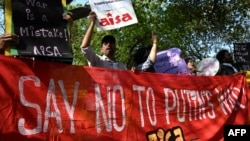
Four people have been arrested in India accused of "trafficking" citizens to fight for the Russian Army in Ukraine, India’s Central Bureau of Investigation said on May 8. The statement said one of the arrested was a translator who lived in Russia and was one of the key figures in the network for “luring” at least 35 fighters. It did not specify where he was arrested. The second suspect was arrested in Dubai. The final two lived in India and were directly involved in recruitment, the statement said. According to Reuters, India's Foreign Ministry said the matter has been "strongly taken up" with the Kremlin. Moscow has not commented. To read the original story by RFE/RL’s Russian Service, click here.
China's Xi Arrives In Hungary For Orban Meeting, Next Leg Of European Charm Trip
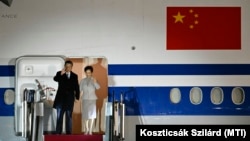
Chinese President Xi Jinping, fresh off an apparently successful trip to Serbia, on May 8 arrived in Hungary, where he is scheduled to meet later in the night with another authoritarian leader -- Prime Minister Viktor Orban -- and where he'll likely receive another warm welcome.
Chinese state television said Xi arrived in Budapest "by special plane and began his state visit to Hungary, at the invitation of Hungarian President Tamas Sulyok and Prime Minister Viktor Orban."
Xi left Belgrade on May 8 after meeting there with Serbian President Aleksandar Vucic at a city palace where thousands of people were gathered to greet them as both men lauded their countries' friendship as "ironclad" and issued a joint statement to boost cooperation toward "a common future in the new era."
Xi is on a rare, six-day European tour that already took him to France to meet with President Emmanuel Macron and EU leaders, who urged him to ease Chinese trade restrictions and to use his influence to press Russian President Vladimir Putin to end his invasion of Ukraine.
Xi's first trip to Europe in five years is seen as part of his drive to increase Beijing’s influence on the continent’s economic and political affairs.
The Sino-Serbian agreement signed by Xi and Vucic raises the level of their cooperation from strategic partnership to "building the community of Serbia and China with a common future in the new era."

After a series of bilateral meetings, Vucic called it "the highest form of cooperation between the two countries."
Xi said their countries will "jointly oppose hegemony and power politics" in the interest of "fundamental and long-term interests."
He called their bilateral political trust "strong as a rock."
Vucic has promoted Chinese investment and trade and diplomatic ties for his Balkan nation of around 7 million as he has sought to balance outreach to Russia and China and the bucking of Western sanctions on Russia over the Ukraine war with his country's bid for eventual EU membership.

Speaking from a balcony of the palace, Vucic thanked Xi for visiting "little Serbia" and said they were "making history today even though it doesn't seem so to many."
Xi called it a "truly two-sided and honest friendship," according to Serbian state television.
Like Moscow, Beijing has supported Belgrade diplomatically in its refusal to recognize former province Kosovo's independence, while Belgrade has supported China's claims to Taiwan. "Taiwan is China," Vucic said on May 8, citing the UN Charter.
Xi's visit was seemingly timed to coincide with the 25th anniversary of NATO's bombing of the former Chinese Embassy in Belgrade in 1999, a deadly incident that has united Beijing and Belgrade in their criticism of Western intervention in the Balkans and around the world.
China has invested some $6 billion in Serbia in the past decade, putting the money into copper mines and a steel mill as well as major highway and infrastructure projects that have been criticized by some as nontransparent and overly risky deals between governments.
Chinese and Serbian officials were expected to sign more than 30 agreements in areas that Vucic suggested were in many cases aimed at boosting technology and innovation in Serbia.
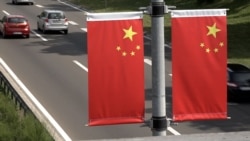
Ahead of the Chinese president's arrival, Belgrade was decorated with flags of Serbia and China, and welcome messages were set up along the route from the airport to the city center in Serbian and Chinese.
Xi also made Serbia a stop in 2016, when he signed a free-trade agreement with Belgrade that alarmed skeptics of Chinese economic and political intentions in Europe.
With reporting by AP
Armenia Stops Financial Contributions To Russian-Led Military Alliance
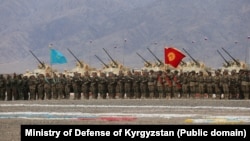
YEREVAN -- Armenia said on May 8 that it has stopped making financial contributions to the Collective Security Treaty Organization (CSTO) after effectively suspending its membership in the Russian-led military alliance.
“Armenia will refrain from signing up to the November 23, 2023, decision on the CSTO budget for 2024 and, thereby, from participating in the financing of the organization’s activities,” Armenian Foreign Ministry spokeswoman Ani Badalian told several media outlets, including Armenia’s Public Television.
At the same time, Badalian said Yerevan will not block other member states, including Belarus, Kazakhstan, Kyrgyzstan, and Tajikistan, from doing so.
For more than a year, Armenia has boycotted high-level meetings, military exercises, and other activities of the CSTO in what Prime Minister Nikol Pashinian described in February as an effective suspension of its membership of the organization.
The premier repeatedly said afterwards that he could pull his country out of the alliance of six ex-Soviet states altogether unless it addressed Yerevan’s concerns.
The Russian Foreign Ministry stressed last week that Armenia formally remains a full-fledged member of the CSTO and must therefore “fulfill appropriate obligations” to the organization.
Armenia officially asked Russia and other CSTO member states for support after Azerbaijan launched offensive military operations along the Armenian-Azerbaijani border in September 2022. Yerevan has repeatedly accused them of ignoring the request. Moscow denies that.
The threats to leave the CSTO reflect Armenia’s deepening rift with Moscow.
Russian Foreign Minister Sergei Lavrov charged in March that Pashinian’s administration is “leading things to the collapse of Russian-Armenian relations” at the behest of the West.
Pashinian and other Armenian leaders say they are only “diversifying” their foreign and security policies because of what they call Russia’s failure to honor its security commitments to the South Caucasus country.
Coincidentally, Pashinian is visiting Moscow on May 8 to chair the summit of another Russian-led grouping – the Eurasian Economic Union (EEU) – in which Armenia currently holds the rotating presidency. Other members of the EEU are Belarus, Kazakhstan, and Kyrgyzstan.
The Kremlin later confirmed that Russian President Vladimir Putin and Pashinian had held face-to-face talks at the session.
"On our bilateral relations are developing quite successfully," Putin told Pashinian, according to AFP.
The Russia leader did not mention tensions between the two nations, saying only that "we always, first and foremost, pay attention to economic cooperation."
With reporting by AFP
Falun Gong Members Held Ahead Of Xi's Serbia Visit, Says Daughter Of 1 Detainee

Three Serbian members of Falun Gong -- the Chinese spiritual movement that China's Communist Party has sought to stamp out since the late 1990s -- were detained in Belgrade on the eve of Chinese President Xi Jinping's visit, a family member said on May 8. Sara Markovic, daughter of one of the detained, Dejan Markovic, told RFE/RL that, in addition to her father, two older women and her uncle, who has no connection with Falun Gong, were also detained. The Interior Ministry didn’t respond to requests for comment. Sara Markovic said the arrests occurred “because the three are practitioners of Falun Gong. It is a forbidden Buddhist practice in China.” Established in the early 1990s, Falun Gong is a spiritual teaching that combines meditation and traditional Chinese gymnastics with a moral philosophy.
- By dpa
Pakistan Declares Emergency To Enroll 26 Million Out-Of-School Kids

Pakistan declared an emergency on May 8 to enroll 26 million children of school-going age who are not registered to seek formal education, the highest number in the world. Prime Minister Shehbaz Sharif announced that his government was imposing the formal emergency declaration to tackle the daunting task of wooing back children to school. The declaration allows for the mobilization of funds and resources and puts the problem high on the government agenda. A combination of policy and administrative tools would be deployed, as well as incentives to encourage parents to send their kids to the classroom, Sharif said.
Nobel Laureate Slams Iranian Government For Number Of Elderly Female 'Political Prisoners'
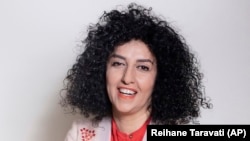
Imprisoned Iranian Nobel Peace Prize winner and human rights activist Narges Mohammadi has slammed the country’s Islamist government for holding almost two dozen women over the age of 60 incarcerated for “political” offenses.
Mohammadi, who is currently among 69 women held in Tehran's notorious Evin Prison, published a statement on Instagram highlighting the determination of older women trapped in Iran’s prison system, saying it shows their "will for liberation, as well as the cruelty and wickedness of the Islamic republic."
"The presence of these women in the ranks of those who are prepared to pay the heaviest prices indicates a widespread uprising among women for democracy, freedom, and equality, as well as the intensity of societal rebellion against discrimination, oppression, and domination," Mohammadi said, noting that "among the 69 female political prisoners in Evin, 21 are over 60 years old."
Mohammadi was sentenced in May 2016 to 16 years in prison after she established a human rights movement that campaigned for the abolition of the death penalty.
She was released in 2020 but sent back to prison in 2021. In January 2024, an Iranian court extended the 51-year-old Mohammadi's prison sentence by 15 months for “spreading propaganda” against the Islamic republic while in jail.

It was her fifth conviction since March 2021 and the third for activities from prison.
While underscoring the harsh realities faced by activists who continue to stand against authoritarian rule, Mohammadi expressed hope in her Instagram post that their resilience will eventually win out over the “tyranny” of the regime.
"It is evident that the presence of mothers and women spending their sixth and seventh decades in prison reflects the regime's brutality, misanthropy, and ferocity, which is increasingly despised as it turns a blind eye to morals, societal values, and humanity in order to maintain its fragile power," she said.
Mohammadi was awarded the 2023 Nobel Peace Prize for what the Norwegian Nobel Committee called “her fight against the oppression of women in Iran and her fight to promote human rights and freedom for all.”
Written by Ardeshir Tayebi based on an original story in Persian by RFE/RL's Radio Farda
Afghan Policemen Killed In Blast During Mission To Eradicate Poppy Crops

Three policemen were killed and five others injured when a bomb exploded near a police convoy on a mission to destroy illegal poppy crops in Afghanistan’s northeastern Badakhshan region, the country’s Taliban rulers said on May 8. Spokesman Ehsanullah Kamgar said explosives had been placed on a motorcycle when they were detonated. No group immediately claimed responsibility. Protests broke out on May 3-4 in the region when the Taliban attempted to forcefully eradicate the poppy crop. The Islamist group banned poppy cultivation in April 2022 after returning to power in August 2021. Afghanistan is the world's top producer of the poppy, from which opium and heroin are developed. To read the original story by RFE/RL’s Radio Azadi, click here.
- By RFE/RL
EU Reaches Deal To Use Proceeds From Russian Assets To Fund Ukraine Military Aid
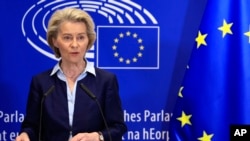
Ambassadors representing European Union states have reached a deal “in principle” to use the proceeds of Russian assets frozen in the EU to finance military aid for Ukraine, the Belgian government said on May 8. “EU ambassadors agreed in principle on measures concerning extraordinary revenues stemming from Russia’s immobilized assets,” it wrote on X, formerly Twitter. “The money will serve to support Ukraine's recovery and military defense in the context of the Russian aggression.” EU Commission President Ursula von der Leyen said that “there could be no stronger symbol and no greater use for that money than to make Ukraine and all of Europe a safer place to live.”
Ukrainian Parliament Passes Bill To Allow Some Prisoners To Serve In Military
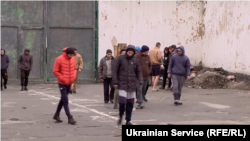
KYIV -- The Ukrainian parliament has approved a bill that would allow some categories of prisoners to serve in the country’s armed forces as it defends itself against a full-scale Russian invasion.
Live Briefing: Russia's Invasion Of Ukraine
RFE/RL's Live Briefing gives you all of the latest developments on Russia's full-scale invasion, Kyiv's counteroffensive, Western military aid, global reaction, and the plight of civilians. For all of RFE/RL's coverage of the war in Ukraine, click here.
Ukraine’s parliament, the Verkhovna Rada, adopted the law after its second reading on May 8 with 279 members of the 450-member parliament voting in favor.
The bill will require the signature of President Volodymyr Zelenskiy, who has supported the idea.
The Russian military has also recruited in the country’s prisons for potential soldiers to serve in Ukraine in exchange for a release from their sentences. Reports have surfaced in Russia of returning former prisoners terrorizing residents of regional cities and committing major crimes.
Olena Shulyak, the head of Zelenskiy's party, said in a Facebook post that the "draft law opens the possibility for certain categories of prisoners who expressed a desire to defend their country to join the defense forces."
She said service would be voluntary and some prisoners would be excluded, including those convicted of certain offenses such as crimes against the foundations of Ukraine's national security, the intentional murder of two or more people, sexual violence, attempts to kill law enforcement officers, and particularly serious corruption violations.
Shulyak said it will also not apply to convicts who previously held a position of responsibility regardless of the crime they committed (e.g. ministers, deputies, their deputies and assistants, etc.).
More than two years after Russia’s full-scale invasion, Ukraine has struggled to maintain its defenses in the face of shortages of manpower and ammunition.
Kyiv has pleaded with Western partners for additional deliveries of weapons but has not requested the deployment of foreign troops.
In April, the Verkhovna Rada passed a law on military mobilization that looks to boost the number of its troops.
The law expands the powers of Ukrainian authorities to issue draft notices, including through an electronic system, a change that is expected to help limit evasion.
A provision on the demobilization of those currently serving in the armed forces was scrapped from the law -- a move likely to be met with anger by Ukrainian troops and their families.
A provision also required all men between the ages of 18 and 60 to update their draft data with military conscription centers across the country.

An unknown number of Ukrainian men fled the country after Russia launched its ongoing unprovoked invasion of Ukraine in February 2022, despite Kyiv's move to ban men of conscription age from leaving the country.
In April, Ukraine also lowered the draft mobilization age from 27 to 25, with 60 being the maximum age.
Russia also imposed strict measures aimed at preventing avoidance of military service after thousands of young men fled the country in the early days following the invasion.
- By Reuters
U.K. Will Expel Russian Defense Attache Over 'Malign Activity'
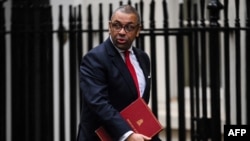
Britain will expel Russia's defense attache, remove diplomatic status from some properties, and limit the length of Russian diplomatic visas in response to what Home Secretary James Cleverly called Moscow's "malign activity," including an arson attack on a Ukrainian-linked business allegedly orchestrated by the Kremlin. Addressing Parliament on May 8, Cleverly said Britain was already "an extremely challenging operating environment for Russian intelligence services" but the measures would "only serve to strengthen our resilience to the Russian threat." Russian Foreign Ministry spokeswoman Maria Zakharova said British allegations of Russian involvement in the arson attack were absurd and part of an information war.
Russian Court Keeps Deputy Defense Minister Ivanov In Detention
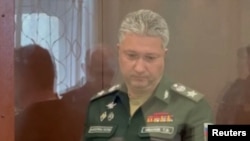
A Moscow court rejected an appeal on May 8 by Russian Deputy Defense Minister Timur Ivanov against his pretrial detention. Ivanov was arrested last month and charged with taking bribes of some $10.9 million, which he denies. The court on April 24 sent Ivanov, 49, to pretrial detention until June 23 after charging him with receiving a large bribe. Ivanov had been the subject of an investigation published in December 2022 by the late opposition politician Aleksei Navalny’s Anti-Corruption Foundation.
- By dpa
Lithuania Still Open To Sending Soldiers To Train Troops In Ukraine
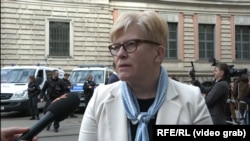
Lithuania remains open to the deployment of ground troops in Ukraine as part of training missions for Ukrainian soldiers, Prime Minister Ingrida Simonyte said. In a story published on May 8, she told the Financial Times that her NATO and EU member state is prepared to send soldiers on training missions to Ukraine. There is parliamentary authorization to do so, but Kyiv has not yet asked for it, she said. Lithuania is one of the most determined supporters of Ukraine, which has been defending itself against a full-scale Russian invasion for more than two years. The Baltic state had previously expressed its openness to French President Emmanuel Macron's ideas about the deployment of Western ground troops in Ukraine. However, other states -- including Germany -- have rejected the idea.
- By AFP
Jewish Groups Protest Former Iranian President's Hungary Visit

Hungarian Jewish organizations and the Israeli Embassy have condemned a public university for having invited Iran's populist former President Mahmud Ahmadinejad to an event this week. The Budapest-based Ludovika University of Public Service invited the controversial politician -- who has said Israel is doomed to be "wiped off the map" and that the Holocaust was a "myth" -- to an academic meeting. Two Hungarian Jewish congregations, together with a Jewish advocacy group, were the latest to protest the visit of "openly anti-Semitic" Ahmadinejad in a joint statement on May 8. Ludovika University of Public Service did not respond to the AFP news agency's request for comment. The government has also not yet responded. To read the original story by AFP, click here.
Jailed Ukrainian Magnate Kolomoyskiy Suspected Of Being Behind 2003 Attempted Contract Killing
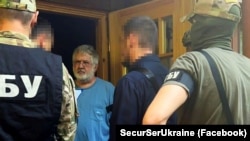
Ukrainian prosecutors and police suggested on May 8 that jailed billionaire Ihor Kolomoyskiy has been informed that he is under suspicion of a crime in connection with an attempted contract killing two decades ago.
Without naming Kolomoyskiy, the National Police said via Telegram that they have "indisputable evidence confirming the identity of the customer" who ordered the hit and described that suspect's circumstances.
The Prosecutor-General's Office also avoided naming the suspect but accompanied its Telegram post with a pixelated image that appeared to be Kolomoyskiy, who supported Zelenskiy's presidential bid in 2019 election and is already in custody to face fraud and money-laundering charges.
The police said the suspect has been in custody since September 2023.
One of Ukraine's richest individuals, Kolomoyskiy has been in custody since September. He has already denied involvement in the attempted murder case, which could carry a life sentence if he is convicted.

The National Police said the motive was "revenge on a lawyer for refusing to cooperate in an illegal arrangement."
They said the unnamed suspect was notified of their suspicions on May 8.
Doctors managed to save the life of the lawyer at the center of the 2003 case after four men beat and stabbed him. The perpetrators were apprehended.
More than a month after his detention in September, Kolomoyskiy transferred corporate rights over his 1+1 media group to the company’s employees.
A native of Dnipro, a major industrial city in southeastern Ukraine, Kolomoyskiy has owned banks, energy firms, metals companies, airlines, and one of the nation's most influential television channels.
In 2021, he was blacklisted by the U.S. State Department for alleged corruption and undermining democracy at home.
His supporters say he is being wrongly prosecuted in an effort by Ukrainian officials to demonstrate to Western allies that they are serious about fighting corruption.
Russia-Installed Officials Blame Ukraine For Attack On Luhansk Oil Refinery
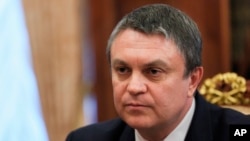
Kremlin-installed leader Leonid Pasechnik said an oil depot has caught fire in the Russian-occupied eastern Ukrainian city of Luhansk, blaming the attack on Ukrainian shells. Pasechnik said employees of the Emergency Situations Ministry were working at the site early on May 8. Another Russia-installed official said Ukraine had used a U.S.-made Army Tactical Missile System, known as ATACMS, in the attack. Further information was not available, and Kyiv did not immediately comment. To read the original story by RFE/RL’s Russian Service, click here.
- By AP
Italian President Says Ukraine War Can't Be Solved By Rewarding Moscow's Aggression
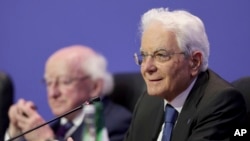
Italy’s president told the UN General Assembly on May 7 that Russia’s invasion of Ukraine can’t be solved by rewarding its aggression and peace can only come when Ukraine’s sovereignty and territorial integrity are restored. Sergio Mattarella said Italy, which now heads the Group of Seven meetings, and many international partners have come to Ukraine’s defense to support the principle that solidarity must be given to nations attacked by acts that violate international law and the UN Charter. “No state, no matter how powerful or how equipped it is with a menacing nuclear arsenal can think of violating principles, including the sovereignty, territorial integrity, and independence of another country without facing sanctions,” he said.
Iran Seeks To Tighten Crackdown On Afghan Refugees
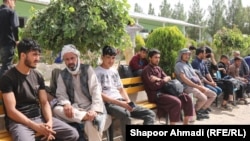
Iran says it has expelled some 1.3 million foreigners over the past year, highlighting a significant crackdown by the government on unauthorized migrants, primarily Afghan refugees.
Interior Minister Ahmad Vahidi told a press briefing that the efforts to regulate foreign nationals needs to be bolstered with legislative reforms to tighten border controls and prevent any future influx of unauthorized migrants.
"To stop unauthorized nationals from entering Iran, it is necessary to amend the relevant laws in parliament," Vahidi said in an indication the government doesn’t plan to heed calls from human rights groups to ensure a fair immigration policy.
Vahidi added that "effective” laws must be enacted to deal with expelled individuals who have managed to re-enter Iran after being deported. He did not elaborate.
Iranian officials typically use the term "unauthorized nationals" to refer to Afghan refugees and Vahidi’s statement is seen as an indication that the government plans to continue with its efforts to deport those who have fled the Taliban regime.
According to the United Nations Refugee Agency, Iran currently hosts around 3.4 million foreign refugees, with Afghans comprising the largest single group. The agency requested $114 million in aid for Iran last year to support refugee management, of which Tehran had received over $26 million by mid-2023.
This year, the refugee agency has sought $110 million in aid for Iran, with commitments from several countries, including Italy, Japan, Bulgaria, and Germany, to cover part of the sum.
Iran ranks alongside Turkey as one of the top host countries for refugees globally. The issue of Afghan migration has regained prominence following the Taliban's return to power in August 2021, leading to an increase in the number of refugees seeking safety outside their home country.
Recent government estimates suggest significant discrepancies in the number of unauthorized Afghan nationals in Iran, with figures ranging from 500,000 to 1.2 million, according to last year's assessment by the head of the National Immigration Organization.
Written by Ardeshir Tayebi based on an original story in Persian by RFE/RL's Radio Farda
- By AP
Taliban Rejects Claims Of Afghan Involvement In Recent Attacks In Pakistan
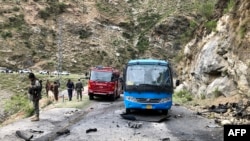
The Taliban has rejected claims of Afghan involvement in recent attacks in Pakistan, calling it “irresponsible and far from the reality.” Pakistan’s military said on May 7 that a suicide bombing which killed five Chinese engineers and a Pakistani driver in March was planned in neighboring Afghanistan and that the bomber was an Afghan citizen. Major General Ahmad Sharif, a spokesman for Pakistan’s army, has said that four men have been arrested. Enayatullah Khawarazmi, a spokesman for the Taliban’s Defense Ministry, said in a statement on May 8 that “blaming Afghanistan for such incidents is a failed attempt to divert attention from the truth of the matter and we strongly reject it."
To read the original story by AP, click here.
Kremlin Dismisses Kyiv Allegation Of Role In Plot To Kill Zelenskiy, Other Officials
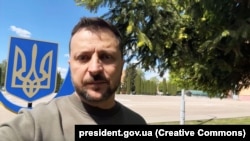
Russian President Vladimir Putin's spokesman declined to comment on May 8 on an assertion by Ukrainian intelligence officials a day earlier that they had "thwarted" an assassination plot against Ukraine's president involving Russia's Federal Security Service (FSB). Kremlin spokesman Dmitry Peskov was quoted by Reuters as saying only that the Ukrainian accusation was likely to be inaccurate information. Ukraine’s SBU security service alleged on May 7 that five Ukrainian agents linked to the FSB had targeted Ukrainian President Volodymyr Zelenskiy, SBU chief Vasyl Malyuk, military intelligence chief Kyrylo Budanov, and other high-ranking Ukrainian officials.
- By Reuters
Pakistani Ex-PM's Wife Moved From House Arrest To Jail, Lawyer Says
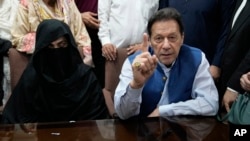
A Pakistani court ordered former Prime Minister Imran Khan's wife Bushra Bibi on May 8 to shift to a jail from house arrest, her lawyer said. Bibi, who had been detained at Khan's hilltop mansion in Islamabad since they both were convicted earlier this year on charges of selling state gifts illegally, had challenged the house arrest, her lawyer Naeem Panjutha posted on social media platform X, formerly Twitter.
- By RFE/RL
Xi Encourages Hungary To 'Lead' Region's Relations With Beijing
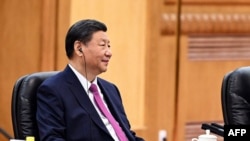
Chinese President Xi Jinping has cited strong "mutual political trust," a shared defiance of "power politics," and "similar views and positions" on regional and international issues to encourage a more active role for Hungary to shape China-EU relations. The May 8 appeal was published on the Hungarian pro-government website Magyar Nemzet ahead of Xi's arrival in Hungary later the same day during a European tour that has already taken the Chinese leader to France and Serbia. Hungarian Prime Minister Viktor Orban is among the EU's harshest critics, and his country takes over the six-month rotating EU presidency in July. “We have gone through hardships together and defied power politics together amid volatile international relations,” Xi said. “We have found our respective path for sovereign states to independently conduct friendly exchanges with other countries.”
North Macedonia Ruling Party Concedes As Opposition Wins Dual Votes
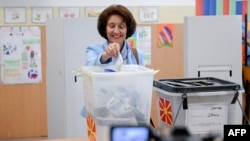
SKOPJE – North Macedonia’s ruling party conceded defeat late on May 8 in presidential and parliamentary elections, setting the stage for right-wing opposition candidate Gordana Siljanovska-Davkova to become the country’s first woman president and perhaps allow new leaders to shape the future of the Balkan nation.
Siljanovska-Davkova, 70, who is supported by the nationalist opposition VMRO-DPMNE party, held a commanding lead over 61-year-old pro-Western incumbent Stevo Pendarovski, backed by the ruling Social Democrats (SDSM), in the vote made necessary when no candidate received a majority of votes in the first round for the largely ceremonial post.
With more than 50 percent of ballots counted, Siljanovska-Davkova had 64 percent of the vote.
In a late news conference, Pendarovski conceded defeat, saying that "the results are clear. I want to congratulate victory to those who won."
Meanwhile, in a simultaneous but separate parliamentary vote, results indicate that the right-wing VMRO-DPMNE will have 59 of the 120 seats in parliament. Expected future Prime Minister Hristijan Mickoski said his party and the Vredi block of Albanian opposition parties, which won 13 seats, would form the government. SDSM won 19 seats.
"I congratulate our political opponent VMRO-DPMNE with this victory in the elections,” said Dimitar Kovacevski, a former prime minister and the leader of the SDSM.
"The result is disappointing and this is a big blow to SDSM," he added.
Following the election, Siljanovska-Davkova -- who is expected to be inaugurated on May 12, said she would be the "president of all citizens, to all ethnic groups, to party members, to those who are not in parties, because a president cannot -- especially if she is a woman -- unite and search for unity if she holds to party lines."
She pledged to cooperate with Balkan neighbors and suggested support for the country's EU hopes.
VMRO-DPMNE supporters celebrated past midnight in Skopje's Macedonia Square, signing and waving banners and flags.
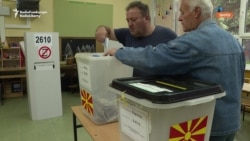
Election officials said that about 30 minutes before polls closed, turnout was 46.31 percent in the presidential election, surpassing the required 40 percent to make the vote valid. Turnout in the parliamentary election was 53.3 percent at the same time, officials said.
Aleksandar Dashtevski, chief of the State Election Commission, told a news conference late on May 8 that “we have had successful, fair, and democratic elections.”
"All citizens had equal voting rights [and] they voted based on their own free will,” he added.
The nationalist Internal Macedonian Revolutionary Organization-Democratic Party for Macedonian Unity (VMRO-DPMNE) had appeared poised for a strong showing after years in opposition, with its preferred presidential candidate riding high after a surprisingly high tally in last month's first round.
Political analyst Marko Tosanovski told RFE/RL's Balkan Service that voters appear frustrated that the governing parties have been unable to pull the country out of economic doldrums, high inflation, and pervasive corruption.
"Failures occurred at several levels, but even more so because the citizens didn’t see a quick reaction to correcting these conditions," Tosanovski said.
Pendarovski is the candidate of the ruling Social Democrats, who have kept the VMRO-DPMNE in opposition for the past seven years but appeared to be hurt by his perceived failure and that of his allies to tackle corruption and kick-start the economy.
Pendarovski has been an advocate of the country's desire to join the EU. North Macedonia joined NATO in 2020.
Siljanovska-Davkova has criticized a pledge to institute a constitutional change establishing Bulgarians as a constitutive people in North Macedonia, but has acknowledged she won't block it in the event that a two-thirds majority can be mustered to approve it.
In 2022, Skopje reluctantly bowed to Sofia's demand for the change in order to convince Bulgaria to lift its veto on the start of North Macedonia's framework negotiations with the European Union.
North Macedonia's potential EU path, a sluggish economy, and corruption were major themes of the campaign.
World Bank forecasters say North Macedonia and its 2.4 million residents are likely to end 2024 as the worst economic performer and with the biggest budget deficit among the so-called Western Balkan Six, which also includes Albania, Serbia, Kosovo, Montenegro, and Bosnia-Herzegovina.
VMRO-DPMNE officials appeared confident going into the double-bill voting that they have a realistic chance of governing alongside a like-minded president.
Mickoski said after Siljanovska-Davkova's strong first-round result that "I wouldn't be surprised if we have 61 MPs" in the currently 120-member parliament.
Kovacevski said after that vote that "it is clear that people have punished us, and we accepted that."
The next government's priorities are expected to grapple with the pledge to change the constitution to clear a path to opening chapters of North Macedonia's full EU negotiations.
The VMRO-DPMNE campaigned on the idea that the EU negotiation framework can be changed.
Macedonians have had EU candidate status since 2005 but their accession efforts ran into a drawn-out name dispute with Greece, which was resolved in 2019. They also found themselves stalled by EU member Bulgaria's veto, which is continuing despite the 2022 compromise requiring the amendment to the preamble of the Macedonian Constitution.
Siljanovska-Davkova has also said she will "respect" the name change that removed the Greek veto "but I will not use it," a reference to the name North Macedonia that has since appeared in all official settings.
She told RFE/RL's Balkan Service that if parliament -- which has so far failed to amend the constitution in line with the "French compromise" involving Bulgarians -- approves the constitutional amendment she will respect that decision.
A constitutional amendment requires a two-thirds majority that neither side appears likely to win, and the VMRO-DPMNE has consistently blocked the move.
With reporting by Reuters
- By Current Time
U.S. Soldier Detained In Russia Had Broken Army Rules, Traveled Via China

The Pentagon has said that the U.S. Army serviceman who is one of two Americans arrested by Russia in separate cases disclosed on May 7 had violated army rules by traveling to the Far Eastern Russian city of Vladivostok, and he had gone there via China.
The detentions renewed questions over whether Russian authorities are targeting Americans for potential prisoner swaps amid sharp disagreements between Moscow and Washington over the war in Ukraine and other international security issues.
A Pervomaisky district court in Vladivostok ordered the arrest of U.S. Army Staff Sergeant Gordon Black and sent him to pretrial detention until at least July 2, according to a court spokeswoman.
Daniel Kanigan, deputy spokesman at the U.S. Embassy in Moscow, told RFE/RL in an e-mail that “we can confirm that two U.S. citizens have been detained in Russia in the past week.” He did not confirm the name of either of the detained Americans.
But U.S. authorities confirmed that Black had been arrested in Russia and accused of stealing from a woman after traveling from South Korea -- where he had been assigned but was due to return to Texas -- without informing his superiors.
"Instead of returning to the continental United States, Black flew from Incheon, Republic of Korea through China to Vladivostok, Russia, for personal reasons," the army said in a statement.

Russian authorities said separately on May 7 that an American identified by court officials as William Russell Nycum had been detained 10 days ago in an unrelated case and was in custody in Moscow on "petty hooliganism" and alcohol charges.
The White House said the State Department was "actively seeking consular access to both individuals, neither of whom are in Russia on behalf or in affiliation with the U.S. government," press secretary Karine Jean-Pierre told reporters.
The detentions add to a list of U.S. citizens being held in Russia under various circumstances and come as tensions between Moscow and Washington are at their highest levels since the Cold War.
Among those being held are journalists Alsu Kurmasheva of RFE/RL and Evan Gershkovich of The Wall Street Journal. Both have been detained on charges that they, their employers, and their supporters reject as politically motivated.
American Paul Whelan was convicted in 2020 and sentenced to 16 years in Russian prison on espionage charges that he and the U.S. government have repeatedly rejected.
Russia's Foreign Ministry has said Black's and Nycum's cases are not political and neither is accused of espionage.

Black was charged with "theft causing significant damage to a citizen," Kommersant reported, the maximum penalty for which is five years in prison.
Black’s mother told the ABC TV network that her 35-year-old son had been visiting his girlfriend in Russia at the time of his arrest.
U.S. Army spokeswoman Cynthia Smith confirmed that Black was detained four days earlier in Vladivostok, a military and commercial port in Russia's Far East, on charges of criminal misconduct.
Smith added that there was no indication “Black intended to remain in Russia” after his two-week leave time ended.
It wasn’t immediately clear if the detained soldier was being considered as absent without leave (AWOL) by the U.S. military.
U.S. Representative Michael McCaul (Republican-Texas), chairman of the House Foreign Affairs Committee, said in a post on X, formerly Twitter, that “I am deeply concerned by reports that a U.S. Army officer has been detained in Russia. Putin has a long history of holding American citizens hostage."
The State Department issued a "Do Not Travel" warning to U.S. citizens in September 2023 and cited "the singling out of U.S. citizens for detention by Russian government security officials."
With reporting by Reuters
Georgian Protests Continue Against 'Foreign Agents' Bill, Absent Police Violence

Demonstrators against the so-called "foreign agents" bill awaiting its final reading in Georgia's parliament have marched again in the capital in the latest show of popular opposition to the government moves to enact legislation that risks damaging Tbilisi's relations with the West.
The May 7 protest began at parliament and headed toward the ruling Georgian Dream's headquarters, where marchers were met with a police cordon.
Some of the participants carried EU and Georgian flags up to Peace Bridge before many returned to the area around the parliament building.
There were no reports of violence.
Weeks of protest against what critics call "the Russian law" have sometimes been met with tough police actions to disperse crowds allegedly including the use of rubber bullets, detentions, and roving bands of thugs targeting demonstrators.
One of the organizers of the latest protest, Zviad Tsetskhladze, said opponents of the bill had created a group that will try to provide financial support to individuals who are dismissed from their public-service jobs over their opposition to it.
Tens of thousands of Georgians have taken to the streets in Tbilisi and other cities in protests that have unleashed fierce police responses, which included chemical spray and tear gas, water cannons, and the alleged use of rubber bullets against protesters or journalists who showed signs of injury from projectiles.

The crackdown in Tbilisi has generally eased since Orthodox Easter although smaller protests and candlelight vigils have continued and even spread in significant numbers to other cities.
The bill says media, NGOs, and other nonprofits must register as "pursuing the interests of a foreign power" if more than 20 percent of their funding comes from abroad.
The government insists the law would be in line with EU standards and is only intended to increase "transparency" and prevent "harmful foreign influence" in the country's political scene.
It is expected to face a third and final reading by May 13, with Georgian Dream and its allies seemingly in control of enough votes to carry the bill and potentially override a veto that has been promised by President Salome Zourabichvili.
EU leaders say implementation of the law would adversely affect Georgia's hopes of eventual EU membership, and condemnation has also come from the United States -- the former Soviet republic's biggest backer in recent years.
RFE/RL has been declared an "undesirable organization" by the Russian government.
If you are in Russia or the Russia-controlled parts of Ukraine and hold a Russian passport or are a stateless person residing permanently in Russia or the Russia-controlled parts of Ukraine, please note that you could face fines or imprisonment for sharing, liking, commenting on, or saving our content, or for contacting us.
To find out more, click here.
Editors' Picks






Top Trending
Iranian IRGC Warship Crosses Equator For First Time
2Exclusive: The TikTok Trail Of The U.S. Soldier Arrested In Russia Left By His Russian 'Wife'
3Kazakh Billionaire Buys English Soccer Club
4Russia Claims Control Over Eastern Ukrainian Town, As Rocket Strikes Kill 3
52 U.S. Citizens, Including Soldier, Join List Of Americans Being Held In Russia
6Chinese-Made Surveillance Cameras Are Spreading Across Eastern Europe, Despite Security Concerns
7North Macedonia Ruling Party Concedes As Opposition Wins Dual Votes
8Putin Inaugurated In Ceremony Marked By Western Boycott
9What Is Behind Serbia And China's 'Ironclad Friendship'?
10Live Briefing: Russia Invades Ukraine
Subscribe

