

Accessibility links

Breaking News

Aftershocks Of Iran's 1953 Coup Still Felt Around The World, 60 Years Later

A communist newspaper kiosk is burned by pro-shah demonstrators in Tehran on August 19, 1953.
1/10 A communist newspaper kiosk is burned by pro-shah demonstrators in Tehran on August 19, 1953.
On August 15, 1953, U.S. and British intelligence operatives put into motion a plan to remove Iran's democratically elected Prime Minister Mohammad Mossadegh from power. The coup reached completion on August 19, when the military, backed by CIA-supported street protests, overthrew Mossadegh, installed a new prime minister, and reinstated Shah Mohammad Reza Pahlavi in the primary position of power. The events sparked massive demonstrations, leaving at least 300 people dead in gunbattles in Tehran.
Soldiers chase rioters during civil unrest in Tehran.
2/10 Soldiers chase rioters during civil unrest in Tehran.
On August 15, 1953, U.S. and British intelligence operatives put into motion a plan to remove Iran's democratically elected Prime Minister Mohammad Mossadegh from power. The coup reached completion on August 19, when the military, backed by CIA-supported street protests, overthrew Mossadegh, installed a new prime minister, and reinstated Shah Mohammad Reza Pahlavi in the primary position of power. The events sparked massive demonstrations, leaving at least 300 people dead in gunbattles in Tehran.
A crowd of demonstrators tears down the sign of the Iran Party, part of Mossadegh's National Front, at its headquarters on August 19.
3/10 A crowd of demonstrators tears down the sign of the Iran Party, part of Mossadegh's National Front, at its headquarters on August 19.
On August 15, 1953, U.S. and British intelligence operatives put into motion a plan to remove Iran's democratically elected Prime Minister Mohammad Mossadegh from power. The coup reached completion on August 19, when the military, backed by CIA-supported street protests, overthrew Mossadegh, installed a new prime minister, and reinstated Shah Mohammad Reza Pahlavi in the primary position of power. The events sparked massive demonstrations, leaving at least 300 people dead in gunbattles in Tehran.
Protesters run in the streets of Tehran.
4/10 Protesters run in the streets of Tehran.
On August 15, 1953, U.S. and British intelligence operatives put into motion a plan to remove Iran's democratically elected Prime Minister Mohammad Mossadegh from power. The coup reached completion on August 19, when the military, backed by CIA-supported street protests, overthrew Mossadegh, installed a new prime minister, and reinstated Shah Mohammad Reza Pahlavi in the primary position of power. The events sparked massive demonstrations, leaving at least 300 people dead in gunbattles in Tehran.
Soldiers surround the parliament building on August 19.
5/10 Soldiers surround the parliament building on August 19.
On August 15, 1953, U.S. and British intelligence operatives put into motion a plan to remove Iran's democratically elected Prime Minister Mohammad Mossadegh from power. The coup reached completion on August 19, when the military, backed by CIA-supported street protests, overthrew Mossadegh, installed a new prime minister, and reinstated Shah Mohammad Reza Pahlavi in the primary position of power. The events sparked massive demonstrations, leaving at least 300 people dead in gunbattles in Tehran.
An issue of "Tehran Mosavvar" shows a picture of the unrest following the coup.
6/10 An issue of "Tehran Mosavvar" shows a picture of the unrest following the coup.
On August 15, 1953, U.S. and British intelligence operatives put into motion a plan to remove Iran's democratically elected Prime Minister Mohammad Mossadegh from power. The coup reached completion on August 19, when the military, backed by CIA-supported street protests, overthrew Mossadegh, installed a new prime minister, and reinstated Shah Mohammad Reza Pahlavi in the primary position of power. The events sparked massive demonstrations, leaving at least 300 people dead in gunbattles in Tehran.
Soldiers clash with protesters in the streets of Tehran.
7/10 Soldiers clash with protesters in the streets of Tehran.
On August 15, 1953, U.S. and British intelligence operatives put into motion a plan to remove Iran's democratically elected Prime Minister Mohammad Mossadegh from power. The coup reached completion on August 19, when the military, backed by CIA-supported street protests, overthrew Mossadegh, installed a new prime minister, and reinstated Shah Mohammad Reza Pahlavi in the primary position of power. The events sparked massive demonstrations, leaving at least 300 people dead in gunbattles in Tehran.
Iranian Army officers and supporters of the monarchy gather on August 27, shortly after the shah returned from a brief period of exile to reclaim power.
8/10 Iranian Army officers and supporters of the monarchy gather on August 27, shortly after the shah returned from a brief period of exile to reclaim power.
On August 15, 1953, U.S. and British intelligence operatives put into motion a plan to remove Iran's democratically elected Prime Minister Mohammad Mossadegh from power. The coup reached completion on August 19, when the military, backed by CIA-supported street protests, overthrew Mossadegh, installed a new prime minister, and reinstated Shah Mohammad Reza Pahlavi in the primary position of power. The events sparked massive demonstrations, leaving at least 300 people dead in gunbattles in Tehran.
Former Iranian Prime Minister Mohammad Mossadegh steps off a plane in August 1953.
9/10 Former Iranian Prime Minister Mohammad Mossadegh steps off a plane in August 1953.
On August 15, 1953, U.S. and British intelligence operatives put into motion a plan to remove Iran's democratically elected Prime Minister Mohammad Mossadegh from power. The coup reached completion on August 19, when the military, backed by CIA-supported street protests, overthrew Mossadegh, installed a new prime minister, and reinstated Shah Mohammad Reza Pahlavi in the primary position of power. The events sparked massive demonstrations, leaving at least 300 people dead in gunbattles in Tehran.
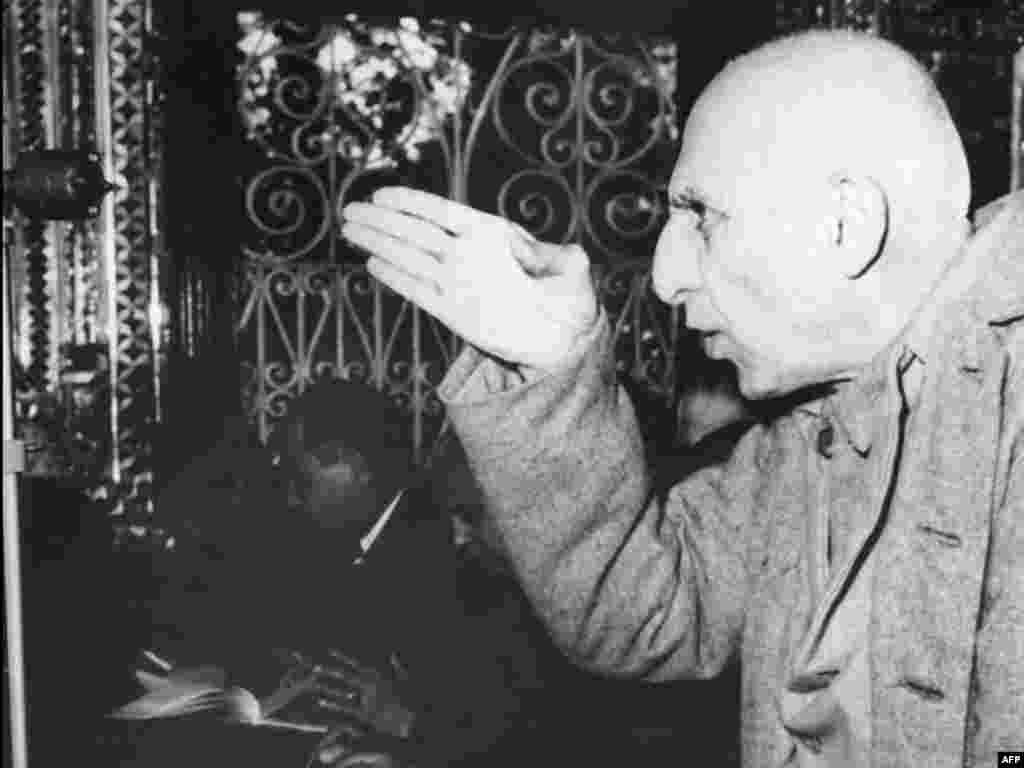
Ousted Prime Minister Mohammad Mossadegh during one of his frequent interruptions of court proceedings in Tehran's military tribunal in November 1953. He was tried for treason, for which he served three years in prison. He died under house arrest in 1967.
10/10 Ousted Prime Minister Mohammad Mossadegh during one of his frequent interruptions of court proceedings in Tehran's military tribunal in November 1953. He was tried for treason, for which he served three years in prison. He died under house arrest in 1967.
On August 15, 1953, U.S. and British intelligence operatives put into motion a plan to remove Iran's democratically elected Prime Minister Mohammad Mossadegh from power. The coup reached completion on August 19, when the military, backed by CIA-supported street protests, overthrew Mossadegh, installed a new prime minister, and reinstated Shah Mohammad Reza Pahlavi in the primary position of power. The events sparked massive demonstrations, leaving at least 300 people dead in gunbattles in Tehran.
Previous slide
Next slide

Sixty years ago, Iranian military officers backed by U.S. and British intelligence agencies initiated a coup d'etat whose aftershocks can still be felt around the globe.

The coup toppled Iran's first democratically elected government and its popular prime minister, Mohammad Mossadegh, and is widely credited with fueling the hostility against the West that culminated decades later with the 1979 Islamic Revolution.

But the events that played out over a five-day period from August 15-19 reverberated far beyond Iran's borders. The coup altered the geopolitical landscape in the Middle East, became a blueprint for a succession of covert U.S. efforts to foster coups and destabilize governments in the '50s, and provided the Soviet Union with ideological ammunition during the Cold War.

The theory, disputed by some, was that the CIA and Britain's MI6 masterminded the coup to maintain control over Iranian oil and to prevent Tehran from falling under Soviet influence after World War II.

From The Archives: The 1953 Iranian Coup

A communist newspaper kiosk is burned by pro-shah demonstrators in Tehran on August 19, 1953.
1/10 A communist newspaper kiosk is burned by pro-shah demonstrators in Tehran on August 19, 1953.
On August 15, 1953, U.S. and British intelligence operatives put into motion a plan to remove Iran's democratically elected Prime Minister Mohammad Mossadegh from power. The coup reached completion on August 19, when the military, backed by CIA-supported street protests, overthrew Mossadegh, installed a new prime minister, and reinstated Shah Mohammad Reza Pahlavi in the primary position of power. The events sparked massive demonstrations, leaving at least 300 people dead in gunbattles in Tehran.
Soldiers chase rioters during civil unrest in Tehran.
2/10 Soldiers chase rioters during civil unrest in Tehran.
On August 15, 1953, U.S. and British intelligence operatives put into motion a plan to remove Iran's democratically elected Prime Minister Mohammad Mossadegh from power. The coup reached completion on August 19, when the military, backed by CIA-supported street protests, overthrew Mossadegh, installed a new prime minister, and reinstated Shah Mohammad Reza Pahlavi in the primary position of power. The events sparked massive demonstrations, leaving at least 300 people dead in gunbattles in Tehran.
A crowd of demonstrators tears down the sign of the Iran Party, part of Mossadegh's National Front, at its headquarters on August 19.
3/10 A crowd of demonstrators tears down the sign of the Iran Party, part of Mossadegh's National Front, at its headquarters on August 19.
On August 15, 1953, U.S. and British intelligence operatives put into motion a plan to remove Iran's democratically elected Prime Minister Mohammad Mossadegh from power. The coup reached completion on August 19, when the military, backed by CIA-supported street protests, overthrew Mossadegh, installed a new prime minister, and reinstated Shah Mohammad Reza Pahlavi in the primary position of power. The events sparked massive demonstrations, leaving at least 300 people dead in gunbattles in Tehran.
Protesters run in the streets of Tehran.
4/10 Protesters run in the streets of Tehran.
On August 15, 1953, U.S. and British intelligence operatives put into motion a plan to remove Iran's democratically elected Prime Minister Mohammad Mossadegh from power. The coup reached completion on August 19, when the military, backed by CIA-supported street protests, overthrew Mossadegh, installed a new prime minister, and reinstated Shah Mohammad Reza Pahlavi in the primary position of power. The events sparked massive demonstrations, leaving at least 300 people dead in gunbattles in Tehran.
Soldiers surround the parliament building on August 19.
5/10 Soldiers surround the parliament building on August 19.
On August 15, 1953, U.S. and British intelligence operatives put into motion a plan to remove Iran's democratically elected Prime Minister Mohammad Mossadegh from power. The coup reached completion on August 19, when the military, backed by CIA-supported street protests, overthrew Mossadegh, installed a new prime minister, and reinstated Shah Mohammad Reza Pahlavi in the primary position of power. The events sparked massive demonstrations, leaving at least 300 people dead in gunbattles in Tehran.
An issue of "Tehran Mosavvar" shows a picture of the unrest following the coup.
6/10 An issue of "Tehran Mosavvar" shows a picture of the unrest following the coup.
On August 15, 1953, U.S. and British intelligence operatives put into motion a plan to remove Iran's democratically elected Prime Minister Mohammad Mossadegh from power. The coup reached completion on August 19, when the military, backed by CIA-supported street protests, overthrew Mossadegh, installed a new prime minister, and reinstated Shah Mohammad Reza Pahlavi in the primary position of power. The events sparked massive demonstrations, leaving at least 300 people dead in gunbattles in Tehran.
Soldiers clash with protesters in the streets of Tehran.
7/10 Soldiers clash with protesters in the streets of Tehran.
On August 15, 1953, U.S. and British intelligence operatives put into motion a plan to remove Iran's democratically elected Prime Minister Mohammad Mossadegh from power. The coup reached completion on August 19, when the military, backed by CIA-supported street protests, overthrew Mossadegh, installed a new prime minister, and reinstated Shah Mohammad Reza Pahlavi in the primary position of power. The events sparked massive demonstrations, leaving at least 300 people dead in gunbattles in Tehran.
Iranian Army officers and supporters of the monarchy gather on August 27, shortly after the shah returned from a brief period of exile to reclaim power.
8/10 Iranian Army officers and supporters of the monarchy gather on August 27, shortly after the shah returned from a brief period of exile to reclaim power.
On August 15, 1953, U.S. and British intelligence operatives put into motion a plan to remove Iran's democratically elected Prime Minister Mohammad Mossadegh from power. The coup reached completion on August 19, when the military, backed by CIA-supported street protests, overthrew Mossadegh, installed a new prime minister, and reinstated Shah Mohammad Reza Pahlavi in the primary position of power. The events sparked massive demonstrations, leaving at least 300 people dead in gunbattles in Tehran.
Former Iranian Prime Minister Mohammad Mossadegh steps off a plane in August 1953.
9/10 Former Iranian Prime Minister Mohammad Mossadegh steps off a plane in August 1953.
On August 15, 1953, U.S. and British intelligence operatives put into motion a plan to remove Iran's democratically elected Prime Minister Mohammad Mossadegh from power. The coup reached completion on August 19, when the military, backed by CIA-supported street protests, overthrew Mossadegh, installed a new prime minister, and reinstated Shah Mohammad Reza Pahlavi in the primary position of power. The events sparked massive demonstrations, leaving at least 300 people dead in gunbattles in Tehran.
Ousted Prime Minister Mohammad Mossadegh during one of his frequent interruptions of court proceedings in Tehran's military tribunal in November 1953. He was tried for treason, for which he served three years in prison. He died under house arrest in 1967.
10/10 Ousted Prime Minister Mohammad Mossadegh during one of his frequent interruptions of court proceedings in Tehran's military tribunal in November 1953. He was tried for treason, for which he served three years in prison. He died under house arrest in 1967.
On August 15, 1953, U.S. and British intelligence operatives put into motion a plan to remove Iran's democratically elected Prime Minister Mohammad Mossadegh from power. The coup reached completion on August 19, when the military, backed by CIA-supported street protests, overthrew Mossadegh, installed a new prime minister, and reinstated Shah Mohammad Reza Pahlavi in the primary position of power. The events sparked massive demonstrations, leaving at least 300 people dead in gunbattles in Tehran.
Previous slide
Next slide

Mossadegh played a prominent role in Iran's 1951 move to nationalize its oil industry, which had long been controlled by Britain. The decision led to a worldwide boycott of Iranian oil intended to rein in Mossadegh's government, but when that failed a secret plan was devised to oust him.

The replacement of Mossadegh with a handpicked prime minister, General Fazlollah Zahedi, opened the way for Iran's relatively weak shah to gain nearly absolute power within Iran's constitutional monarchy.

With strong military and economic backing from Washington, Shah Mohammad Reza Pahlavi would take on the role of autocrat until the Islamic Revolution in 1979.

As for Mossadegh himself, he was arrested and convicted of treason, along with scores of government officials, after the coup. He served three years in jail before living under house arrest until his death in 1967.

Lingering Coup

Stephen Kinzer, the author of "All The Shah's Men: An American Coup And The Roots of Middle East Terror," sees the coup as a short-term victory for Washington. But in the long-term, he says, Washington's intervention in Iran would prove detrimental to its standing in Iran.
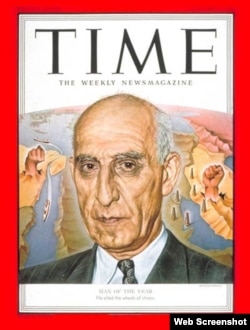
Mossadegh was named "Time" magazine's Person of the Year in 1953.

"From the perspective of history, the coup was not successful for the United States," Kinzer says. "The 1979 revolution was a long-term effect of the increasing repression from the shah, who came to power as a result of the coup. That Islamic Revolution brought to power a fanatically anti-American regime that has spent more than 30 years working to undermine American interests all over the world."

Sixty years on, the coup continues to loom large in Iran's national psyche and remains a thorn in the country's relations with the West.

Mark Gasiorowski, author of "Mohammad Mosaddeq And The 1953 Coup In Iran," says the removal of Mossadegh paved the way for two political trends -- radical Islamists led by Ayatollah Ruhollah Khomeini and radical leftists in the form of the militant Mujahedin-e Khalq -- to gain ground in the decades after the coup.

"What the coup did was to take out the moderate, secular, element of Iranian politics and enabled radical Islamists and radical leftists to emerge as key opposition factions in place of it [in the 1960s and '70s]," Gasiorowski says. "The coup had this big impact of essentially eliminating this pro-democracy faction and that had a very important impact on Iranian politics in the intervening years."

Regional Repurcussions

Gasiorowksi, a professor of political science at Tulane University in New Orleans, says that to many in Iran the coup proved Washington's duplicity. The United States, which portrayed itself as the guardian of freedom, was seen as resorting to nefarious means to get rid of a democratically elected government to suit its own strategic interests.

Gasiorowski says the '53 coup had major regional repercussions as well. He says Iran became a key part of the U.S. strategy of containing the Soviet Union in the region, thereby further underpinning the Middle East as a key battleground of the Cold War.

Had the Iran operation not succeeded, the idea of covert operations that became such an integral part of American foreign policy during the 1950s and beyond might not have seemed so appealing.
Author Stephen Kinzer

"The coup really reinforced the Cold War polarization of the region," he says. "Of course, that's the reason the United States did it. They did because they were afraid of communist influence in Iran, and they wanted to make Iran, along with Turkey and Pakistan, into a battleship to oppose the Soviet Union."

In response, the Soviet Union escalated its own activities in the region, providing aid and arms to governments in Egypt, Syria, Iraq, Libya, and a host of other states in the Middle East and North Africa.

Kinzer, an award-winning journalist who teaches at Boston University, says the Iranian coup was a milestone for the upstart CIA, which was established in 1947. He says the 1953 coup, which was the agency's first major successful overthrow of a foreign government, became a template for the future.

"Had the Iran operation not succeeded, the idea of covert operations that became such an integral part of American foreign policy during the 1950s and beyond might not have seemed so appealing," he says.

READ NEXT: Remembering When Right Was Right And Left Was Wrong


Following the 1953 coup in Iran, the CIA orchestrated the successful Guatemalan coup one year later, failed to oust Syria's president in 1957; and suffered a black eye backing the unsuccessful military invasion of Cuba in 1961.

For decades, the United States denied playing any part in the Iranian coup. But that position ended in 2009 when President Barack Obama acknowledged Washington's role.

In Britain, meanwhile, the government-funded BBC provided details in 2011 of how it broadcast anti-Mossadegh programs to undermine his government.

Secret files and memoirs of CIA operatives show that the CIA played a pivotal role in initiating and planning Operation Ajax, as the covert operation to oust Mossadegh was called.

  • 16x9 Image

    Frud Bezhan

    Frud Bezhan is Senior Regional Editor in the English-language Central Newsroom at RFE/RL, leading coverage of the Middle East, South Asia, and Central Asia. Previously, he was the Regional Desk Editor for the Near East, with a primary focus on Iran, Afghanistan, and Pakistan. As a correspondent, he reported from Afghanistan, Turkey, Kosovo, and Western Europe.

This item is part of
XS
SM
MD
LG