



As engineers battled to contain radiation leaking from Japan's stricken Fukushima nuclear plant, thousands of kilometers away in Moscow, Russian President Dmitry Medvedev announced his answer to deepening questions about the safety of nuclear power.
It's "obvious," he said.
"It can be and is safe if the right decisions are made about the location of nuclear plants, their plans, and operators," Medvedev said. "If those conditions are met, atomic energy is absolutely safe and extremely useful for humanity."
Other countries may be debating the sense of atomic power, but Russia is pressing ahead with plans to build a series of new nuclear power stations at home and abroad. Moscow promises its atomic power designs are completely safe, but experts say that's just not true.
Medvedev spoke on March 16 after confirming plans to construct a Russian atomic power station in Turkey during a meeting with Turkish Prime Minister Recep Tayyip Erdogan. Moscow signed a $20 billion deal last year to build a four-reactor nuclear plant there.
But Turkey is earthquake-prone, like Japan, and the Russian plant is planned for a site only 25 kilometers from an active fault line. Still, Medvedev promised the Russian reactors would be safe even in the "most devastating earthquake." Erdogan, for his part, said the project would provide a "model for the whole world."
Criticism From Environmentalists
The announcements by Medvedev and Erdogan came the same week Russia signed another deal to build a new, $9 billion nuclear power plant in Belarus.
The deals are part of a Kremlin drive to revive Russia's nuclear energy industry after the collapse of communism dealt it a big blow in 1991. Moscow appears to be using the crisis in Japan's American-designed 1960s-era Fukushima plant to push its own reactors, which the Kremlin says have radically improved since the world's worst nuclear disaster at Chornobyl in 1986.
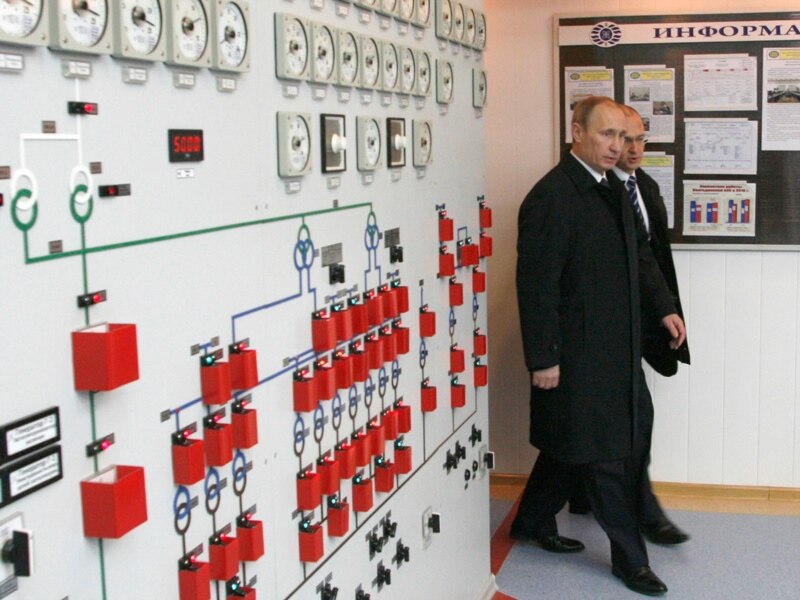
 Russian Prime Minister Vladimir Putin (left) and Rosatom Director-General Sergei Kiriyenko visit the Volgodonsk nuclear power plant in southern Russia in March 2010.
Unlike the Soviet-designed reactors at Chornobyl, the new versions include containment structures similar to those that have so far protected the reactors at Japan's Fukushima plant. The new Russian plans also provide for passive cooling systems that would continue functioning if power fails, as it did in Japan.
Nevertheless, Medvedev's claims are drawing criticism from environmentalists. Aleksandr Nikitin of the Norwegian environmental group Bellona says despite the new improvements, there's no such thing as a safe nuclear reactor.
"It's practically impossible to foresee all the circumstances that would make a reactor safe," Nikitin says. "Just like if you own a car, you know it will break down sooner or later. That's why when people say a nuclear plant is safe, that an accident can’t happen, they're lying -- to put it mildly."
Russia's Federal Atomic Energy Agency, Rosatom, is building or planning nuclear power plants in 14 countries, including India, Bulgaria, and Iran, where work is finishing on an atomic power plant under a deal signed in 1995. The station's long-delayed launch was postponed again last month, when a pump in the 1970s-era cooling system malfunctioned, raising new questions about the reactor's safety.
Iran's Bushehr plant also sits at the junction of three tectonic plates, an area hit by a 4.6-magnitude quake in 2002, the kind of event Nikitin says can lead to a new disaster,
"As we see now in Japan, it's impossible to even theoretically predict all possible developments," he says. "Accidents tend to produce chain reactions that can lead to uncontrollable situations."
'Absolutely Unrealistic'
Russia is also constructing nuclear reactors at home. Five years ago, Rosatom announced a highly ambitious project to build 40 new reactors by the year 2030 -- more than doubling the current number -- although the program has been drastically curtailed since then.
Nuclear expert Alexei Yablokov, head of the Green Russia faction of the liberal Yabloko Party, calls the program "absolutely unrealistic."
"We've had five such programs in the last 20 years," he says. "None of them has been completed."
"The fact that Russia is demonstratively signing deals to build nuclear reactors when the rest of the world is watching the catastrophe in Japan with great concern is a call for world public opinion [to stop the deals]," Yablokov says.
 A Russian worker walks past the Bushehr nuclear power plant in Iran in October 2010.
The choice of nuclear energy may seem odd for a country sitting on the world’s biggest reserves of natural gas. But Russia sees far larger profits from exports than from the gas it sells at subsidized domestic rates. The state gas monopoly Gazprom has even raised financing for new nuclear reactors.
Nikitin criticizes Russia's nuclear energy plans for being driven solely by officials' desire to make profits.
"We don’t need those plants," he says. "They make no common sense."
At the same time, experts say Rosatom is courting danger by extending existing nuclear power stations’ lifetimes long beyond their expiration dates. None of Russia's currently operating reactors has a containment shell that could minimize radiation leaks, including in the 11 Chornobyl-generation reactors Rosatom still operates.
As the world prepares to mark 25 years since the Chornobyl disaster, experts are finding little comfort in the government’s promises that things have changed.
It's "obvious," he said.
"It can be and is safe if the right decisions are made about the location of nuclear plants, their plans, and operators," Medvedev said. "If those conditions are met, atomic energy is absolutely safe and extremely useful for humanity."
Other countries may be debating the sense of atomic power, but Russia is pressing ahead with plans to build a series of new nuclear power stations at home and abroad. Moscow promises its atomic power designs are completely safe, but experts say that's just not true.
Medvedev spoke on March 16 after confirming plans to construct a Russian atomic power station in Turkey during a meeting with Turkish Prime Minister Recep Tayyip Erdogan. Moscow signed a $20 billion deal last year to build a four-reactor nuclear plant there.
But Turkey is earthquake-prone, like Japan, and the Russian plant is planned for a site only 25 kilometers from an active fault line. Still, Medvedev promised the Russian reactors would be safe even in the "most devastating earthquake." Erdogan, for his part, said the project would provide a "model for the whole world."
Criticism From Environmentalists
The announcements by Medvedev and Erdogan came the same week Russia signed another deal to build a new, $9 billion nuclear power plant in Belarus.
The deals are part of a Kremlin drive to revive Russia's nuclear energy industry after the collapse of communism dealt it a big blow in 1991. Moscow appears to be using the crisis in Japan's American-designed 1960s-era Fukushima plant to push its own reactors, which the Kremlin says have radically improved since the world's worst nuclear disaster at Chornobyl in 1986.
Nevertheless, Medvedev's claims are drawing criticism from environmentalists. Aleksandr Nikitin of the Norwegian environmental group Bellona says despite the new improvements, there's no such thing as a safe nuclear reactor.
"It's practically impossible to foresee all the circumstances that would make a reactor safe," Nikitin says. "Just like if you own a car, you know it will break down sooner or later. That's why when people say a nuclear plant is safe, that an accident can’t happen, they're lying -- to put it mildly."
Russia's Federal Atomic Energy Agency, Rosatom, is building or planning nuclear power plants in 14 countries, including India, Bulgaria, and Iran, where work is finishing on an atomic power plant under a deal signed in 1995. The station's long-delayed launch was postponed again last month, when a pump in the 1970s-era cooling system malfunctioned, raising new questions about the reactor's safety.
Iran's Bushehr plant also sits at the junction of three tectonic plates, an area hit by a 4.6-magnitude quake in 2002, the kind of event Nikitin says can lead to a new disaster,
"As we see now in Japan, it's impossible to even theoretically predict all possible developments," he says. "Accidents tend to produce chain reactions that can lead to uncontrollable situations."
'Absolutely Unrealistic'
Russia is also constructing nuclear reactors at home. Five years ago, Rosatom announced a highly ambitious project to build 40 new reactors by the year 2030 -- more than doubling the current number -- although the program has been drastically curtailed since then.
Nuclear expert Alexei Yablokov, head of the Green Russia faction of the liberal Yabloko Party, calls the program "absolutely unrealistic."
"We've had five such programs in the last 20 years," he says. "None of them has been completed."
"The fact that Russia is demonstratively signing deals to build nuclear reactors when the rest of the world is watching the catastrophe in Japan with great concern is a call for world public opinion [to stop the deals]," Yablokov says.

Nikitin criticizes Russia's nuclear energy plans for being driven solely by officials' desire to make profits.
"We don’t need those plants," he says. "They make no common sense."
At the same time, experts say Rosatom is courting danger by extending existing nuclear power stations’ lifetimes long beyond their expiration dates. None of Russia's currently operating reactors has a containment shell that could minimize radiation leaks, including in the 11 Chornobyl-generation reactors Rosatom still operates.
As the world prepares to mark 25 years since the Chornobyl disaster, experts are finding little comfort in the government’s promises that things have changed.