We are now closing the live blog for the day. We'll be back at 7:30 a.m. Central European time to cover the latest events across the Middle East.
US Wants ‘Unified’ Iranian Proposal For Ending War, No Firm Deadline For Now
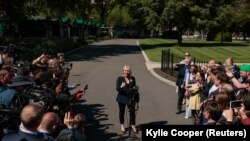
WASHINGTON -- US President Donald Trump wants to see a “unified” response from Tehran to US proposals for ending the US-Israeli war with Iran and has not set a “firm deadline” at this point, the White House said a day after he unilaterally extended a cease-fire that had been due to expire on April 22.
Trump is “offering a bit of flexibility” to the Iranian regime, White House press secretary Karoline Leavitt told reporters. She asserted there is “a lot of internal division” in Tehran.
“This is a battle between the pragmatists and the hard-liners in Iran right now, and the president wants a unified response, and so as we await that response, there's a cease-fire with the military and kinetic strikes” while economic pressure and a US naval blockade remain in place, Leavitt said.
Trump has made a “very strong proposal” for ending the war and “has not set a firm deadline to receive an Iranian proposal” in response, she said, without going into detail. Earlier on April 22, Leavitt told Fox News that Iran must agree to turn its enriched uranium over to the United States as part of negotiations to end the war.
The war began with US and Israeli air strikes on Ian on February 28. After face-to-face talks in Islamabad on April 11-12 ended without an agreement, a new round was expected this week but has not materialized, with Iran never confirming it would take part and US negotiators holding off so far on traveling to Pakistan.
Leavitt’s comments came after Iranian parliament speaker Mohammad Baqer Qalibaf repeated Tehran’s accusations that the US naval blockade on Iran, which Trump imposed on April 13 and has said will stay in place until there’s a deal, was a violation of the cease-fire.
In a post on X, Qalibaf said that “reopening the Strait of Hormuz is impossible with such a flagrant breach of the cease-fire."
Iran has effectively shut the narrow strait, normally the conduit for about one-fifth of global oil and liquefied natural gas supplies, since shortly after the war began.
Trump Says Iran To Spare 8 Women He Claims Faced Imminent Execution
US President Donald Trump said he has learned that eight Iranian women "who were going to be executed tonight" would not be killed after he appealed to Tehran to release them. Iran's judiciary denied it and asserted that none of the women faced the death penalty.
Neither claim could immediately be verified.
"Very good news! I have just been informed that the eight women protestors who were going to be executed tonight in Iran will no longer be killed. Four will be released immediately, and four will be sentenced to one month in prison," Trump wrote in a post on his Truth Social platform on April 22.
"I very much appreciate that Iran, and its leaders, respected my request, as President of the United States, and terminated the planned execution," he wrote.
In a post a day earlier, Trump called on Iran to release eight women whom a US-based activist claimed the Iranian regime was "preparing to hang" -- an assertion that could not be verified and was denied by the Iranian judiciary. He said releasing them "could be a very good start" for negotiations that had been expected this week in a bid to end the US-Israeli war with Iran.
Trump's April 21 post included an X post from earlier that day in which US-based pro-Israel activist Eyal Yakoby wrote that Iran "is preparing to hang eight women" and included photographs of eight girls and women; he said earlier that one of them was 16 years old.
Yakoby did not name them, but RFE/RL's Radio Farda determined that they are Bita Hemmati, Ghazal Ghalandari, Golnaz Naraghi, Panah Movahedi, Ensieh Nejati, Mahboubeh Shabani, Venus Hosseinnejad, and Diana Taherabadi.
Rights groups have said Hemmati has been sentenced to death in connection with large, widespread protests in January that were suppressed with a massive and deadly state crackdown.
The Iran-focused human rights group Hengaw said earlier this month that Shabani, who is 33 and was also detained during the protests, faces a charge of "waging war against God," which "can result in the death penalty."
A source who spoke on condition of anonymity due to the sensitivity of the subject told RFE/RL that Naraghi has been out of jail since February 18. RFE/RL could not immediately confirm the status of the others and whether any of them have been sentenced to death.
Iran's judiciary claimed that the post Trump cited was "completely false." In a statement carried by its official news agency, Mizan, the judiciary said that "a number of the women have been released, some face charges that would, if confirmed by a court, result at most in prison sentences, and none of them have a final verdict carrying the death penalty."
The judiciary's claim could not be independently verified, and rights groups have documented numerous executions and harsh sentences tied to protest-related cases in Iran.
Iran has executed at least eight people in connection to the January protests.
"Hundreds of protesters are currently facing death penalty charges, with at least 30 having already been sentenced to death," according to the Oslo-based organization Iran Human Rights.
PEN America Freedom To Write Award Goes To 2 Jailed Iranian Writers
PEN America announced on April 22 that this year’s PEN/Barbey Freedom to Write Award will go to two jailed Iranian writers, Golrokh Ebrahimi Iraee and Ali Asadollahi.
In its statement, the organization referred to what it called the worsening crisis of freedom of expression in Iran and highlighted the pressures facing writers.
“It is essential that we continue to shine a spotlight on writers like Golrokh Ebrahimi Iraee and Ali Asadollahi,” said Summer Lopez, executive director of PEN America. “Together, they represent both the increasing repression of dissent in Iran and the longstanding persecution of writers and civil society.”
Iraee and Asadollahi will be honored at a PEN America ceremony on May 14 at the American Museum of Natural History in New York City.
The annual Freedom to Write Award “recognizes writers who are in jail at the time the recipients are selected, and who have been targeted for their expression.”
PEN America says that most past recipients have since been released, often following international attention and pressure.
Bessent Says US Extended Russian Oil Sanctions Waiver Due To Requests From Several Countries
Treasury Secretary Scott Bessent says the United States renewed sanctions relief for Russian oil for a month due to requests from several countries that are particularly vulnerable to oil shortages.
Bessent had initially said last week that the waiver allowing certain shipments of Russian seaborne oil to be delivered and sold would not be extended. But the government later reversed itself and extended the waiver for 30 days.
On April 22, Bessent told a US Senate Appropriations subcommittee budget hearing that the change was made after he was "approached by more than 10 of the most vulnerable and poorest countries in terms of energy" during International Monetary Fund and World Bank meetings last week.
"They asked us to extend that [waiver], and it's only for 30 days," he said.
Iran has choked off most traffic through the Strait of Hormuz, the sole sea route out of the Persian Gulf and normally the conduit for about one-fifth of global oil and liquefied natural gas supplies, since shortly after its war with the US and Israel began on February 28. That has driven prices up and increased demand for oil and gas from other sources.
Ukrainian President Volodymyr Zelenskyy has criticized the waiver, saying it helps Russia fund its full-scale war on Ukraine, now in its fifth year.
A report from the International Energy Agency said Russia's revenues from exports of crude and refined oil products rose from $9.7 billion in February to $19 billion in March.
With reporting by AFP and Reuters
Iran's Qalibaf Accuses US Of 'Bullying' And Violating Cease-Fire With Blockade
Iran's lead negotiator criticized the US blockade of Iranian ports amid uncertainty over the prospects for further peace talks with the United States, reiterating Tehran's claim that the restrictions are a violation of a cease-fire the countries agreed to earlier in April.
"A complete ceasefire only makes sense if it is not violated by the maritime blockade and the hostage-taking of the world’s economy," Iranian parliament speaker Mohammad Baqer Qalibaf wrote in a post on X on April 22.
Qalibaf added that "reopening the Strait of Hormuz is impossible with such a flagrant breach of the ceasefire."
Iran's adversaries "did not achieve their goals through military aggression, nor will they through bullying," he wrote. "The only way forward is to recognize the rights of the Iranian nation."
Qalibaf, who led the Iranian delegation in talks with the United States in Islamabad earlier this month that did not produce an agreement, made no direct comment on the prospect for a second round or on US President Donald Trump's decision to extend a two-week cease-fire that was due to expire on April 22.
Iran's president, Masud Pezeshkian, echoed the statement, writing on X that "bad faith, siege, and threats are the main obstacles to genuine negotiation. The world is witnessing your hypocritical empty talk and the contradiction between your claims and your actions."
Iran has effectively shut the Strait of Hormuz, normally the conduit for about one-fifth of global oil and liquefied natural gas supplies, since shortly after the US-Israeli war with Iran began on February 28. The United States imposed a naval blockade on Iran on April 13, and Trump has said that would remain in place until a deal to end the war is reached.
US Warns Its Citizens To Leave Iran
Citing the partial reopening of Iranian airspace, the US State Department has urged American citizens to leave Iran immediately.
The US Virtual Embassy in Iran issued an update on April 21 advising American citizens to contact airlines and follow local media for more information about flights.
The statement noted that Americans can still travel by land to Armenia, Azerbaijan, Turkey, and Turkmenistan. The State Department urged US citizens to avoid traveling via Afghanistan, Iraq, and the Pakistan-Iran border region when leaving Iran.
The department said the Iranian government may prevent American citizens from leaving or charge an "exit fee" to leave Iran. The US State Department has urged dual US-Iranian citizens to leave Iran using their Iranian passports.
Iran Says War Has Cost More Than 700,000 Jobs
Alireza Mahjub, secretary-general of Iran’s Labor House, an influential officially recognized labor organization, has said that more than 700,000 jobs have been lost during Iran's war with the United States and Israel.
Speaking at a press conference in Tehran on April 22, he said 130,000 people were directly made unemployed as a result of the bombing of workplaces, while 600,000 other jobs were lost indirectly.
He also warned that the consequences of unemployment caused by the economic crisis after the war would be far greater than these figures.
During nearly six weeks of conflict before a cease-fire was declared on April 8, some of the country's largest steel and petrochemical production facilities suffered serious damage in air strikes, forcing their production lines to halt. Other commercial and industrial units were also damaged.
Mohammad-Hadi Asgari, a deputy labor minister, also said at the April 22 press conference that the Labor Ministry was identifying and following up on problems facing affected businesses.
He said the government would provide "support packages" to help rebuild damaged facilities, but gave no further details.
Lebanese Official Says Beirut To Seek One-Month Cease-Fire Extension
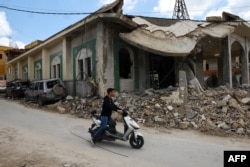
Lebanon and Israel are set to hold a second round of talks in Washington on April 23, with a Lebanese official saying Beirut will seek a one-month extension of a fragile US-mediated cease-fire between Hezbollah and Israel, which is due to expire on April 26.
The official told the AFP news agency that Lebanon would also seek an end to Israeli bombing and destruction in areas where Israeli troops remain and a renewed commitment to the truce.
The 10-day cease-fire has come under strain, with Hezbollah saying they fired rockets at northern Israel this week in response to Israeli violations, while Israel accused the group of breaches and said it killed two militants in south Lebanon.
On April 22, an Israeli strike killed two people in southern Lebanon in a strike on a car, Lebanon's state news agency reported. Hezbollah said it launched an attack drone at Israeli forces in the south.
Hezbollah is a Tehran-backed militant group and political party that controls much of southern Lebanon. It is considered a terrorist organization by the United States, while the European Union has blacklisted its armed wing.
Cross-border hostilities escalated on March 2 after Hezbollah opened fire in support of Iran during the regional war.
The Lebanese government says extending the cease-fire is a prerequisite for broader negotiations covering an Israeli troop withdrawal, the return of Lebanese detainees, and land border demarcation between the two countries.
US Secretary of State Marco Rubio is expected to attend the meeting.
Israeli Foreign Minister Gideon Saar has called the talks a "historic decision" after more than four decades without direct negotiations.
Lebanon and Israel have remained formally in a state of war since Lebanon joined the 1948-49 Arab-Israeli conflict following Israel's creation, though hostilities have flared only intermittently since.
With reporting by AFP and Reuters
Iran's Revolutionary Guards Say They Seized 2 Ships In Hormuz Strait
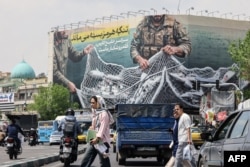
Iran's Islamic Revolutionary Guards Corps (IRGC) says it has seized "two offending vessels" during an alleged "secret attempt to leave" the Strait of Hormuz.
The naval arm of the IRGC said on April 22 that it had detained "two violating ships" that it claimed were attempting a "secret departure" from the Strait of Hormuz.
According to the IRGC statement, the vessels were the MSC Francesca, which it described as belonging to Israel, and the Epaminodes.
The IRGC said they were stopped on accusations that they intended to leave "without permission," while committing "repeated violations," tampering with navigational assistance systems, and endangering maritime security in an attempt to exit the strait "secretly."
The IRGC navy said the vessels had been transferred to Iran's territorial waters for inspection of their cargo and documentation.
The announcement came on a day when Iran's armed forces said they had attacked and disabled three cargo ships off the country's coast, according to state media.
The IRGC, which has closed the strait to ships and oil tankers since February 28, briefly reopened the waterway for one day after a cease-fire in the war with the United States and Israel started on April 8, but shut it again after negotiations between the sides collapsed and a naval blockade of Iranian ports began.