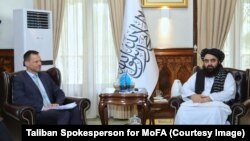


The European Union's special envoy for Afghanistan says girls’ access to secondary education has been on the agenda in recent talks he's had with members of the Taliban-led government, but they have not explained why girls have been excluded or indicated when schools might reopen for girls.
Tomas Niklasson, speaking in an interview on June 29 with RFE/RL's Radio Azadi, said he has participated in conversations with acting ministers as recently as May and many of the ministers agreed that the issue of girls’ education needed to be clarified, but there was no proposed action.
“Some of the acting ministers said they hoped, and then wished, and they thought that schools would open relatively soon, but no one gave a date and no one was more specific either about why they couldn't open and why they did not open in March, or what would be needed for them to open in the near future,” Niklasson said.
The international community, many Afghans, and the girls themselves were stunned a last-minute reversal by the Taliban meant they were turned away from schools. The radical group that seized control of the country in August gave no reason for the turnaround, which sparked national and international outcries.
The Taliban-led government has remained largely isolated internationally as a result of its hard-line Islamist policies toward women and girls. The government sparked further outrage last month when it issued a decree telling women to wear the head-to-toe burqa in public.
Niklasson said the reason the EU continues to engage with the Taliban is that Western governments learned when the Taliban ruled Afghanistan in the 1990s that isolating it “may not have been conducive to our wish to stay engaged with and support the Afghan people.”
He said the issue of girls’ access to education remains a matter of human rights and living up to the standards of other Muslim-majority countries.
“We could, of course, decide that until [girls are allowed to attend secondary school] we will not engage with the Taliban,” he said. “But I find it difficult to see what would be achieved by that. I think there are elements within the Taliban movement, perhaps within the leadership, that would like to see schools open.”
He declined to name the ministers who have been more open to loosening restrictions on girls’ education but said some of the acting ministers “who have perhaps a lesser religious background” are more willing to see that happen.
Niklasson also said the EU has assessed that very little progress has been made on five benchmarks that the EU set for deeper engagement with the Taliban, and this is the reason the EU does not engage in any way beyond dialogue and humanitarian assistance.
The EU has said the five benchmarks -- including respect for human rights, guarantees for media freedom, and ensuring that Afghanistan does not again become breeding ground for terrorism -- must be met before it will resume regular development aid.
The EU has had a humanitarian assistance presence in Kabul since September and Niklasson said through that “massive” assistance has been provided through international partners, including after the recent earthquake.
EU Envoy For Afghanistan Says Taliban Has Still Not Explained Decision On Girls' Education