




Armenia is courting Central Asia as it intensifies efforts to break ground on an ambitious trade corridor named after US President Donald Trump -- the Trump Route for International Peace and Prosperity, or TRIPP.
Part of a peace deal between Yerevan and Baku, the planned corridor would run across Armenian territory, linking Azerbaijan to its Nakhchivan exclave while opening a new east-west trade artery bypassing Russia and Iran.
The proposed plan has the backing of Washington, but has riled Moscow and Tehran, two countries under heavy Western sanctions.
Armenian Prime Minister Nikol Pashinian has in recent weeks pushed for the involvement of Kazakhstan and Kyrgyzstan. But both countries, observers say, are wary of angering Russia, a key political and economic player in Central Asia.
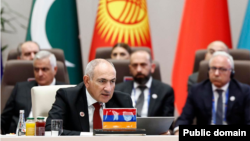
Pashinian discussed TRIPP with the leaders of Azerbaijan and India as well representatives from the United States during the Shanghai Cooperation Organization (SCO) summit in Bishkek on September 1.

On August 27, Pashinian confirmed to RFE/RL’s Armenian Service that he had discussed Kazakhstan’s possible participation in TRIPP during a recent phone call with Kazkah President Qasym-Zhomart Tokaev.
“We discussed this issue in relation to Kazakhstan and the TRIPP project. Various countries are now showing interest,” Pashinian said, without elaborating.
Kyrgyz official Daniyar Amangeldiev told RFE/RL’s Kyrgyz Service that the government had yet to receive an official proposal.
Public Rollout
While the participation of potential regional partners remains uncertain, Armenia and the United States are moving ahead with plans to publicly launch the project.
On September 1, they launched the official TRIPP Armenia Facebook page, jointly managed by the Armenian Foreign Ministry and US Embassy in Yerevan.
On the same day, US and Armenian officials met in Armenia’s province of Syunik, where the 43-kilometer-long corridor is planned, to discuss the project and its potential economic benefits.

The United States owns 74 percent of the project, with Armenia retaining the rest. Washington has committed an initial $145 million. Pashinian has called TRIPP a “multibillion-dollar project.”
TRIPP was approved by the Armenian government in July. The Constitutional Court is expected to rule on it on September 15 before it goes to parliament for a final vote. Washington has pledged to help secure additional financing from public and private investors, although no new investors or funds have been announced.
For landlocked Armenia, the project is seen as a way to end its economic isolation and become a regional transport hub.

Unveiled as part of the US-mediated peace process following Armenia's war with Azerbaijan over its breakaway region of Nagorno-Karabakh, TRIPP envisages rail and road infrastructure, possible oil and gas pipelines, and fiber-optic and electricity ventures.
Since Azerbaijan regained control over Karabakh in a lightening offensive in September 2023, Armenia has shifted its geopolitical orientation, distancing itself from longtime ally Moscow and aligning more closely with the West.
Bishkek, Astana 'Curiously Muted'
Kazakhstan has publicly expressed interest in participating in TRIPP.
TRIPP would complement the Middle Corridor, an emerging 6,500-kilometer-long trade route, bypassing Russia, that connects China to Europe through Central Asia and the Caucasus. TRIPP would provide onward connectivity from Azerbaijan through Armenia and Nakhchivan to Turkey and Europe.
Kyrgyz officials have also presented TRIPP as a potential extension of the country’s transport links to Europe.
“Our railway would reach Baku, which would also open a direct route for us to Turkey... It is a new opportunity,” Kyrgyzstan’s ambassador to the United States, Edil Baisalov, told RFE/RL’s Kyrgyz Service.
Still, neither Bishkek nor Astana has publicly committed to participating in TRIPP.
Kyrgyz political analyst Emilbek Dzhuraev said both countries have been “curiously muted.”

“While both of them have had positive exchanges with the US, their SCO partners -- Iran in particular, but also Russia -- do not welcome TRIPP, and therefore, probably, they are hesitant at jumping on this opportunity,” Dzhuraev said.
Russia, he added, may be the biggest factor behind their caution, given Moscow’s increasingly tense relations with Pashinian’s government.
“Russia has a still greater stake in this -- given its collapsing hold on Armenia -- and hence, Kazakhstan and Kyrgyzstan would not be cheered on by Russia to join TRIPP,” he said.