



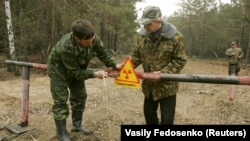

For many Belarusians living in territory contaminated by Chernobyl, the effects of the 1986 nuclear accident will end on January 1, 2027 -- on paper at least.
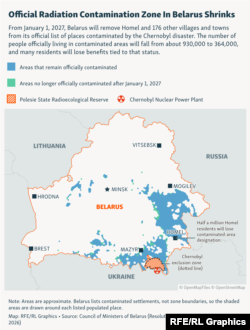
A recent announcement says that 177 cities, towns, and villages will lose their contaminated-area designation at the beginning of 2027, affecting some 566,400 people. A total of 930,600 Belarusians currently live on territory that was contaminated by wind-blown fallout from the nuclear accident in the neighboring Soviet republic of Ukraine.
Belarus claimed in August that studies carried out between 2021-2025 showed a “significant improvement in conditions within certain settlements located in radionuclide-contaminated areas." The decision to change the status of the land comes after Belarus's authoritarian leader, Aleksandr Lukashenko, took aim at the designation in an April 2025 meeting. “What have we been doing for 30 years if we have 900,000 people living in contaminated areas?” he said, adding, "the statistics need to be updated.”
Belarusians living on contaminated territory today are eligible for significant state benefits, including free meals for students, annual health resort trips for children, and payouts totalling 150 percent of the standard state childcare allowance for some new parents.
In the eastern Homel region alone, around 88,000 children living or studying on contaminated land receive state-funded meals each year. Eligible students will reportedly continue to receive free meals up until June 2027.
Syarhey Besarab, a Belarusian expert in radiation safety who now lives outside the country, slammed the decision to reclassify the land, which he said will take around another 260 years to return to pre-1986 radiation levels.
Besarab points to a complex aftereffect of the Chernobyl disaster in which plutonium-241 that settled on the landscape is transforming into the severely radiotoxic americium-241 as it decays, a process he said will peak in the late 2050s. “Deregulating these lands immediately prior to a secondary surge in extreme alpha radioactivity constitutes a catastrophic failure of prospective safety analysis,” he told RFE/RL. Additionally, he said, some areas within the contaminated land have localized hot spots that “obsolete Soviet macro-evaluation techniques” used by Belarus do not factor in.
But not all experts agree on the level of remaining radiation risks.
Jim Smith has been studying the fallout from Chernobyl for the past 35 years and was the lead author of a book on the nuclear disaster. The British environmental scientist said in most areas of Belarus and Ukraine today, the risk from radiation is largely limited to foragers and fishermen. “The main pathway for people to ingest radioactivity is from wild foodstuffs -- going out into the forest and eating mushrooms -- if they're eating the berries, if they're catching the fish,” he told RFE/RL.
Local authorities in Belarus offer free radiation testing of wild food, and people are warned not to buy mushrooms and berries from roadside stalls.
In most urban areas, Smith said, Chernobyl’s radioactive fallout has largely dissipated through a combination of rain and wind, and the short half lives of many of the isotopes released by the disaster. The radiation expert points to cesium-134, which he said, “more or less disappeared in the first 10 years after the accident” due to its two-year half-life. Much of the remaining radioactive material in Belarus today is the longer-lived cesium-137.
Outside the highly radioactive exclusion zone on Belarus's border with Ukraine, where people are forbidden to live, Smith said he does not see a significant radiation risk in most contaminated territories.
In Ukraine, tens of millions of dollars are spent each year on benefits for those affected by the Chernobyl disaster, but Smith predicts Kyiv is unlikely to follow Minsk in reclassifying contaminated land any time soon.
“The [Belarusian] government has been much more sort of dictatorial, as you might imagine, saying ‘well, this is what we're going to do regardless.’” In contrast, he said, Ukrainians living in Chernobyl-affected areas “have voted for politicians who don't want to change the status quo.”
That perception is shared by Andrey, a Belarusian who was born in the southeast of the country and suffers from a chronic illness he believes is linked to Chernobyl. "The Belarusian authorities don't care about what the people think," the 47-year-old, whose surname has been withheld for security reasons, told RFE/RL’s Belarus Service.
"There are no elections, the regime never changes, so they don’t worry about how voters perceive them,” he said, adding, “these benefits were often purely symbolic for people -- you can’t buy a car with them, you can’t build a house. But, still, it was some kind of help.”
Smith said the issue of benefits provided to people affected by Chernobyl has proved complex and, in some cases, counterproductive.
“It was quite easy to be classified as a victim of Chernobyl, even when the health effect evidence is very difficult,” the environmental scientist said. “Unless you were a firefighter in the plant on the night [of the disaster], for the vast majority of the millions of people that were affected, there's a very low probability that they had a health effect from that, but nevertheless, they were classified as victims of Chernobyl.”
A 2002 report by the United Nations Development Program on the aftermath of the disaster highlighted a benefits system that encouraged “potentially harmful or wasteful behaviour.” The report cites people returning to live on contaminated land “in order to be able to claim a higher level of benefits” and others declining to open businesses “for fear of losing Chernobyl entitlements.”
But locals in Belarus say there is little chance of any widespread opposition to the upcoming legal change that will have a major impact on many in the authoritarian country.
"In Belarus today, it’s dangerous to express outrage about anything," Viktar, who was born in a settlement now in the exclusion zone, told RFE/RL's Belarus Service. The 43-year old, who now lives in the Hrodna region, added that "people just keep their heads down and live their lives."

