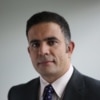


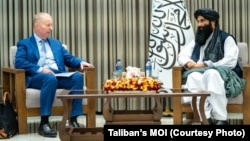
In October, Danish diplomat Thomas Frellesen took up a new role as the European Union’s new special envoy for Afghanistan. Mustafa Sarwar, a senior news editor at RFE/RL’s Radio Azadi, spoke with him about the limits of engagement with the Taliban, the return of Afghan migrants from the EU, and the terrorist threat still emanating from Afghanistan.
RFE/RL: A Taliban delegation was in Brussels in June to talk about Afghan deportations. How can you negotiate with the Taliban while the restrictions on Afghan women keep getting worse inside Afghanistan?
Thomas Frellesen: When it comes to the situation of women in Afghanistan, I think the EU has a very good track record at the multilateral level. You probably know that the EU is the penholder of the human rights resolutions on Afghanistan that are drafted and also of the one that was agreed last year that established the independent investigative mechanism. And at the bilateral level, the situation of women and girls in Afghanistan is a top priority for us. It's also the first issue I mentioned when I was in Kabul recently and engaged with the de facto authorities.

And more broadly, the EU has kept in place since 2021 our delegation and we have maintained a high level of assistance for the benefit of the Afghan people. More than 2 billion people and more than 2 billion euros ($2.2 billion) in assistance over the last five years. And all following the principle: by women, for women.
RFE/RL: But the fact is that the EU hosted the Taliban in June, and there was also criticism from various groups, for example Afghan activists. How can the EU use migration cooperation without giving the Taliban a blank check?
Frellesen: So our overall framework for engagement in Afghanistan allows for technical operational engagement. And this is also how you should see the meeting that was held in June. So our colleagues in the [European] Commission were asked by some of our member states to facilitate this discussion with the de facto [Afghan] authorities. And that's why the meeting was organized in Brussels. And it was really more a question of ensuring a coherent European approach to [Afghan migrant] returns and to address the practical aspects of the readmission process. As you know, the returns that we talking about concern migrants that have been convicted of criminal capital offenses. And this poses a serious issue for a number of our member states. But, of course, every return decision has to be in line with EU and international law.

And, as I said, it really concerns people who pose a security threat or serious criminals. But the individual decision is carried out by EU member states. This is a member-state competence, and the meeting held in June was a way to facilitate the contact at the technical level with the Taliban authorities. And I have to emphasize, this doesn't change anything for the time being. There's no normalization of relations between the EU and Afghanistan, and it doesn't reflect any kind of recognition or legitimization of the de facto authorities. That's very important to emphasize.
Sending Migrants Back To Afghanistan
RFE/RL: But you know that since Germany is letting Taliban officials run diplomatic offices and France is reportedly trying to do the same, isn't the EU slowly giving the Taliban de facto recognition?
Frellesen: No, not for us. There's no link between recognition and having this kind of technical cooperation on readmission [of migrants to Afghanistan]. There's no absolutely no move towards normalization or recognition. And there's no link between them. These issues are not being raised in these readmission discussions.
RFE/RL: And staying on the issue of migrant returns for a moment, experts from the UN have warned that sending Afghans back actually puts them in real danger. What's your response?
Frellesen: We are, of course, aware of the opinions of the UN human rights experts.... And, as I said earlier, EU member states are bound by international law, and the returns have to be in full compliance with fundamental rights, including the principle of non-refoulement. (The principle prohibits states from returning a person to a country or territory where they would face a real risk of harm.) So we don't see any issue there.
RFE/RL: In terms of potential numbers, do we know how many Afghans are expected to be deported from the EU? Hundreds or thousands?
Frellesen: No, I can't give you any figure. So far, from what I'm aware, the the numbers are very limited. But I wouldn't be in a position to give you specific numbers here. But we are talking about very, very limited numbers.
RFE/RL: As you know, the United Nations Office on Drugs and Crime (UNODC) says that opium production in Taliban-ruled Afghanistan has jumped five times this year. How worried are you and how are you going to help Afghan farmers find other ways alternative ways to make a living?
Frellesen: So yes, we saw the UNODC report and we are, of course, very concerned. The positive thing that has happened over the past few years is that the [growing] poppies ban at least initially stopped a lot of the drug production. But this is now being at least partially reversed and we are definitely very concerned about it. Not only us, of course. But especially the neighboring countries. So we are engaged quite closely with our partners in the region on this. And indeed it illustrates that the ban in itself is not really enough. The problem is, of course, that you have a lot of farmers who need to have alternatives to provide a living for their families. And we, as the EU, have been quite heavily engaged already in livelihood programs [for Afghans]....
It also [requires] the de facto authorities to get organized and to make sure that sufficient resources are provided to people in the regions who have to find an alternative living. So this is really something that the de facto authorities -- now that they are in charge of the country -- have to demonstrate that they are also able to govern and to ensure the wellbeing of the population.
Islamic State
RFE/RL: And finally let's talk about security threats, which is a major topic of concern for the EU. How is the EU tracking and handling potential threats coming out of Taliban-ruled Afghanistan, given that the Islamic State-Khorasan Province (ISKP) militant group is reportedly still active?
Frellesen: This is a key concern for the EU. It's among our top three priorities -- the counterterrorism to make sure that Afghanistan does not harbor terrorist groups. This was also a commitment taken by the Taliban. So we are, of course, very worried. We also have a delegation on the spot that's following this very closely. And we rely a lot on UN reporting. They have the expertise also. And we also saw the latest report by the UN sanctions-monitoring team published last August. And, of course, one has to acknowledge that the Taliban has done quite a lot also to fight ISKP, because it's an enemy of the Taliban.
ISKP still seems, according to the information that we get, to be able to be active. And this is an enormous concern for us. It's a concern for our partners in the region too. So we do exchange [information] regularly with our partners in Central Asia and and elsewhere on this. But it's not only ISKP.... We've seen the statements issued by China and others that there are numerous terrorist groups active in Afghanistan. And this is really a key concern.
Much of it is fueled by the desperate needs of people who can easily be recruited if their livelihood is not as it should be. And we are evidently also very concerned about the tensions between Afghanistan and Pakistan and the instability in the border regions, which can create pockets where terrorist groups can operate more freely. So this is also something where we are supporting the countries that have offered to mediate and to find a good way forward for the two countries.