



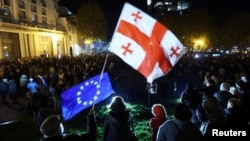
Tens of thousands of people marched through central Tbilisi on November 28, demanding the resumption of Georgia’s EU accession process, fresh parliamentary elections, and the release of jailed protesters.
The rally came as the Constitutional Court prepares to resume hearings on November 30 in a case seeking to ban five opposition parties, and marked the second anniversary of the announcement by Prime Minister Irakli Kobakhidze that Georgia would suspend efforts to open EU accession negotiations until 2028.
The demonstration was called by pro-European activists and opposition groups, including parties facing the court challenge.
Three marches converged on the capital's Freedom Square, where opposition politicians and activists addressed the crowd.


Demonstrators carried Georgian and EU flags and chanted slogans including “Georgia without Ivanishvili” and “Georgia is Europe.”
Bidzina Ivanishvili, the billionaire founder and honorary chairman of the ruling Georgian Dream party, is widely regarded as the country's de facto leader, despite holding no government office.
Critics accuse him and his party of steering the country away from the EU and toward Russia.
Georgian Dream rejects such accusations, insisting that its policies are aimed at protecting Georgia’s sovereignty against foreign interference and what it describes as opposition attempts to destabilize the country.
Nika Gvaramia, one of the leaders of the opposition Coalition for Change, urged Georgians to turn out in even greater numbers, saying this was the key to bringing about political change:
“We have only one test left -- the test of numbers," he said. "The next demonstration must bring together even more people. Change is here, in the air, and once our numbers grow, change will happen. That is inevitable.”
Some protesters who spoke to RFE/RL’s Georgian Service said the turnout strengthened their belief that Georgia could still secure a democratic European future.
“I came out because I think it’s still worth fighting," said Salome Adamashili. "When you come out and see so many people beside you and realize that we all think alike and we all want the same thing, there’s no way we won’t prevail in the end, and there’s no way we won’t survive.”
2 Years Of Protests
The announcement that triggered the current protest movement came on November 28, 2024, less than a year after Georgia had been granted EU candidate status in December 2023.
Kobakhidze’s decision to put efforts to open accession talks on hold sparked nationwide demonstrations and a police crackdown.
The unrest came amid a dispute over the October 2024 parliamentary elections, in which the ruling Georgian Dream party retained power.
Opposition parties rejected the result and accused the authorities of electoral fraud.
Daily protests have continued in Tbilisi since November 2024, despite arrests, heavy fines, and increasingly restrictive legislation governing public demonstrations..
According to ACLED, an organization that tracks political violence and demonstrations worldwide, 1,371 demonstrations were recorded across Georgia between November 2024 and November 2026, up from 552 in the previous two years.
The authorities have also faced criticism over their treatment of protesters, opposition politicians, and independent media.
Amnesty International said on November 27 that more than 150 people had been imprisoned following protest-related trials over the past two years, which it described as unfair and politically motivated.
The prospect of a ban on opposition parties has added to protesters’ concerns.

Giga Bokeria, a leader of the opposition Federalists party, told RFE/RL that the threat would not change the movement’s approach.
“Whether or not [the ruling party] bans [the opposition] today to cover up its own internal crisis and show its strength, our task remains the same -- to continue this protest, to expand it, to build a network of resistance made up of like-minded people and all the political forces united by the prospect of a free Georgia, a network capable of organizing a peaceful protest that can turn the tide,” he said.
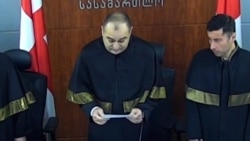
The Constitutional Court is considering a lawsuit filed by 88 Georgian Dream lawmakers seeking to ban five opposition parties -- the United National Movement, Coalition for Change, Strong Georgia-Lelo, the Federalists, and For Georgia.

The lawmakers accuse the parties of attempting to overthrow the constitutional order and undermine Georgia’s independence and territorial integrity.
The opposition rejects the accusations.
The court, which began examining the case on October 21, has until June 2027 to issue a ruling.
Stalled EU Bid
Speaking on Imedi TV ahead of Saturday’s rally, Kobakhidze said his government remained committed to EU membership and was "ready to begin accession talks today" if the EU agreed to open them.
He accused European officials of using the accession process to "blackmail" Georgia, arguing that the 2024 decision to put efforts to open talks on hold had been intended to end that pressure.
He said the government would do everything to make Georgia a full member of the bloc, while also calling on Brussels to change its approach toward the country.
EU officials, however, have repeatedly cited democratic backsliding in Georgia as the reason its accession process has stalled.
Brussels had already declared Georgia's accession process effectively halted in 2024, before Kobakhidze's November announcement.

In its latest enlargement assessment, published earlier this month, the European Commission said the Georgian authorities had failed to address the reforms identified when the country was granted candidate status and that democratic standards had deteriorated further.
The commission said Georgia remained an EU candidate “in name only” but that its accession process could resume if the authorities recommitted to democratic principles, the rule of law, and fundamental rights.
Georgia’s commitment to EU membership is enshrined in its constitution, and opinion polls have consistently shown strong public support for joining the bloc.
Former President Salome Zurabishvili attended the rally on November 28 and called on Georgia’s international partners to support the protesters.
“To Europe and our allies: Georgians are fighting for shared values -- stand firmly beside them,” she said in a social media post.

There was no immediate public response from senior EU officials to the Tbilisi demonstration or Kobakhidze’s latest remarks.
Several members of the European Parliament, however, voiced support for the protesters in posts on X.
Lithuanian MEP Rasa Juknevičienė praised Georgians for their “extraordinary love for Sakartvelo” (Georgia) and said their fight for a European future inspired others.
Austrian MEP Reinhold Lopatka voiced support for "the Georgian people, political prisoners and their families," adding: “Georgia, Europe is your home!”
Polish MEP Krzysztof Brejza said he stood with Georgians fighting for “freedom, democracy and Europe” and called for justice for political prisoners.
The European Parliament adopted a resolution on November 26 calling for the release of people it considers political prisoners and urging targeted sanctions against senior Georgian officials.