


The debate over Iran's potential agreement with the United States has spilled beyond the country's political class and into the religious establishments and street gatherings that have long served as the Islamic republic's most loyal base of support.
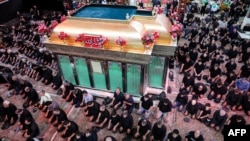
Since the outbreak of war and the death of Supreme Leader Ayatollah Ali Khamenei in US-Israeli strikes, state-aligned clerics and eulogists have played an outsized role in rallying public support for the Islamic republic and armed forces through nightly gatherings in Tehran's squares and religious pulpits across the country.
But as a preliminary memorandum of understanding with Washington has taken shape, that same base has begun to show fissures and the significance of these divisions runs deeper than a dispute over a single agreement.
For years, the religious pulpit and the street gathering were among the most reliable instruments of political mobilization available to the Islamic republic.
Now, amid a landmark diplomatic process, those same instruments are amplifying the state’s internal contradictions -- at a moment when its new supreme leader has yet to appear in public or be heard on camera at all.
Known in Persian as "maddahan," eulogists lead mourning ceremonies and have long served as key political mobilizers for the Islamic republic.
The fault line sharpened after Mojtaba Khamenei, who succeeded his father as the Islamic republic's new supreme leader, issued a statement saying he had "in principle held a different view" on the deal, but had given his permission after President Masud Pezeshkian took personal responsibility for the outcome.
Hard-liners seized on the formulation as a signal that the leadership itself was at best reluctant and used it to justify increasingly public opposition.
Direct Threat To Pezeshkian
Some eulogists have gone further than criticism. In footage that circulated widely online, a "maddah" named Mohammad Ali Bakhshi issued a direct threat to Pezeshkian, warning that if the conditions set by the supreme leader were not met, "we know what to do with a blade and your throat."
The threat drew a sharp public rebuke from a senior presidential spokesman, who called the threat “an affront to the vote of millions of Iranians.”
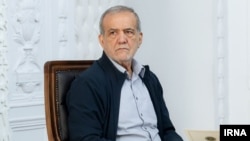
Reza Narimani, another eulogist close to the establishment, used a recent sermon to attack Pezeshkian over remarks in which the president said the government had provided 20 million barrels of oil to the aerospace division of the Islamic Revolutionary Guards Corps (IRGC) to enable it to fight. Narimani called this framing an insult to the armed forces.
"Is the government going to pass a collection bag around in mourning ceremonies asking people to donate to the army?" he asked. He also claimed the supreme leader had explicitly said he opposed negotiations and a deal, arguing that it was "clear" that no engagement should have taken place.
'Exactly What The Counterrevolution Wants'
Not all preachers have taken that line.
Meysam Motiee, one of the most prominent state-aligned eulogists, turned his fire not on the negotiating team but on those attacking military commanders for agreeing to the interim deal with Washington.
"How can anyone allow themselves to sit under an air conditioner, legs crossed, and address the commanders of the Guards, the army and the security forces with the worst language?" he said. "This is exactly what the counterrevolution wants."
His position drew immediate criticism from hard-line media outlet Raja News, which accused him of targeting protesters in the street rather than holding officials to account.
Behind the scenes, pressure is reportedly being applied from above.
A eulogist named Mohammad Taheri claimed at a recent nightly gathering in Tehran that Khamenei had personally instructed religious figures to tell crowds to avoid saying anything that could weaken the government or the negotiating team -- a claim that, while unverified, carried political weight.