




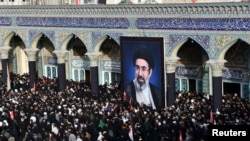
Iranian Supreme Leader Mojtaba Khamenei's decision to formalize six senior military and security postings within 48 hours is less a personnel story than the closing chapter of a five-month improvisation.
Read together, the appointments announced on August 10 show a new supreme leader moving to convert an emergency wartime chain of command, cobbled together after Israeli and US strikes killed much of Iran's senior military leadership, into a permanent structure built around his own circle of trust.
Rebuilding From The Top Down, Twice
The scale of the vacancy Khamenei, who has not been seen in half a year, was filling is easy to lose in a list of names.
Mohammad Baqeri, chief of the Armed Forces General Staff, was killed in the opening days of the 12-day war in June 2025. His successor, Abdolrahim Musavi, lasted barely a summer before he too was killed -- in the February 28 strike that also killed Supreme Leader Ayatollah Ali Khamenei himself. For roughly five months after that, Iran's Armed Forces General Staff had no chief at all; coordination defaulted to the Khatam al-Anbiya Central Headquarters, then run by Ali Abdollahi.
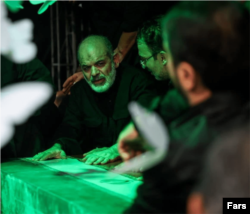
The Islamic Revolutionary Guards Corps (IRGC) command line suffered an identical pattern: IRGC chief Hossein Salami killed in the 12-day war, his successor Mohammad Pakpur killed alongside Musavi in the 40-day war earlier this year, and Ahmad Vahidi running the IRGC in an acting capacity ever since, until Khamenei’s August 10 decree finally made it official and promoted him to major general.
That two parallel chains of command were both operating on acting, undeclared leadership for months is itself a story about how thin Iran's senior officer corps was cut by Israeli and US targeting. The new decrees don't just install new men, they close out a period in which Iran's military hierarchy existed more as a wartime improvisation than as a chain of command with the supreme leader's formal seal on it.
Integration, Not Just Replacement
The more interesting signal is in the language of the decree appointing Abdollahi, which calls for "completing the integration" of the Armed Forces General Staff with the Khatam al-Anbiya Central Headquarters -- a merger that the new supreme leader attributes to a strategy his father initiated.
Pairing this with the fact that no new Khatam al-Anbiya commander was named alongside Abdollahi's promotion suggests the post itself may be getting absorbed rather than filled -- a structural consolidation, not just a staffing decision.
If Khatam al-Anbiya effectively folds into the General Staff, it marks a real centralization of Iran's wartime coordination apparatus under a single command rather than the semi-parallel structure that existed under the slain Ali Khamenei.
Taeb's Return
Perhaps one of the most overlooked appointments in the media is the one carrying the most domestic-facing weight: Hossein Taeb as Basij paramilitary force commander.
Taeb is not a wartime replacement in the way Abdollahi or Vahidi are; he's a return. He built his career at the Ministry of Intelligence before being pushed out, then constructed a parallel intelligence apparatus inside the Revolutionary Guards -- the notorious IRGC Intelligence Organization -- that he ran until his own ouster in mid-2022.
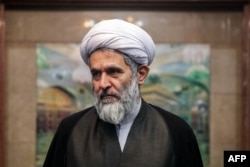
The language of the degree announcing Taeb's appointment reinforces the domestic angle: it calls for strengthening a "popular intelligence network" and realizing the slogan "every Iranian, a Basij member," explicitly invoking the pro-Islamic republic street mobilizations that have run since the start of the 40-day war as a base to build on "in defense of the Islamic Revolution."
Where the other five appointments answer a military attrition problem, this one answers a different question: who does the new supreme leader trust to watch the population and manage internal threats as the state's legitimacy is tested by dynastic succession and wartime hardship.
Paris-based analyst Reza Alijani, speaking to RFE/RL’s Radio Farda, argued that the appointments -- including Mohsen Rezaei being named as Iran’s new security chief -- are primarily about Khamenei "activating and displaying" his own authority rather than a real shift in direction. Most of the men being elevated, he noted, already served within the Islamic republic's executive apparatus, suggesting that the same military logic in foreign policy and security logic at home are simply reproducing themselves.
He singled out the Taeb and Rezaei moves as, in essence, rehabilitating "politically and security-wise bankrupt figures," but cautioned that on the domestic-security front specifically, little actually changes: the same apparatus, without Taeb at the helm, already killed thousands of people during widespread protests in January.
Still, Alijani's broader read is that, factional optics aside, the reshuffle "doesn't carry much significant political meaning" for either domestic or foreign policy. He predicts that, ultimately, the "expediency of the system" will narrowly "prevail over its ideology", at a cost paid from the pockets and lives of ordinary Iranians.