




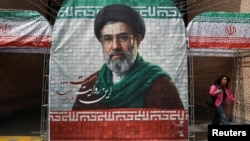
Iran held an extravagant, weeklong funeral procession to mourn Supreme Leader Ayatollah Ali Khamenei, who was killed at the start of the war with the United States and Israel.
The state-organized public events drew hundreds of thousands of people across the Islamic republic. But one man was conspicuous by his absence: Mojtaba Khamenei.
The son and successor of Iran’s longtime leader, he was out of sight throughout the mourning ceremonies and rallies that ended on July 9. Mojtaba Khamenei was reportedly wounded in the same Israeli air strike that killed his father and has not been seen in public since his succession in March.
The no-show, experts say, has inflicted a further blow to Mojtaba Khamenei's legitimacy and intensified questions about who runs the Middle Eastern country of some 90 million people. According to the authorities, he did not attend his father's funeral because of security concerns.
“His absence is politically significant because it underlines the central dilemma of the succession. Mojtaba can inherit the office, but not his father's authority,” said Alex Vatanka, director of the Iran Program at the Washington-based Middle East Institute.

Mojtaba Khamenei was a controversial pick as supreme leader. While his selection represented continuity during wartime, it also angered government supporters who said hereditary succession betrayed the anti-monarchist roots of the 1979 Islamic Revolution.
“Keeping him out of sight may avoid those accusations, but it also leaves the transfer of legitimacy visibly unfinished,” added Vatanka, author of The Battle Of The Ayatollahs In Iran. “The regime can choreograph continuity, but it cannot manufacture personal authority overnight.”
To many Iranians, Mojtaba Khamenei remains a mystery. While the 56-year-old has made written statements, no image, video, or voice recording of him has been issued.
Farzan Sabet, an Iran expert at the Geneva Graduate Institute, said legitimacy in the Islamic republic -- like other authoritarian regimes -- matters as far as the base of the system is concerned.
“For most Iranians, Mojtaba will likely have even less legitimacy than his father, and appear weaker, but he can establish his authority among the regime's core followers, especially if he becomes more visible after his injuries have healed or the security situation permits," Sabet said. "So, this is ultimately a surmountable obstacle.”
Changing Power Dynamics
For decades, power in Iran was centralized in the hands of Ali Khamenei, who had the final say on all important state matters and ruled the country with an iron first from 1989 until his assassination on February 28.
But since his killing and the succession of Mojtaba Khamenei, decision-making in Tehran has changed.
“Iran has not replaced the supreme leader with a collective leadership, but Ali Khamenei spent decades building institutions capable of governing alongside the leader,” said Vatanka.
The Office Of The Supreme Leader, the Islamic Revolutionary Guards Corps (IRGC), and the Supreme National Security Council, the country’s key policymaking body, “now share the day-to-day burden of decision-making, while the supreme leader increasingly arbitrates rather than personally directs every major issue,” Vatanka added.
Despite his absence from public life, Mojtaba Khamenei still plays a prominent role in war strategy and managing peace talks with the United States, according to US intelligence.
The IRGC, the elite branch of Iran's armed forces, has always played a key role in politics. But it is now the dominant political force in the Islamic republic, experts say.
The Supreme National Security Council, under the leadership of Mohammad Baqer Zolqadr, a former IRGC commander, remains influential.
Senior civilian figures such as President Masud Pezeshkian, Foreign Minister Abbas Araqchi, and Mohammad Bagher Qalibaf, the parliament speaker and chief negotiator with the United States, also play a role, experts say.
“The IRGC was the single most powerful actor in the state when Ali Khamenei was alive, and it remains the most powerful actor today, even less restrained within and by the system in his absence,” said Sabet.
“Nonetheless, there appears to still be efforts to build consensus among key stakeholders in the system, within which the IRGC plays an outsized role,” he added.
The result, experts say, is that decisions are increasingly reached through institutional agreement rather than the personal authority of one man.
“That makes policymaking slower and more cautious, but also more resilient because responsibility is distributed across the system rather than resting solely with the supreme leader,” said Vatanka.

