




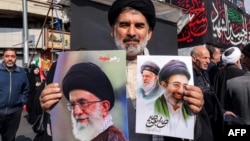
US President Donald Trump said the military operation launched against Iran last month will end "very soon" and vowed to hit the country "much, much harder" if it blocks oil supplies in the Middle East.
Trump spoke on March 9 after Tehran launched multiple missiles and drones at Israel and Gulf Arab states following the announcement that Mojtaba Khamenei would succeed his late father, Ayatollah Ali Khamenei, as supreme leader.
"We're winning very decisively. We're way ahead of schedule," Trump told a news conference in Florida.
"It's going to be ended soon." Asked whether it would end this week, he suggested it would not but said: "Soon, very soon."
"I will not allow a terrorist regime to hold the world hostage and attempt to stop the globe's oil supply. And if Iran does anything to do that, they'll get hit at a much, much harder level," Trump said.
Earlier in the day, Trump told fellow Republicans at his golf club in Florida that the air strikes on Iran were a "little excursion" that "had to be done."
"We've already won in many ways, but we haven't won enough," he said.
Trump told CBS he has a replacement for Mojtaba Khamenei in mind but declined to give a name, a CBS reporter wrote on X.
Earlier, he told other news outlets that he was "not happy" with Iran's decision to hand the top post to Khamenei and called it "a big mistake."
Meanwhile, US Secretary of State Marco Rubio accused Iran of trying to "hold the world hostage" by launching retaliatory strikes across the Middle East and said US military operations aimed at curbing Tehran's capabilities were progressing as planned.
In an apparent example of Tehran's attacks on neighbors, NATO said it had shot down a ballistic missile in Turkish airspace for the second time since the United States and Israel began their campaign of strikes against Iran on February 28.
"NATO has again intercepted a missile heading to Turkey. NATO stands firm in its readiness to defend all Allies against any threat," the alliance said in a social media post on March 9. It gave no further details.
The Turkish Defense Ministry confirmed the incident, adding that some ammunition fragments landed in empty fields in Gaziantep, a city in southern Turkey near the Syrian border. There were no casualties, it added.


Early on March 9, shortly after midnight, Iran announced that a group of leading clerics had chosen hard-liner Mojtaba Khamenei, 56, to replace his father, who was killed on the first day of the US-Israeli attacks on February 28.
Trump told CBS he had "no message" for the new leader, "none whatsoever."
'Not Happy'
The New York Post said that it asked Trump about his plans for the new supreme leader in a phone interview. "Not going to tell you," the newspaper quoted him as saying. “Not going to tell you. I'm not happy with him."
"I think they made a big mistake," Trump said of the decision in a separate remarks to NBC News later in the day. “I don't know if it's going to last."
Trump earlier called Mojtaba Khamenei -- then seen as the favorite to succeed his father -- an "unacceptable choice" and a "lightweight" and said anyone chosen by Tehran must be acceptable to Washington.
On March 8, Trump told ABC News that "if [the next supreme leader] doesn't get approval from us, he's not going to last long," adding that there are "numerous people that could qualify" for the role.
Iran’s powerful Islamic Revolutionary Guards Corps (IRGC) immediately pledged support for Khamenei, who is believed to have close ties to the hard-line military organization. The head of the regular armed forces also hailed the selection.
As supreme leader, Khamenei will have final say in all political and military matters and, effectively, hold dictatorial powers over the country.
Iranian Strikes
In the first few hours after the new leader was named, Iran launched missiles and drones at Israel and Persian Gulf Arab states, which have begun expressing increasing anger over Tehran's retaliatory strikes.
"Iran fires first wave of missiles under the leadership of Ayatollah Seyyed Mojtaba Khamenei toward occupied territories," Iranian state broadcaster IRIB said on Telegram early on March 9. The post carried a photo showing a projectile with the words: "At Your Command, Sayyid Mojtaba."
Iran is "trying to hold the world hostage," Rubio said at the State Department during events marking US Hostage and Wrongful Detainee Day. "They are attacking their neighbors, their energy infrastructure, their civilian population. They're attacking embassies. This is a terrorist government."
The United States is seeking "to destroy the ability of this regime to launch missiles -- by destroying their missiles and their launchers, destroying the factories that make these missiles, and destroying their navy," Rubio said.
"Every single day this regime in Iran has less missiles, has less launchers, their factories work less, and their navy is being eviscerated," he said, adding that "the world is going to be a safer and a better place when this mission is accomplished."

Saudi Arabia, Qatar, Kuwait, Bahrain, the United Arab Emirates, and Iraq all reported incoming missiles and drones overnight as Tehran lashed out and the US-Israeli war on Iran continued to spread through the region. Israel said one woman was moderately injured in attacks before the all-clear was given.
One of the most damaging attacks appeared to be in the small Gulf island nation of Bahrain, where the Health Ministry said on March 9 that an Iranian drone attack wounded 32 civilians. Four of the injured were "serious cases," including children, the ministry said.
Witnesses later reported seeing thick smoke rising from the direction of Bahrain's Bapco oil refinery, Reuters reported.
Explosions also rocked the Qatari capital, Doha, which has been targeted by waves of Iranian drones and missiles.
The Saudi Foreign Ministry said continued attacks by Iran would lead to further escalation and have a "serious impact" on relations "now and in the future." It assailed the "blatant Iranian attacks against a number of Arab countries and the resulting targeting of civilians, vital facilities, and diplomatic missions."
The US State Department ordered nonessential diplomatic personnel and families at the embassy in Riyadh to leave Saudi Arabia because of safety concerns.
Iraqi Kurdistan Territory Hit
Drones struck near a US military base close to Irbil in Iraqi Kurdistan, security sources said, while security forces said they intercepted a volley of drones and missiles targeting a US diplomatic post near Baghdad airport.
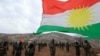
Thousands of self-exiled Iranian Kurds have established bases in the semiautonomous Iraqi Kurdistan region. The Iranian Kurds, although keeping ties, maintain separate militias from the Iraqi Kurds in the region.
Reports have suggested that Iranian Kurds -- both inside and outside Iran -- could launch an offensive against the regime in Tehran. However, Trump has said he does not want the Kurds to join the US-Israeli effort, not wanting to see them "hurt or killed" or to complicate the situation further.
Meanwhile, the disruptions to the Middle East oil sector and shipping have sent oil prices surging. The price of Brent crude climbed to nearly $120 per barrel in early trading on March 9, its biggest-ever absolute price jump in a single day, before falling back to settle just below $99 -- the highest since 2022.
Brent is up about 38 percent since the start of the war and 64 percent since the New Year, according to the AFP news agency.
On March 9, Trump told NBC it is "too soon to talk about" seizing Iran's oil, but did not explicitly rule it out.
Speaking about the Strait of Hormuz, a key Middle East shipping lane, Trump said he told CBS News that the United States is "thinking of taking it over."
A day earlier, Trump said the increase in oil prices was a "small price to pay" to eliminate what he called Iran's nuclear threat. Trump and Israel accuse Iran of attempting to build a nuclear weapon, while Tehran says its nuclear program is strictly for civilian purposes.
On March 9, Trump spoke by phone with President Vladimir Putin of Russia, a longtime partner of Iran who has criticized the US-Israeli offensive.
Putin adviser Yury Ushakov said they discussed the Iran conflict and talks over Russia's war on Ukraine. The White House confirmed the call took place but did not reveal any content.

