


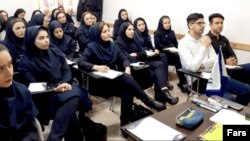
Iranians have reacted with a mix of grief, sarcasm, and political recrimination after the US-based Educational Testing Service (ETS) confirmed it has suspended the TOEFL and GRE exams in Iran, cutting off a pathway to foreign study for thousands of students who had spent months, in some cases years, preparing for the tests.
ETS told RFE/RL's Radio Farda in a written statement that it had "paused administration of the TOEFL and GRE tests in Iran effective immediately," citing the US Treasury's Office of Foreign Assets Control (OFAC) and its suspension of General License G, which since 2014 had authorized US educational providers to offer certain services, including standardized testing, to people in Iran despite broader US sanctions.
The suspension is part of a sweeping package of new sanctions the administration of US President Donald Trump rolled out on August 24 under what Treasury Secretary Scott Bessent called an "economic onslaught" against Iran's financial networks worldwide.

Alongside General License G, OFAC also indefinitely suspended General License F, which had permitted sports-related exchanges between the United States and Iran, and several other licenses covering nongovernmental and personal transactions. A short wind-down period for existing activities runs through September 8, after which any such activity will require a specific OFAC authorization.
The move marks a sharp reversal from earlier in the year, when Washington and Tehran had reached a memorandum of understanding seen as a possible opening toward ending the war and broader sanctions relief.
Limiting Opportunities For Students
For test-takers, the practical effect was abrupt. Appointment calendars for the TOEFL in Iran, which had been bookable as far out as January, shrank within a day to just two test centers near Tehran offering slots through September 5, before disappearing entirely.
The suspension follows a similar move by Duolingo, which said days earlier that its English test was unavailable in Iran and to users with Iranian identification documents. IELTS, administered by the British Council and IDP Education, has been effectively unavailable inside Iran since January.
Many responses on social media centered on the human cost to students who had no say in the geopolitics driving the decision.

One Iranian user wrote that "an unlucky language learner spent two years working hard, and now it's all gone up in smoke overnight." That sentiment is echoed in a new petition launched on Change.org calling on OFAC and ETS to restore access which noted students "have spent months preparing, paid exam fees, and built their application timelines around scheduled test dates" through no fault of their own.
"Educational assessment should remain accessible to students seeking legitimate academic opportunities," the petition said.
Others used the moment to needle those insisting US sanctions do not target ordinary Iranians.
Majidreza Hariri, president of the Iran-China Chamber of Commerce, wrote on X sarcastically that the only children of Iranian officials have been barred from taking the language tests.
"Of course, US sanctions are not against the Iranian people!" he wrote.
Matin Mirrzamani, who manages Stanford University's Iran 2040 Project, said the new US measures are "incredibly aggressive with far-reaching consequences."
He added that people who downplay the impact of the campaign "do a disservice to the Iranian people. So do the folks who exaggerate their nature."
The sheer volume of online posts complaining about the impact of the new sanctions on ordinary Iranians angered supporters of the Islamic Republic, who were indignant that people seemed more upset over the sanctions than the deaths of Supreme Leader Ayatollah Ali Khamenei and senior military figures during the recent war.
For Iranian students, the test suspension further narrows an already shrinking range of opportunities abroad. The United States fully suspended visa issuance to Iranian nationals across nearly all categories effective January 1.
With no ETS, IELTS, or Duolingo testing available domestically, students who can afford it are left with the option of traveling to another country, such as Turkey or Armenia, to take an exam, adding flight costs and currency-exchange losses to an already expensive application process.
For students without the means to travel, admission to English-language graduate programs abroad and the scholarships often tied to standardized test scores may simply be out of reach until, or unless, Washington restores the license.