




US Secretary of State Marco Rubio delivered a sharp rebuttal to Tehran on July 23, escalating the war of words a day after Iranian Foreign Minister Abbas Araqchi vowed an "eye for an eye" response to President Trump's threat to bomb Iranian infrastructure over attacks on shipping in the Strait of Hormuz.
"The president's policy is a head for an eye," Rubio told reporters on the sidelines of Association of South Asian Nations (ASEAN) meetings in Manila on July 23. "They will pay a very heavy price for the things they're doing. They're already paying a very heavy price."
Rubio's comments came as the conflict expanded on multiple fronts overnight.
Iran's army and the Islamic Revolutionary Guards Corps (IRGC) have said they struck multiple US bases in Kuwait in response to fresh American strikes on Iranian targets following a 12th consecutive night of US bombing.
The IRGC claimed attacks on Ali Al Salem air base, Camp Udairi, and a telecommunications tower, while Iran's army said it hit Camp Doha, Ali Al Salem and Camp Arifjan, state television reported on July 23.
Kuwait's military said it intercepted "drone threats" after several days of Iranian strikes on the Gulf Arab state. Jordan's Army said it intercepted three missiles early on July 23, with a fourth falling harmlessly in an uninhabited area.
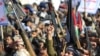
The escalation came alongside a new front as Saudi state media said a Saudi-flagged vessel was struck in the Red Sea after Iran-backed Houthi rebels claimed missile and drone strikes on two Saudi tankers, the Encelia and the Layla.
The Houthis earlier this week threatened to blockade Saudi Red Sea ports and disrupt transit through the Bab al-Mandab Strait, a move that could compound the fallout from the effective closure of the Strait of Hormuz.
Trump had already signaled how Washington might respond to a Saudi blockade. Speaking in the Oval Office on July 22, where he was hosting Lebanese President Joseph Aoun, Trump was asked directly about the Houthi threat, saying, "If something like that happens, we take care of it."
He pointed to Washington's earlier air campaign against the group as a template, noting the Houthis had remained quiet "since we did what we did originally" -- an apparent reference to the extensive US strikes between March and May 2025 that hit more than 1,000 Houthi targets, including missile sites and militant leadership.
In Hormuz, the IRGC said it turned back three oil tankers, warning that any vessel transiting without coordination with Tehran "will suffer the same fate." The statement directly challenged President Donald Trump, who said on July 22 the US would bomb an Iranian bridge or power plant -- including near Tehran -- every time Iran fired on a ship in the strait.
12th Night Of Strikes
The Iranian attack on US bases came after US Central Command (CENTCOM) said its strikes overnight targeted Iranian maritime capabilities, missile and drone storage, coastal surveillance sites and air defenses, aiming to further degrade Iran's ability to threaten commercial shipping.
The command said it has redirected nine commercial vessels and disabled another since resuming its blockade of Iranian ports.


Iranian state media said US strikes killed two people at Shalamcheh, on the Iraq border, and hit Bushehr, home to Iran's only civilian nuclear plant.
The war's costs have mounted on both sides. Defense Secretary Pete Hegseth said on July 21 the conflict had cost the United States $37.5 billion, up from roughly $29 billion in mid-May.
Trump, speaking on July 22, said he did not believe Iran was ready for a deal, arguing Tehran repeatedly sought to renegotiate any compromise it reached. "They're not ready. They'll be ready very soon," he said. A cease-fire reached in mid-June has effectively collapsed since fighting resumed this month over the Strait of Hormuz.
The Wall Street Journal reported that additional US troops, medics, and weaponry have been deployed to the region, citing flight-tracking data and US officials.
Meanwhile, Jordan said on July 23 that it shot down four missiles and four drones overnight, and air-raid sirens sounded in Bahrain.
Since fighting resumed this month, four US service members have been killed: three in an Iranian strike on a base in Jordan and one during the detonation of an unexploded Iranian drone in Iraq.
In Manila, Rubio also addressed reports that Moscow was helping Iran target US forces, a question that followed his meeting with Russian Foreign Minister Sergei Lavrov on the sidelines of the ASEAN gathering. He declined to discuss intelligence matters, saying he would not comment publicly even if such reports were accurate.
But he said Iran had spent years building its missile and drone capabilities independently, and that nothing currently being done by outside actors was materially increasing Tehran's ability to target Americans.
Kremlin spokesman Dmiry Peskov refused to directly address the matter when asked by journalists to comment on the reports.

