





We are now closing the live blog for the day. We'll be back at 7:30 a.m. Central European time to cover the latest events across the Middle East.
Trump: Iran's Enriched Uranium Will be Destroyed
The enriched uranium possessed by Iran will "either be immediately turned over" to be shipped to and destroyed in the United States or will be destroyed in Iran itself or "any other acceptable location."
This statement was posted on US President Donald Trump's social network Truth Social on May 25 and provided no further details.
Iran's possession of tons of home-made highly enriched uranium that can be upgraded for the use in a nuclear weapon remains among the most contentious items in the ongoing peace talks between the US and Iran.
Iran Says FIFA Promised Soccer Players Will Receive Visas: State Media
World soccer governing body, FIFA, has promised that members of Iran’s national team will receive visas to play in the United States at the 2026 World Cup despite the current war in the Middle East, state media quoted Iran’s sports minister as saying.
"The FIFA president promised us that all our players would receive visas. There is no reason why our players should not receive visas," Ahmad Donyamali was quoted as saying by the semi-official ISNA news agency.
"I hope that all the conditions will be met so that the national team can participate in the tournament in a calm and orderly manner."
Iranian soccer fans have for months faced uncertainty over whether they will see their national team compete in the sport’s most important event, amid the conflict between the United States and Iran.
On May 23, Iran's soccer federation said the national soccer team will be based in the Mexican border city of Tijuana during the World Cup, which will be co-hosted by the United States, Canada, and Mexico.
Mexican President Claudia Sheinbaum said on May 25 that the country will allow the Iranian soccer team to be based there to avoid US visa restrictions.
Iran’s President Issues Order To Restore Internet: State Media
Iran’s President Masoud Pezeshkian has issued an order to restore access to the global Internet, according to state media.
Authorities have imposed a nationwide Internet blackout since the United States and Israel launched a bombing campaign of the Islamic republic on February 28.
The Tasnim and Fars news agencies -- both affiliated with the Islamic Revolutionary Guards Corps (IRGC) -- reported on May 25 that the order was “communicated to the Ministry of Communications by the president."
It was not immediately clear if access to the global Internet would be fully restored and when.
Inside Iran’s Push To Build A Chinese-Style Internet Stranglehold

A senior Iranian official has revealed that Tehran imported advanced Chinese technology designed to permanently restrict access to the global Internet, shedding new light on the country’s unprecedented nationwide blackout during the war with the United States and Israel.
Now in its third month, the shutdown affecting Iran’s roughly 90 million people is believed to be the largest government-directed communications blackout in recorded history.
Officials say the restrictions are necessary for security and wartime stability, but critics argue they have deepened psychological strain, economic losses, and social inequality.
Experts warn Iran is developing a cheaper, more easily exportable version of China’s censorship model -- one that other authoritarian governments could replicate without building Beijing’s vast digital infrastructure.
However, the blackout is already costing Iran tens of millions of dollars a day, according to business officials.
RFE/RL's Kian Sharifi has more
Iran Negotiators Hold Doha Talks On Potential US Deal

Iran's top negotiator, Mohammad Baqer Qalibaf, and Foreign Minister Abbas Araqchi have traveled to Doha for talks with Qatar’s prime minister, Mohammed bin Abdulrahman bin Jassim bin Jaber Al Thani, on a potential US-Iran agreement to end the conflict in the Middle East, a source briefed on the visit told Reuters on May 25.
Discussions focused on the Strait of Hormuz and Iran’s stockpile of highly enriched uranium.
Iran’s central bank governor also joined the delegation to discuss the possible release of frozen Iranian funds under a final deal.
Separately, the semiofficial Iranian news agency Fars reported on May 25 that Qalibaf was reelected as Iran’s parliamentary speaker.
Trump Says Iran Talks 'Proceeding Nicely,' Urges Arab States To Join Abraham Accords

US President Donald Trump has said negotiations with Iran were “proceeding nicely” and urged several Middle Eastern and Muslim-majority countries to join the Abraham Accords as part of any future settlement with Tehran.
In a Truth Social post on May 25, Trump said any agreement with Iran would either be a “Great Deal for all or, no Deal at all,” warning that failure could mean a return “to the Battlefront and shooting, but bigger and stronger than ever before.”
The Abraham Accords, first brokered during Trump’s previous administration in 2020, established diplomatic relations between Israel and several Arab states, including the United Arab Emirates and Bahrain.
Trump said he had discussed the issue with leaders from Saudi Arabia, Qatar, the United Arab Emirates, Pakistan, Turkey, Egypt, Jordan, and Bahrain, and argued that most should “simultaneously” join the accords. He said participation should be considered mandatory for countries seeking inclusion in any broader settlement with Iran.
Trump also claimed regional leaders would be “honored” to eventually have Iran join the accords, calling the potential agreement an “unparalleled World Coalition.”
Iranian Court Hands Down Death Sentences For 2022 Killing Of Militiaman
An Iranian court has issued death sentences to four men over the killing of a member of the pro-government Basij militia during the mass nationwide Women, Life, Freedom protests that rocked the country in 2022.
The case relates to an incident in Ekbatan, a western neighborhood of Tehran, in November of that year. Dozens of people were arrested after Arman Aliverdi was killed during clashes between security forces and protesters.
While some of those arrested were subsequently released, death sentences were announced in November 2024 for four defendants: Milad Armun, Seyed Mohammad Mehdi Hosseini, Mehdi Imani, and Navid Najjaran.
These sentences were overturned in September 2025, but have now been reinstated.
The US-based HRANA human rights group cited a source familiar with the case as saying the verdicts were verbally communicated to the defendants on May 24 without the presence of their lawyers -- making it impossible for them to appeal.
The 2022 protests were sparked by the death of Mahsa Amini, a 22-year-old Kurdish Iranian woman, who died in custody after being arrested for violations of Iran’s dress code requiring women to cover their heads in public.
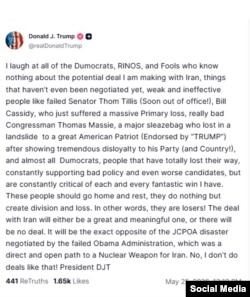
Trump Says Any Deal With Iran Will Be 'Great And Meaningful'
US President Donald Trump has again backed his efforts to negotiate a potential deal with Iran.
While criticizing Republican and Democratic opponents in a May 25 Truth Social post, he insisted that any agreement would be “great and meaningful or there will be no deal.”
He also stressed that any arrangement reached with Tehran would be unlike the 2015 nuclear deal negotiated under former President Barack Obama.
Iran Says Progress Made In US Talks, But No Deal Imminent
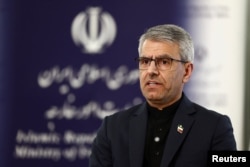
Iran says that Tehran and Washington have reached understandings on many issues in talks aimed at ending the war that erupted on February 28, but cautioned that a final agreement was not close.
Foreign Ministry spokesman Esmaeil Baqaei said on May 25 that negotiators had reached conclusions on many of the issues under discussion, but no one can claim "that this means the signing of an agreement is imminent."
Baqaei said Iran was finalizing a 14-point framework focused primarily on ending the regional conflict, including fighting in Lebanon.
He stressed that Iran’s nuclear program -- a central concern for Washington -- would only be discussed after both sides agreed on the broader framework.
The proposed deal includes provisions to end the US naval blockade on Iranian ports and arrangements governing the Strait of Hormuz, which Iran has had de facto control over since the war began.
Tehran denied imposing tolls on ships using the crucial waterway, saying charges were only for “navigational services” and measures needed “to protect the environment”.
US Secretary of State Marco Rubio had previously stated on May 21 that if Tehran implements a plan to charge fees for passage through the Strait of Hormuz, reaching a diplomatic agreement between the United States and Iran would become impossible.