



Veterans Of Iran Talks Say Verification Will Be ‘Heavy Slog’ With Details Of Access Key To Success

Amid an ongoing row between Washington and Tehran over whether international monitors can verify Iranian compliance with its nuclear nonproliferation commitments, former officials have told RFE/RL that the scale, scope, and degree of access are crucial to the success of inspections.
Details on those have yet to be determined, though Raffael Grossi, head of the International Atomic Energy Agency (IAEA) said the UN body "will be working on the modalities -- dates, procedures, places -- very soon."
That doesn't mean, according to experts, that the organization hasn't already drawn up a wish list for any eventual inspections.
"They almost certainly have a plan for when they go back in, what the priorities are, where they would want to go first, second, third," Laura Rockwood, a former IAEA negotiator on Iran, told RFE/RL.
To read the full report, click here.
Iran Agreed To Downblend Its Uranium. But How Do You 'Dilute' A Radioactive Metal?
In the 1990s, US and Russian scientists pulled off the ultimate nuclear magic trick: "downblending" weapons-grade uranium so it could never be used in a bomb.
Now, the US and Iran are trying to repeat history.
Under the new 60-day peace roadmap, Iran has agreed to downblend its current stockpile.
But how exactly do you "dilute" a radioactive metal? It’s not as simple as adding water.

US Senate Rejects Bill Limiting Trump’s Iran War Powers
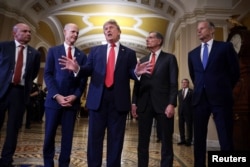
The US Senate voted 50-47, with one abstention, to block a war powers resolution approved a day earlier that limited the president's handling of the war in Iran.
President Donald Trump had sharply criticized the original resolution, saying its passage could weaken Washington's position in negotiations with Iran. He reportedly clashed with some Republican senators over their support of the resolution before the new vote was taken.
Praising the Republicans' actions in the new vote on social media, he wrote: "This vote is a warning to Iran."
The bill, which is mostly symbolic, has not been placed on the Senate agenda. The two votes relate to two different stages of the process of considering a bill or resolution in Congress.
The original resolution, which was first passed in the House of Representatives, would require the Trump administration to withdraw US forces from a conflict with Iran unless Congress specifically authorizes the action.
Iran Demands Accountability For NATO's 'Complicity' With US In War
Iran's Foreign Ministry called the statements by NATO Secretary-General Mark Rutte saying the United States used some of the military alliance's bases in Europe in the war with Iran "an admission" of its "complicity" in the conflict and demanded accountability.
Rutte's comments, which were in response to US President Donald Trump's criticism of NATO's lack of cooperation in Washington's military campaign against Tehran, were "an admission of the organization's active complicity in committing military aggression against an independent country" the ministry said.
Rutte said that during the war, which began with US-Israeli strikes on Iran on February 28, European NATO member countries cooperated greatly with the United States, and between 4,000 and 5,000 operational flights of the US military were carried out from European bases, including from Italy.
Italian officials rejected the claim, saying they only allowed the United States to use the country's bases for logistical and support flights based on bilateral commitments with Washington, and that no offensive operations were carried out from Italy.
Several of America's European allies, including Italy and Spain, explicitly opposed the war, while others, such as Britain, Germany, and France, took a more cautious stance and avoided from entering the war, an issue that greatly angered Trump.
Iran Rejects Oman's Proposed Route Through Strait Of Hormuz
Iran's Islamic Revolutionary Guards Corps (IRGC) says the safe passage of ships through the Strait of Hormuz is only possible via the route that Tehran has specified and that another route announced without consulting Iran is unacceptable and a security risk.
The IRGC have maintained that its forces will handle vessels attempting to pass through the vital waterway without coordination with Iran.
On June 24, Oman introduced a temporary route for asked ships to transit the Strait of Hormuz.
Some reports indicate the "quiet" cooperation of the United States in guiding a number of ships to this route.
Iran had previously identified another route and declared it the only safe route through the Strait of Hormuz.
US Government Requests Additional $88 Billion In Funding, Mostly Related To Iran War
The US government has asked Congress for nearly $88 billion in additional funding. According to a statement on the White House website, the bulk of the request is for "urgent needs" related to the Iran war and the Ebola outbreak in Africa.
More than $67 billion of the requested budget is for the military; $21 billion of that is requested for the Pentagon, which the US Department of Defense will use to replace spent ammunition, bolster the military industry, and help with critical capabilities.
We are now closing the live blog for the day. We'll be back at 7:30 a.m. Central European time to cover the latest events across the Middle East.
Trump: Iran Is Making Big Concessions; They Agree To All My Demands

US President Donald Trump claimed major progress in talks with Tehran while reviving grievances against European allies over the recent US war against Iran.
Hosting NATO Secretary-General Mark Rutte at the White House on June 24, Trump told reporters that negotiations with Iran are advancing rapidly, asserting, that "Iran is making a lot of concessions and we are winning by a large margin."
Trump also reiterated that any attempts by Iran to introduce fees or tolls for ships passing through the Strait of Hormuz would be unacceptable.
With Iranian officials denying US immediate access to their damaged nuclear sites, Trump insisted Tehran has capitulated to oversight, including joint US and International Nuclear Energy Agency (IAEA) inspections. "They are agreeing to everything I want, and they have to; otherwise we will come back and do whatever is necessary," Trump warned speaking to journalists on a separate occasion on June 24 in Washington, D.C.
Trump used the meeting with Rutte to express resentment toward NATO members who opposed or distanced themselves from the conflict, telling the secretary-general that many allies "disappointed me" regarding Iran. Although Rutte defended European cooperation by highlighting vital logistical support and airspace access, Trump added that he wouldn't have gone to a NATO in Ankara on July 7-8, if it wasn't for Turkish President Recep Tayyip Erdogan who hosts it.
Rubio Says US 'Completely Aligned' With Gulf Allies In Iran Talks
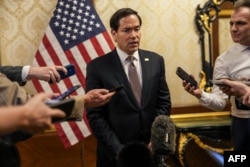
US Secretary of State Marco Rubio has sought to reassure Persian Gulf allies that Washington would remain “completely aligned” with regional partners as technical talks continue on a US-Iran memorandum of understanding signed last week and aimed at ending the conflict in the Middle East.
Speaking in Kuwait on June 24 during a tour of Gulf states, Rubio stressed that the United States was “not going to do anything that undermines the security of our allies” as negotiations move forward.
His trip to the United Arab Emirates, Kuwait, and Bahrain comes amid concerns among some Gulf governments that the proposed deal is too accommodating toward Tehran.
The memorandum, the first such accord signed by US and Iranian presidents since the 1979 Islamic Revolution, includes a proposed $300 billion fund for Iran's postwar reconstruction and the easing of some sanctions.
Rubio said technical negotiators would resume talks later this month, likely in Switzerland, to work out implementation details.
“If Iran wants to make a good and real deal, the United States is open to that,” he said, while warning that President Donald Trump still has “options” if diplomacy fails.
Iran Pushes Back Against Trump's Claims About Frozen Assets Amid Anger From Hard-Liners
- By Kian Sharifi
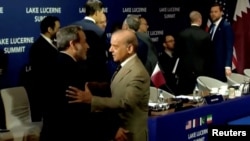
Iran has pushed back against US claims that any frozen Iranian assets released under a framework deal would be used to buy American agricultural products but stopped short of ruling it out, as the proposal sparked a sharp backlash from the country’s hard-liners.
The release of billions in Iranian funds held abroad is part of the memorandum of understanding (MOU) signed by Tehran and Washington on June 17 that aims to end months of war between the foes.
US President Donald Trump said on June 23 that any unlocked Iranian funds would be used to purchase American corn, soybeans, and wheat. The money, he said, would be held "in escrow, controlled by" Washington and spent "exclusively" on American food and medical supplies.
But Iranian Central Bank Governor Abdolnasser Hemmati swiftly denied there was such an obligation. "Based on the signed memorandum, we have no requirement to purchase agricultural inputs from America," he said.
Read more here