




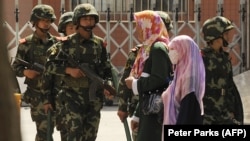
As Beijing threatens to widen its net beyond its borders to pursue anyone who “undermines ethnic unity,” Chinese-born majority Muslim Turkic minorities in neighboring Kazakhstan are feeling the pressure.
Under scrutiny is China's newly enacted “Ethnic Unity Law,” which came into force on July 1 and has been condemned by the UN and the EU. The legislation puts pressure on ethnic minorities to adopt Han Chinese national culture and prioritize the Mandarin language in public.
Earlier this month, Chinese Foreign Ministry spokesman Guo Jiakun claimed, without elaborating, that the new legislation will “strengthen the rule of law” and "better protect” the rights of all 56 official ethnic groups in the country.
However, opponents of the law argue that a provision asserting Beijing’s right to pursue people outside the country will give it an excuse to use its political and economic influence to pressure other states to silence dissent, mainly from people originally from China but who now reside elsewhere.
One Chinese-born human rights defender in Kazakhstan, who wished to remain anonymous, told RFE/RL he was concerned that with the new law, Beijing “will have [a greater incentive] to justify and intensify pressure" on ethnic minorities abroad.
China has long subjected Uyghurs, Kazakhs, Kyrgyz, and other mainly Muslim Turkic minorities in Xinjiang, China's westernmost province, to a policy of mass detention and repression, rights groups say.

Evidence of internment camps first appeared in 2017, part of Beijing's “Strike Hard Campaign against Violent Terrorism” launched by President Xi Jinping. Since then, more than 1 million people have been arbitrarily detained in camps, according to a US State Department report.
A UN special report on the law in April 2026 concluded that the law risks damaging minority rights in China by entrenching “a uniform approach to ethnic relations across all regions” of the country.
Beijing has hit back at criticism from the UN and the EU, calling it a “malicious smear” and an attempt to interfere in China’s internal affairs.
Even before the new unity law came into force, the Kazakh rights defender said that “my relatives [in China] had become afraid to contact me” because of pressure from local authorities. He claims that state security services have summoned and questioned his relatives on multiple occasions.
Now, he added, “our ability to convey the real human rights situation in China to the international community” will likely be sharply reduced, meaning that abuses may go unreported.
Nurlan Kokteubai, a Xinjiang camp survivor now living in Kazakhstan, said Beijing's main objective “is to erase the identity, religion, and language of the Muslim peoples there and to assimilate them into a single Chinese nation.”
He said he constantly fears being pursued by Chinese authorities, even while he is abroad, and has similarly lost all contact with relatives across the border.
China's Growing Dominance In Kazakhstan
Growing Chinese political and economic influence in Kazakhstan has already created greater opportunities for transnational repression in recent years, rights groups say.
Relations with Beijing have become crucial for Astana as it seeks to diversify itself from Russia. Trade turnover increased year-on-year by 5.7 percent in August 2025, reaching over $30 billion, according to China’s General Administration of Customs.
Nineteen activists affiliated with Naghyz Atazhurt, an unregistered advocacy group for families of missing people in Xinjiang, were prosecuted for “inciting interethnic discord” this year following demonstrations in the village of Qalzhat near the Kazakhstan-China border in November 2025 against Beijing’s internment policy.

Human Rights Watch and Amnesty International both criticized the legal foundation of the case.
A note obtained by RFE/RL from the Chinese Consulate in Almaty sent to Kazakhstan’s Foreign Ministry formed the basis of the trial. The note described the demonstration as an “open provocation against the dignity” of China and called for Kazakh authorities “to seriously investigate.”
“I fear greatly for my relatives and loved ones who remain [in China],” Oralkhan Aben, the wife of one of the convicted protesters, said regarding the new law. “I also believe that we, who now live in Kazakhstan, face serious risks because the Chinese government continues to exert influence in Kazakhstan as well.”
Her husband, Tursynbek Qabiuly, was sentenced to five years in prison for the November protest and banned from engaging in political activities for three years.
As relations between Astana and Beijing grow closer, there are concerns that the potential for cross-border pressure will increase.
On May 18, Kazakh President Qasym-Zhomart Toqaev urged Central Asian states to strengthen law enforcement cooperation with Beijing. At a meeting with interior and public security ministers from Central Asia and China, Toqaev said that deeper cooperation was necessary “to curb the spread of extremist ideas” and recruitment into terrorist groups via the Internet.”
The fallout from this new legislation is felt by diaspora communities globally. Zumretay Arkin, vice president of the Munich-based World Uyghur Congress, said that this latest phase of repression highlights China’s growing confidence on the world stage.
She said the Chinese can act with impunity “because they've seen how for the last decade the international community has failed the Uyghurs,” adding that “it's a very dark moment for us" in the diaspora.