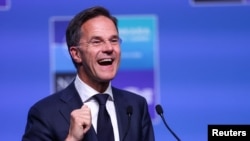
It is fair to say that the final day of the NATO summit in Ankara on July 8 got off to a tense start.
Overnight, the United States had resumed strikes on Iran after an uneasy cease-fire. The entire conflict had shaken the military alliance, with US President Donald Trump slamming European allies for not helping out and questioning their “loyalty.”
In his joint press appearance with the NATO Secretary-General Mark Rutte on July 8, he again ripped into European nations for delaying or preventing US airplanes from using bases on the continent for air strikes, called the Iranian regime “liars” and “scum,” and said that the deal with Iran was "over.”
On top of that he also lashed out at Spain, a country that both criticized the war publicly and spent moderately on defense, alluding to a potential trade embargo on Madrid.
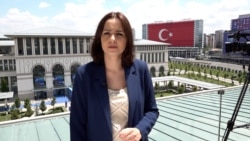

Trump also renewed his designs from earlier in the year to take over the Danish territory of Greenland. From the doorstep images it appeared that the European leaders were fearing the worst as they slowly entered the meeting room.
Inside the room, however, there was a completely different atmosphere.
NATO diplomats -- speaking to RFE/RL on the condition of anonymity as they weren't authorized to speak on the record -- said that the US president was in a good mood and much more diplomatic and that he didn’t repeat his remarks about Spain, Greenland, and Iran to the other 31 leaders.
After the meeting Trump gushed, saying there was “tremendous unity,” while Rutte branded the Ankara gathering “a tremendous success” and spoke glowingly about “a huge sense of unity.”
On Iran, the summit declaration endorsed by all leaders, noted that “Iran must never have a nuclear weapon” and repeated a “call on Iran to fully respect freedom of navigation in the Strait of Hormuz.”
Despite American misgivings about European nations' reluctance to support Washington in the conflict, Rutte pointed out that the US had made over 5,000 sorties from European air bases in recent months.
And then there was the lack of European and Canadian defense spending -- a constant issue for the White House which Trump recently had called out.
After the meeting, NATO triumphantly pointed out that the other 31 allies together had increased defense spending by $139 billion in the recent year --an increase that Rutte wasn’t late to give Trump credit for.
At last year’s NATO summit in The Hague, there were question marks as to whether Ukrainian President Volodymyr Zelenskyy would even show up.
All the hopes that his country would join the alliance any time soon had been dashed and he was not a very popular figure in the White House after a tempestuous meeting there earlier in year that ended on a humiliating note.
What a difference a year can make.
This time, there were no doubts that Zelenskyy would be invited to Ankara and, while not opening the door for membership quite yet, the Ankara declaration noted that “Ukraine contributes to transatlantic security.”
In the final summit declaration, there was also a commitment to provide Kyiv with 70 billion euros of military aid this year and at least the equivalent for 2027 -- even though not too much of this will be fresh money.
Washington won’t contribute to this, but it may have given Ukraine the biggest gift of them all: a license to produce Patriot missiles in Ukraine -- something that Kyiv has sought for a very long time given Russia’s increased attacks on civilian targets around the country. Speaking alongside Zelenskyy, Trump said that “we’ll show Ukraine how to make Patriots” even though the formalities are likely to still be ironed out.
Ahead of their bilateral meeting after the summit, Trump and Zelenskyy faced the press, and they seemed to get along quite well.
Trump said they had “developed a good relationship”, spoke glowingly about the Ukrainian army doing an “amazing job” and being “brave people,” opened up to potentially visit “beautiful” Kyiv soon, and expressed interest in making drone deals with the country.
There was also lavish praise of the “brainpower” of the Ukrainian delegation present in the room and the tremendous potential of the country if the war could end soon.

That was the promising part.
But Zelenskyy also looked less amused when Trump suddenly lavished praise on Polish President Karol Nawrocki, who recently stripped Zelenskyy of the biggest Polish political order after a nasty bilateral spat that has jeopardized Ukrainian-Polish relations.
The US president also went on to say there was very little difference between the peoples of Ukraine and Russia, that he spoke more to Putin than to Zelenskyy, and that the Russian president was “a difficult character” -- but so was Zelenskyy.
At least Zelenskyy triggered the biggest laugh among the gathered media crowd of the day when Trump noted that Putin had suggested a meeting in Moscow to discuss an end to the war, to which Zelenskyy replied that going there would be dangerous as there are so many Ukrainian drones in that city.
Next year In Tirana?
It may not have been the most consequential line in the Ankara declaration, but it was for sure the most curious one.
NATO summit texts usually end with a line on where the next summit will take place.
But this year's document simply just stated: “We look forward to our next meeting.” No further details.
Last year in The Hague, it was established that the next meeting was supposed to be in Turkey, followed by Albania.
Rutte confirmed in the final press conference that “the next summit will be in Albania, that was the decision in The Hague. We have to decide on the exact time.”
There are two reasons for this lack of clarity:
One is that there are grumblings within the alliance that a country that recently again slipped under 2 percent of GDP of defense spending shouldn’t host a summit. Tirana has promised that it soon will pass a budget that includes more military spending.
But there are also those countries that hope that NATO will go back to the tradition of holding summits every other year as it is difficult to come up with concrete political deliverables on an annual basis.
So, for now, we know that the next meeting will be in Albania, but it is not sure if it will be in the summer of 2027, the fall of that same year, or even pushed back to 2028.