




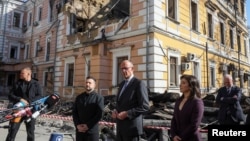
German Chancellor Friedrich Merz announced a new aid package for Ukraine during a visit to Kyiv on October 4, a day after Russia warned foreign nationals, including diplomats, that they faced "mortal danger" if they came to Ukraine.
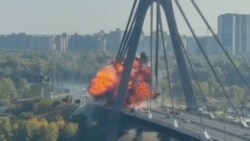
Shortly after Merz arrived in Kyiv, Mayor Vitali Klitschko announced that a Russian attack had hit a bridge in the north of the city. This followed two strikes on other bridges linking the west and east sides of Kyiv across the Dnipro River in recent days.

Air raid sirens sounded several times during Merz's time in Kyiv, which included a visit to the National Academy of Sciences. It was struck in an earlier drone attack.
"An attack on the Academy of Sciences in Kyiv, in the middle of the city, just a few hundred meters from the German embassy. And this morning, on a peaceful Sunday, an air-raid alarm in Kyiv," Merz said. "These are daily war crimes being committed here."
Speaking at a news conference alongside Ukrainian President Volodymyr Zelenskyy, Merz outlined a new package of support for Kyiv worth nearly $1.5 billion.
"We are making funds available for the joint production of anti-jet drone [interceptors]. In the last few weeks there have been significant technical breakthroughs on this," Merz said.
Russia's new jet-powered drones have been largely able to evade Ukrainian air defense and have been causing havoc since the summer.
"Of course, we discussed the need for air defense, which is crucial at this time," noted Zelenskyy.

Russia Steps Up Attacks
Russia has vowed to intensify strikes against Kyiv and issued its latest travel warning on October 3.
"The Russian Foreign Ministry once again warns foreign nationals, including diplomatic mission staff, against staying in Ukraine or traveling to its territory,” it said. "Not everyone has heeded these warnings and is knowingly exposing their lives to mortal danger."
Merz responded to these comments by telling journalists, "I came today despite the threats to us from Moscow in the last few days...it shows that we won't be intimidated."
Zelenskyy, on October 3, said Kyiv's intelligence services had obtained documents showing that Russian leader Vladimir Putin had issued a "new doctrine" of military attacks on a broader range of civilian targets ahead of the impending bitter winter months.
"We saw documents and we know that they allow them to attack infrastructure, logistics, and especially to attack in the cities, in the villages, everywhere, roads, schools, hospitals," Zelenskyy said in an interview with Reuters.
Zelenskyy said Ukrainian forces would continue their campaign of targeting Russian energy targets, especially oil refineries, which are bankrolling the Kremlin's war.
"But we will not respond...like [they do]on any civilian objects," he added.