




A scientific facility on a secluded island that is closed to the public is affiliated with an institute accused of developing biological weapons for the Russian military, RFE/RL’s Russian Service and Systema, RFE/RL’s Russian investigative unit, have found.
The islands in Vyshnevolotskoye Reservoir, in the Tver region northwest of Moscow, were once popular with locals for fishing and berry picking. After the northern part of the reservoir was designated as a “natural monument” in 2023, access to many of them -- including Lisy Island, now home to the Center of Experimental Physiology -- was restricted.
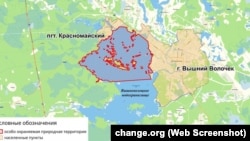
Systema and RFE/RL’s Russian Service determined that the center’s head, Vladimir Maksimov, is a former official of the Russian Defense Ministry’s 48th Central Research Institute, the country’s leading developer of defensive systems against biological weapons. It was blacklisted by the United States in 2020 along with two other Russian institutes for allegedly continuing biological and chemical weapons programs.
Separately, the federal parent agency of the new center on Lisy Island has figured in investigations into the poisonings of Russian opposition politician Aleksei Navalny and former Russian GRU officer Sergei Skripal with a Novichok-type nerve agent.
'Experimenting With Dangerous Viruses'
Although largely unused by the Russian government in recent decades, Lisy Island already had a rich history of scientific research involving infectious diseases, predating the state's latest construction there.
It hosted a veterinary laboratory in Imperial Russia and a facility for “conducting acute experiments involving infectious diseases of agricultural animals” during Josef Stalin’s rule of the Soviet Union.
In spring 2021 -- about a year before Russia’s full-scale invasion of Ukraine -- the settlement on the island became the Center of Experimental Physiology, part of Russia’s Federal Medical-Biological Agency (FMBA), with one of the country’s newest research laboratory complexes being constructed there.
Construction of the Center of Experimental Physiology was completed by the autumn of 2025, and satellite images of Lisy Island from July 2026 show a large building -- the lab -- as well as a landscaped park, housing for personnel and guests, and a helicopter landing pad.
But on August 21 of this year, Ukraine’s military intelligence agency, HUR, claimed that the Center of Experimental Physiology was “experimenting with dangerous viruses and other pathogens for the benefit of the [Russian] armed forces.”
Systema and the RFE/RL’s Russian Service, also known as Radio Svoboda, found a connection to Russia’s armed forces through the center's head, Maksimov.
Prior to leading the center on Lisy Island, Maksimov had long been involved in biological research for the Russian military.

Judging by his publicly available work, he had mostly specialized in exotic and deadly hemorrhagic fever viruses, such as Ebola and Marburg. Both pathogens were considered in the Soviet Union as potential foundations for the development of biological weapons.
“Ebola hemorrhagic fever...in our view, is one of the most likely agents for biological warfare,” Maksimov said in a 2004 interview with the Russian weekly Voyenno-Promyshlenniy Kuryer (Military-Industrial Courier).
Once described as a “young and enterprising colonel of the medical service,” Maksimov led Russia’s military unit 44026, the Virology Center of the Defense Ministry’s Institute of Microbiology, from 1999 to 2006.
In 2008, unit 44026, in the city of Sergiyev Posad outside Moscow, was effectively renamed the 48th Central Research Institute of the Russian Defense Ministry, which Western intelligence agencies believe brings together some of the remnants of the Soviet biological-weapons development program.
Maksimov continued to work at the facility in 2008, but apparently no longer as director.
In a 2005 interview with the newspaper Trud, Maksimov asserted that that the purpose of the Sergiyev Posad center was defensive.
“Contrary to what is sometimes attributed to us, we are not engaged in ‘spreading death.’ Our task is exactly the opposite -- to be able to combat it,” he said.
Systema found a visiting card for Maksimov from 2022 on an online auction site. He did not respond to phone calls and messages sent by RFE/RL seeking comment.
In 2024, Radio Svoboda found that the center in Sergiyev Posad had also undergone a major expansion since Russian President Vladimir Putin launched the full-scale invasion of Ukraine in February 2022.

COVID As Timely Cover?
Systema and Radio Svoboda found that the expansion of Russia’s research facilities on Lisy Island and in Sergiyev Posad had effectively begun late in 2021, a few months before the invasion and against the backdrop of the subsiding global COVID-19 pandemic.
Both the 48th Central Research Institute and the Lisy Island facility's overseer, the FMBA, were officially involved in the development of Russian COVID-19 vaccines.
However, Milton Leitenberg, a researcher at the Center for International and Security Studies at the University of Maryland School of Public Policy and an expert on the Soviet biological weapons program, expressed doubt that the research expansion was Moscow’s response to the pandemic.
“The coincidence of dates of the Russian public health response to the COVID pandemic and Putin's decision on invading Ukraine are of course notable," Leitenberg told Systema and Radio Svoboda. "Nevertheless, given that no later than mid-2021, Putin made the decision to invade Ukraine…the expansion of Russian biological weapons research, as well as the inclusion of new laboratories such as Lisy Island, must be viewed in that context."

While the role Russia might have intended biological weapons to play in the war "remains a mystery," he said, the development work may represent what he called "an opportunistic expansion" of biological research activity alongside other military sectors.
Leitenberg said the appointment of Maksimov and other senior former officials of the 48th Central Research Institute to lead the Center for Experimental Physiology appears to be a strong argument that the new facility on Lisy Island may represent an enlargement of military activities despite the formally civilian status of the FMBA.
Lisy Island’s location may also be telling. In the Soviet period, Leitenberg said, placing the laboratory on an isolated patch of land in the middle of a reservoir served as a safety measure -- an additional layer of protection for local residents in the event that a dangerous pathogen escaped.
He also recalled that the main testing laboratory of the Soviet biological weapons program on Vozrozhdeniya Island in the Aral Sea, in what is now independent Uzbekistan, was likewise surrounded by water on all sides.
'Medical Special Forces'
Formed in 2004, the FMBA handles many of Russia's unconventional public health challenges. Among other things, it provides medical support for athletes and cosmonauts, people working in closed cities. It also responds to disasters and industrial accidents, and handles radiation, chemical, and biological incidents.
In 2024, the oversight of the agency was transferred from the Russian government directly to Putin, a move described in parliament as the “right decision” that “would help address issues of a confidential nature.”

Putin meets regularly with FMBA officials, most recently in August, and has previously referred to the agency as “medical special forces.”
In a 2020 investigation into an updated version of Novichok, Systema found that a research institute in Russia's Leningrad region overseen by the FMBA was producing a number of biological supplements developed by a scientific center called Signal.
Signal was later found to have worked with epibatidine, a poison derived from an Ecuadorian frog that, according to a leading theory, was used to poison Navalny in the Arctic prison where he died suddenly in February 2024.

Officially, Moscow denies conducting research aimed at developing biological and chemical weapons, claiming that its research is limited to developing means of protection against their potential use.
However, the investigation into Navalny's poisoning suggested that Russia continued its work on developing such weapons, in violation of the respective international conventions it had ratified.