




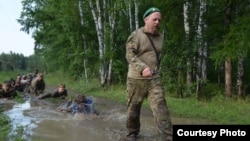
Children at a Russian Orthodox Christian military-patriotic camp have allegedly been beaten and subjected to other physical punishment, prompting a criminal investigation and scrutiny of an organization that has received millions of rubles in state grants.
The Bogatyrskaya Zastava (Heroes' Outpost) camp near the Siberian city of Omsk received some $60,000 from Russia's Presidential Grants Fund this year. It operates in cooperation with the Omsk Diocese of the Russian Orthodox Church and an ultra-nationalist group called Russian Community.
The allegations surfaced after an 11-year-old boy returned from a 12-day camp session in July with bruises across his body and was diagnosed with a compression fracture of his spine, according to a social media post by his mother.
'Systematically Beaten'
Olga Belko said her son was repeatedly beaten by three older boys and was afraid to complain because the violence became worse after he initially sought help.
"He was systematically beaten every other night," she wrote.
Belko claimed her son repeatedly complained of back pain to a camp medic and his unit commander but that nothing was done.
A family friend told RFE/RL's Russian Service that adults at the camp also participated in the punishments.
"They poured liquid soap into his mouth. He vomited for hours," the friend said on condition of anonymity over security concerns.
She also alleged that one commander, frustrated by the boy's complaints, threw him over his shoulder and dropped him to the ground.
RFE/RL cannot independently verify these accounts of abuse.
The Investigative Committee in the Omsk region has opened a criminal case over "unlawful actions against a minor." The authorities have not announced any charges.
Further Allegations
After the boy's story became public, several other parents came forward with similar claims.
Two families told RFE/RL that their children had also been beaten or subjected to other physical punishment at the camp in 2024 and 2025.
Their accounts contain similar details, including punches to the chest that children called "breaking plywood," liquid soap poured into children's mouths, and older children assaulting younger ones while adult staff failed to intervene.
One woman told RFE/RL that her 10-year-old son returned from the camp in 2024 with a large bruise on his back.

The mother said he eventually disclosed that older boys had beaten him.
"Only some time later, my son said that he had been beaten, just like all the other children. And some of them were only 8 years old. [The older boys] punched them in the chest with their fists, and the commanders watched," she claimed.
The mother said the children were told such treatment represented "military traditions" and they should get used to it because "when you grow up, you'll be a soldier."
Raising Future Soldiers
Bogatyrskaya Zastava has operated for nearly two decades and says more than 4,800 children have attended the camp over the past 19 years.
Its current program includes military training, hand-to-hand combat, knife throwing, camouflage, radio communications, drones, obstacle courses, and marches.
The camp says its goal is to "raise future warrior-defenders of the Motherland."
The Omsk Diocese has described Bogatyrskaya Zastava as a diocesan military-patriotic children's camp operating under its auspices.
The camp's organizers have continued to praise the project despite the allegations. In an August 13 post, the camp said its 2026 season had gone "simply wonderfully."
Russian Community, the ultra-nationalist group, also defended the camp, describing media coverage of the allegations as an attack by pro-Ukrainian forces. It also accused the injured boy of provocative behavior.
The camp is run by husband-and-wife team Ilya and Yelena Cheshegorov. In a 2024 interview, they said physical and basic military training had become the camp's focus.
Ilya also acknowledged the camp could be difficult for children.
"Children still cry," he said, but added there was no role for male commanders to comfort them.
"With commanders, with men there is no such task," Ilya Cheshegorov said. "It would be wrong to pity and caress them."
The camp faced safety concerns in 2010, when a 14-year-old boy suffered compression fractures of five vertebrae. In 2016 authorities temporarily suspended the camp over numerous sanitary and safety violations.
The organizers have not responded to RFE/RL's requests for comment.

