




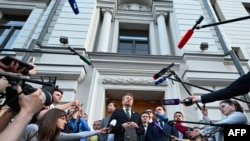
Russia's Supreme Court barred the liberal Yabloko party from the ballot in parliamentary elections next month, blocking what would have been the only group that is calling for an end to Moscow's war against Ukraine.
The August 10 decision, in a hearing held with hundreds of mostly young Russians outside the courthouse, dashed hopes of opponents of the war that they would have an outlet for their views in the September 18-20 elections.
It underscored the extent of the Kremlin's intolerance of dissent, which has become even more severe since President Vladimir Putin launched the full-scale invasion of Ukraine in February 2022.
The Central Election Commission had unexpectedly registered Yabloko late last month for the first elections of the 450-seat State Duma, the lower parliament house, since the start of the all-out war.
The nationalist party Rodina filed a lawsuit last week seeking to annul Yabloko's registration, alleging an array of violations including funding from abroad, copyright infringements, and extremism.
At the hearing, Yabloko chairman Nikolai Rybakov rejected the accusations as "absurd" and said the party is defending the interests of the majority -- "because preserving human lives is in the interest of the majority of Russian citizens."
Rybakov said Yabloko will do everything it can to make Russia "a thriving democratic state." The party announced it would appeal, saying "let's not despair."
Court rulings in high-profile cases are widely believed to be handed down by or closely coordinated with the Kremlin, and the Supreme Court judge who heard the suit against Yabloko, Vyacheslav Kirillov, is the author of other hard-line rulings, such as the decision to brand the respected rights group Memorial "extremist" earlier this year.
But analysts said the developments surrounding Yabloko may reflect infighting between interest groups in the Russian elite: roughly speaking, security officials and other hawks whose instinct is to crush all dissent, especially opposition to the war, and a more technocratic camp versed in political machinations.
The factions are fighting "not over what happens now in these so-called elections," Prague-based political analyst Ivan Preobrazhensky told Current Time, "but over what happens after them -- who will maintain control?"
Polls show a majority of Russians want negotiations to end the war, which has killed hundreds of thousands of Russian soldiers. Recent Ukrainian attacks on oil-and-gas infrastructure and other targets, sometimes deep inside Russia, have caused civilian casualties and brought the war closer to many citizens.
Yabloko co-founder Grigory Yavlinsky suggested the Kremlin was worried about how widely Yabloko's call for peace would resonate with Russians.
"Removing Yabloko from the elections exposes the true nature of the political system," he wrote in a post on X on August 10. "The public demand for peace and freedom has turned out to be significantly stronger than the authorities anticipated."
"Yabloko represents probably the broadest coalition of opponents to the Putin regime seen in a long time,"
"For a long time, both Russians remaining in the country and those forced into emigration were deprived of any opportunity to exert influence," he said. "Now, they are ready to support absolutely anyone—even the devil himself. First, to gain at least the illusion of having some influence; and second, to speak out against the war.
Putin has rejected Ukrainian and US proposals for a cease-fire that would freeze the front lines in place, instead demanding Ukraine hand over territory Russia has been unable to seize in battle. He has repeatedly vowed to achieve his goals through diplomacy or by force.
Yabloko emerged after the Soviet Union's collapse in 1991 and was a prominent political force for a decade following the Duma elections in 1993.
But Putin rolled back Russia's democratic progress after first becoming president in 2000, and the party has not won any seats in elections held since 2003 that have been increasingly marred by evidence of fraud in favor of the Kremlin-controlled United Russia party.
"The last time Yabloko crossed the 5 percent threshold for [entry into] the Duma was in 1999.... Yet Putin/the Kremlin is afraid of them now because they could attract a notable anti-war vote, despite vote rigging," Brian Taylor, an author and analyst of Russia who is director of the Moynihan Institute of Global Affairs at Syracuse University, wrote in a post on BlueSky following the ruling.
The initial decision to register Yabloko for the elections engendered excitement among Kremlin critics and support from opposition figures abroad, such as the late Putin's foe Aleksei Navalny's widow, Yulia Navalnaya.
It also prompted new debate among Kremlin opponents about a perennially divisive question: Does a vote for a party with no chance of winning a crooked election help the cause -- or harm it by legitimizing the authorities?
Ahead of the court hearing, analysts said that a decision to let Yabloko run would have been an attempt by the Kremlin to show that opposition to the war, and to Putin's rule, is weak.
The Supreme Court ruling is another blow to a party under severe pressure from the Russian authorities. Dozens of Yabloko members are facing prosecution and several are in custody, including deputy leader Maksim Kruglov, who was sentenced to seven years in prison in June over social media posts about the war published in 2022.



