
In September 1955, Robert F. Kennedy arrived in Moscow as part of an unusual Cold War driving tour of the Soviet Union. The future US senator's traveling companion was a prominent judge on the US Supreme Court.
Their interpreter during the two-month journey across the closed-off country was a Russian-speaking former US Army officer whose position at the US Embassy in Tehran provided cover for his identity as a CIA agent: Frederick Flott.
Back home in the United States, the trip brought wide attention to Kennedy, whose political career was on the upswing along with that of his older brother John, the future president.
The trip also brought attention to Flott -- from the KGB. The Soviet spy agency assigned him a code name, Douglas, and went on to track him for the next two decades, hoping to cultivate him as a spy.
In the early 1970s, the agency may have succeeded.
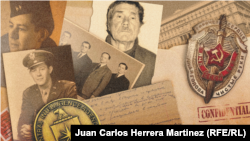
The details of Moscow's pursuit of Flott are tucked away in an unpublished Russian-language manuscript housed in a collection of KGB documents called the Mitrokhin Archive.
The files are named after Vasily Mitrokhin, a senior KGB archivist who spent years compiling thousands of pages of notes, then smuggling them out when he defected to Britain in the early 1990s.
Over several pages of the manuscript, KGB interactions with, and surveillance of, an American code-named "Douglas" are described in detail. The code name is used in many of the mentions, but the file also specifically mentions the name "Flott," with accompanying biographical details that match Flott's government career.
Among the most intriguing statements: that the KGB in June 1974 paid for Flott to travel to Moscow from Jakarta, where he worked as an embassy political officer, along with a $10,000 payment authorized by KGB chief Yury Andropov; and that Flott provided KGB officials in Washington with more than 100 classified State Department cables in the mid-1970s.
"It's unusual because it is a case from the Cold War that no one has ever heard of before," said Kevin Riehle, a former US national security and counterintelligence analyst who first came across the description of Flott and shared the original file with RFE/RL.
Who Was Vasily Mitrokhin?
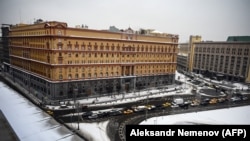
Vasily Mitrokhin worked in the KGB for decades, but he was unsuccessful as an agent posted abroad. When reassigned to Moscow, he was tasked with overseeing the archives of the KGB’s First Directorate, which ran the agency’s spy operations abroad. When the agency moved its archives from its infamous Lubyanka headquarters in Moscow to a suburb, he was tasked with cataloging and organizing the move.
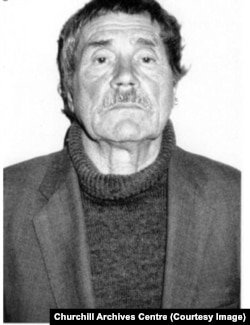
Disillusioned by Soviet rights abuses and inspired by dissident writer Aleksandr Solzhenitsyn, Mitrokhin copied notes on the files, smuggling them out to his country dacha, then painstakingly typing them up and hiding the records in milk jugs stored in a dirt cellar.
In 1992, Mitrokhin approached the US Embassy in Riga, offering himself and his voluminous files. US officials were dubious, so he went to the British in Vilnius, who realized the value of the trove.
Mitrokhin defected to Britain in 1992, turning over his files to the British spy agency MI6, which analyzed and redacted them, and tipped off the CIA and other agencies about KGB informants. Two books were published about the files before Mitrokhin’s edited typewritten Russian-language notes were released to the public in 2014 by the University of Cambridge.
He died in 2004.
"This is an unknown espionage case," said Riehle, now a researcher and lecturer on intelligence and international security at Brunel University of London.
The Mitrokhin files were turned over to the British spy agency MI6, which scoured them, and redacted or withheld many of them. It's unclear why Flott's name was not redacted.
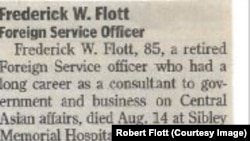
Flott retired from US government service in 1978. He died in 2006.
His relatives and friends say they have never heard any such allegations. They say it is absurd to think he might have been a Soviet spy or worked with the KGB in any clandestine capacity.
His nephew, Robert Flott, said that if Uncle Fred had communicated with the KGB, it was most likely authorized by his government superiors -- perhaps even as part of a disinformation campaign.
"I find it hard to believe that he would pass on classified information that was legitimate," Flott said in an interview from his home in California. "I would believe that he was passing misinformation or information that was not detrimental to the US military or the US government."
"It would be totally in character for Fred to see himself as some sort of double agent," Flott said.
"Fred absolutely giving away secrets without a plan to do that? Hell no. Not a snowball's chance in hell. But with malice aforethought, to screw up the enemy? Yeah," said Jim Mattix, who was a business partner of Flott's after he retired and a close friend in his final years. "What I know of Fred was that he was an incredible patriot, and I'm sure he would've enjoyed being sneaky."
'Kennedy Does Not Know Flott's Associations'
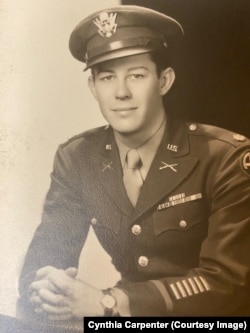
Born in March 1921, Flott grew up near Chicago, the eldest of three brothers. He graduated from Carleton College, a Minnesota liberal arts school with an outsized reputation as a training ground for foreign service officers.
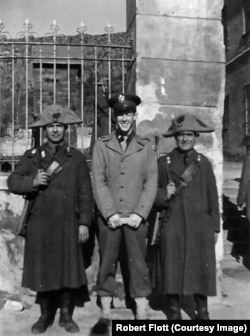
During World War II, he served in Italy and then France, where he spent time with the French underground in the war's final months, sabotaging German locations. Family records say he rose to the rank of major.
After graduating from Washington's Johns Hopkins School of Advanced International Studies -- renowned as a training ground for both diplomats and intelligence officers -- he was sent to Paris and Madrid.
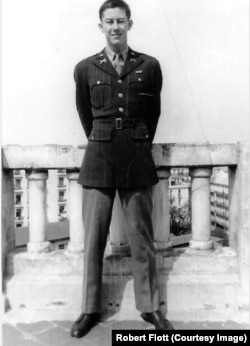
In interviews he gave years after retiring, Flott said in addition to French, he was trained in Russian. He was posted as a political officer to the US Embassy in Tehran, in the months after the 1953 US- and British-backed coup that deposed Prime Minister Mohammad Mossadegh.
In Iran, he said, Soviet agents were trying to stir up trouble around the time.
"I was sent there probably because I spoke Russian," he said. "They figured they'll send a guy who, in case the Russians came in, could deal with them."
He went on to learn German, Spanish, Portuguese, and Italian.
According to Mitrokhin's files, Flott first came to the KGB's attention in Tehran, when a Georgian woman contacted him and asked for a job. Flott arranged for the woman to work for a CIA-sponsored radio station that broadcast Georgian-language information into the Soviet republic.
He was given the code name "Douglas." It was unclear why he was given that name in particular.
In August 1955, Flott was ordered by the US ambassador to accompany Kennedy and the Supreme Court Justice William Douglas on the driving trip around the Soviet Union. The trip was covered widely in US newspaper reports; Douglas penned a first-person travelogue for a magazine afterward.
According to Mitrokhin, the KGB enlisted a Moscow university student to try to "get close" to Flott during the trip. He declined the overtures.
Months after the trip, Kennedy was debriefed by the CIA, interviewed about things of interest to the spy agency: diameters of Soviet pipelines, the heights of oil derricks in Baku, Azerbaijan.
The CIA interview was declassified last year, part of 64,000 CIA documents that were ordered released by President Donald Trump.
In the CIA files, a memo among agency officials advises that Kennedy not be told of Flott's actual employer: "May we suggest that in the...briefing Flott's true position not be revealed."
"Kennedy does not know Flott's associations," a handwritten margin note says.
An Agent Named 'Dita'
Flott was dispatched to US diplomatic posts in Geneva and Bonn in the late 1950s and early 1960s. He traveled again to the Soviet Union as an adviser to Louis Cabot, an industrialist.
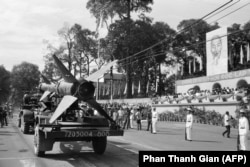
"During that trip," according to Mitrokhin's file, Flott "avoided any critical remarks, asked many questions about life, but did not ask questions of a probing nature that would give reason to think of espionage."
As US involvement in Vietnam deepened in the 1960s, Flott played a key behind-the-scenes role as a special assistant to then-Ambassador Henry Cabot Lodge.
During the CIA-backed coup in November 1963 in which South Vietnam's president was deposed and assassinated, Flott was tasked with escorting the children of the president's sister-in-law -- a woman known officially as Madame Nhu and unofficially as Vietnam's first lady -- out of the country on a US military plane.
In 1965, the Mitrokhin file states, Flott shifted from the CIA to the State Department.
A year later, in July 1966, when Flott was on a brief diplomatic assignment to Israel, the KGB again tried to introduce him to a Soviet agent, this one codenamed "Dita."
"She spoke highly of him as a spy, he did not seek to deepen his relationship with her," the file says.
According to his obituary, Flott's work in Vietnam also included advising and interpreting for top US officials including Defense Secretary Robert McNamara and General Maxwell Taylor, and he was a consultant to President Lyndon Johnson.
An Aeroflot Flight To Moscow
Among the most eye-popping assertions about Flott is that the KGB paid for him to travel to Moscow, from Jakarta, in June 1974.
Flott had been posted to Indonesia the previous year, assigned as political counselor to the US ambassador, Francis Galbraith.
In Jakarta, Flott interacted regularly with several Soviet officials, something he described years later in an interview now on file in the Library of Congress.
"Ambassador Galbraith asked me to handle the relation[s], if any, with the Soviet Embassy," Flott said. "I spent a lot of time taking their temperature, having a channel to them if we should want a channel. I did not get into purely Indonesian things very much."
In January 1974, Flott purportedly shared with a KGB officer codenamed "Petrakov" details of a conversation between the US ambassador and the Indonesian foreign minister; the two discussed the case of a US diplomat who had been attacked in Leningrad that same month.
Flott also shared classified State Department cables regarding a visit by the deputy secretary of state. And, according to the Mitrokhin file, Flott expressed an interest in traveling to the Soviet Union, but suggested the cost of airline tickets was too high.
That same January, KGB chairman Andropov authorized the purchase of an Aeroflot ticket for Flott from Jakarta, to Moscow, and then New York in June 1974.
"Having decided that recruitment of ‘Douglas' should take place in the U.S.S.R., he was provided with a free airline ticket from Jakarta to New York and back," the file says.
Andropov also authorized the head of the KGB's First Directorate, Viktor Chernyshov, to pay Flott $10,000 for the information he had previously provided, plus 600 rubles in spending money while in Moscow, according to the Mitrokhin file.
Flott reportedly was in Moscow from June 17 to July 10, 1974, according to Mitrokhin. While in the Soviet capital, he met with US embassy staffers, but also with Chernyshov, and he agreed to meet with KGB officers once he completed his Jakarta posting and moved to Washington.
There is no known public record that Flott traveled to Moscow in June 1974.
Flott was rotated back to Washington the following year, working at the State Department on issues including international maritime law.
Over the next several years, according to the Mitrokhin file, he provided over 100 classified State Department cables on various topics. In March 1978, the KGB received information that the FBI might have begun monitoring Flott's meetings with Soviet officials, and they cut off contact.
'I'd Love To Fly To Moscow, But It's Too Expensive'
Researchers who have studied the Mitrokhin Archive have found minor discrepancies scattered through it but consider it overwhelmingly reliable: both because of where Mitrokhin worked and because many of the details contained in the documents have been independently corroborated.
Tipped off by MI6 after it received the files, the CIA and other Western intelligence agencies identified numerous informants, spies, and "illegals" the KGB had managed infiltrate into the West over decades.
"He took meticulous notes," said Mark Kramer, director of the Cold War Studies program at Harvard University's Davis Center. "The Mitrokhin materials were extremely important for counterintelligence purposes. They would definitely be among the top one or two collections of publicly available KGB materials."
"They fact that they watched [Flott] so closely is a little surprising," Riehle said in an interview. "The Soviet handlers believed, apparently, that he was approachable, so they watched him for two decades, and that is a long time, a lot of patience to watch someone hoping that he might eventually relent."
"If somebody shows willingness…and approaches a Soviet embassy colleague in Jakarta and says 'I'd love to fly to Moscow, but it's too expensive,' that's just an opening waiting to be exploited for the KGB," Riehle said. "I believe it is very, very plausible that it happened."
Asked if it was possible that the classified cables and other information that Flott had transmitting to the KGB might have been misinformation or useless -- for example, false leads, or information already publicly available -- Riehle said it would have require substantial work by Flott to do that on his own, and there is no known indication the State Department was aware of the effort.
RFE/RL submitted Freedom of Information requests to the State Department, the FBI, and CIA, seeking files on Flott and his career -- or whether he had even been under FBI surveillance.
The CIA did not immediately respond to a request for comment.
Riehle himself said he submitted a Freedom of Information request to the FBI, seeking records indicating the agency was monitoring Flott. He said he was told they could not locate any such files.
'Back When We Were Doing Terrible Things To The Russians'
After retiring in 1978, Flott lived in an apartment not far from Washington's famed Watergate complex and consulted for private companies including the Saudi oil giant Aramco.
After the Soviet Union collapsed in 1991, he consulted with Mattix, trying to set up satellite distance learning programs in Uzbekistan and other newly independent countries.
"Fred once made a crack about 'back when we were doing terrible things to the Russians'," Mattix said in an interview. "I could guess what kind of things those things may have been, but you could not have pried the actual facts from him with a crowbar."
Flott, who never married, had no direct survivors when he died in 2006. His niece and nephew helped clean out his Washington apartment -- sifting through memorabilia from decades of travels and foreign posts: guns, samovars, carpets.
The family called the Washington police department to take away Flott's collection of seven "machine guns" and the ammunition he had acquired.
Flott's niece, Cynthia Carpenter, said there were also hints about the professional contacts Flott developed over the years: a personal letter from Robert F. Kennedy thanking Flott for attending the funeral of his brother after John's assassination; an expensive overcoat that Henry Cabot Lodge had loaned him.
The family was surprised to discover a Swiss bank account in his name that had to be closed in order to settle his estate.
Carpenter said she was stunned to hear of the description of Flott's activities in the KGB files.
"It just doesn't seem to fit," she said in an interview from her home in South Carolina. "He was very anti-Communist. The elements of him being a spy, that was kind of always there, but I just can't see him spying for the Russians."