





During the twilight of Stalin’s Great Purge, the historian Lev Gumilyov did time in a tsarist-era red-brick prison in St. Petersburg’s notorious complex for housing political prisoners. Bolshevik firebrand Leon Trotsky was there years earlier; poet Joseph Brodsky did time there years later.
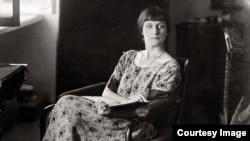
During Gumilyov's stint behind bars in 1938-1939, his mother -- the poet Anna Akhmatova -- shivered in long lines waiting to see her son, and deliver food packages. One of her most famous poems, Requiem, opens with a description of her desperation -- and that of millions of others whose relatives were caught up in Stalin’s whirlwind.
Thanks in part to Akhmatova, the prison complex known as Kresty has long occupied a large emotional place in Russians’ collective memory.
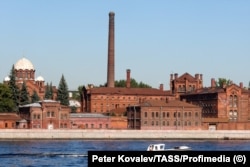
It also occupies prime real estate on the Arsenalnaya Embankment in a central St. Petersburg district.
Earlier this month, however, excavators and tractors began picking apart the bricks at the aging complex -- closed since 2017 -- to make way for a luxury hotel development, complete with spas and restaurants.
Kresty’s destruction is far from an isolated example of prisons and jails being repurposed into swank real estate, driven by politically connected business interests.
Across Russia, a growing number of facilities are being decommissioned by the Federal Penitentiary Service and sold off.
The redevelopment effort serves multiple purposes, said Anna Karetnikova, who previously worked as an analyst at the Federal Penitentiary Service and later with the now shuttered human rights group Memorial.
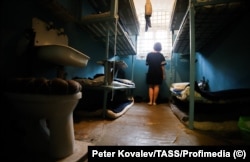
It’s a source of revenue for the government. It’s also a cost-saving measure, allowing the penitentiary service to have bigger, “super prisons” to house more inmates under relatively more modern conditions.
It also helps avoid the sticky issue of remembering Russia’s troubled 20th century history -- which has slowly been whitewashed or outright rewritten during President Vladimir Putin’s 26 years as the country’s preeminent political figure.
That includes outlawing Karetnikova’s organization, Memorial, which did more than any other nongovernmental entity in trying to preserve and document historical crimes.

"The state currently only considers the creation of memorial sites in the context of their destruction, demolition, and other abolition, so I think this option should be ruled out immediately,” she told Current Time.
“Why is it selling them? Because it sees an opportunity to generate income,” she said.
Somewhere 'We Could Bring Madonna'
Butylka, another 19th-century St. Petersburg prison that used to hold sailors, was transferred from the Defense Ministry to the city in 2004.
Six years later, a company owned by billionaire oligarch Roman Abramovich acquired the development rights and put up cafes, restaurants, a beauty salon, and a ballet studio.
In central Moscow, a building that used to house the administrators for the nearby Taganka prison facility is now an 82-room boutique hotel, with rates starting at 5,280 rubles ($70) a night.

Built in 1804 and known simply as Taganka, the complex held political prisoners until Soviet leader Nikita Khrushchev ordered its buildings demolished, save the administration building.
Developer Aleksandr Sharapov, who said he purchased the facility for 15.2 million rubles in 2014 (worth about $400,000 at the time), then invested 500 million rubles into refurbishing it and later opened a museum on the site dedicated to some of its more famous former inmates, and Russia’s wider prison culture.
In Tobolsk, a tsarist-era fortress city in Siberia, the detention center in the central “kremlin” once housed prisoners who were being sent to hard labor or exile. More than 2,500 people were executed on the nearby grounds during Stalin's purges.
Now called Uznik, the facility houses a state-owned museum dedicated to Siberian prisoner labor, along with a 16-bed hostel that has rooms decorated like prison cells. One night on bunk beds in a four- or six-person cell starts at 600 rubles ($7).
"A gorgeous hostel!!! It's stylish, there's a punishment cell,” one visitor wrote in an online review. “It's atmospheric, clean, comfortable. It was easy to fall asleep. We slept sweetly, despite it being a former prison.”

In the coal-mining Kemerovo region, Maximum Security Penal Colony No. 4 was opened by Soviet officials more recently: in 1970.
Its location at the foot of a small ski area that opened in 1981 primed it for acquisition by developers, and the prison was shuttered in 2020 as authorities moved to build a recreation facility for employees.
That never happened, and as of this month, the complex remained vacant and crumbling as officials moved to hold a new auction.
"We need a venue where we could bring Madonna. It's understandable why entrepreneurs don't want to build something like this -- the amount of capital required and the payback period," the head of the resort's management, Aleksei Stoyanov, told a local news outlet.
As for the complex’s cultural significance, the regional tourism minister told the newspaper Argumenty i Fakty that “these buildings… are not cultural heritage sites and have no historical value.”

Get Out Of Jail, Go Fight In Ukraine
Selling off prison facilities is a clear cost-saving measure for the Federal Penitentiary Service. The nationwide prison system used to house hundreds of thousands of inmates, across jails, detention centers, colonies, labor camps, and other far-flung facilities: more than 465,000 prior to 2021.
As of May, however, the prison population has dropped by nearly 40 percent: to 282,000, according to service director Arkady Gostev, who attributed the decline to more humane criminal penalties.
He also quietly agreed with the findings of independent media outlets and rights groups: the Russian military’s use of inmates as low-skilled infantrymen in the war in Ukraine -- essentially cannon fodder -- has sharply reduced the prison population.
Meanwhile, even as prison facilities are being closed down, larger pretrial detention centers are still overcrowded and operating beyond capacity, Karetnikova said.
The reason for that, she said, is that authorities keep people in detention longer as a way of coercing them into signing up to fight in Ukraine.
"They can't immediately persuade everyone to go to the front. And if they spend a little time in the detention center and see that their criminal case won't be dismissed, that the mistake won't be resolved, they'll probably reconsider..." she said.
'A Place Of Freedom'
Used most recently for pretrial detention, when the Kresty complex in St. Petersburg was finally shuttered in 2017 its inmates moved to a new facility southeast of the city.
The 15-billion-ruble ($182 million) complex that will replace Kresty’s barred windows and drafty concrete corridors will include a 136-room four-star business hotel, a 126-room “family” hotel, plus an open-air food street, a concert hall, and playground. The site of the former exercise yard, where prisoners shuffled in meager clothing for limited daily walks, will be a luxury restaurant.
Developer KVS bought the property in February 2025 for 1.14 billion rubles, outbidding another developer who had proposed a “Museum of the History of Good and Evil” on the site.
KVS hired famed graphic designer Artemy Lebedev to craft a logo for the complex.
"This used to be a place of imprisonment,” Lebedev said in June, as he unveiled the design during the St. Petersburg business forum, “but now it's a place of freedom.”

