




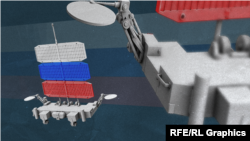
Russia is building its own version of Starlink -- Elon Musk’s constellation of satellites in low-earth orbit that can provide fast Internet access anywhere in the world.
Until earlier this year, Ukraine and Russia used Starlink for command-and-control on the ground, as well as for piloting explosive-laden drones to their targets hundreds of kilometers away.
In February, Starlink cut off access for terminals in Ukraine, except for a whitelist approved by Ukraine’s Defense Ministry. Russia’s battlefield performance suffered immediately; the number of assaults launched by Moscow’s forces declined, and a Pentagon report linked Russia's loss of satellite communications to Ukraine recapturing hundreds of square kilometers of territory earlier this year.
A prominent pro-invasion Telegram channel said the loss of Starlink “sets communications and battlefield command-and-control in the Russian Armed Forces back a couple of years, to old technologies many had already forgotten about: wired Internet, Wi-Fi, and radio communications.”
Most traditional military communications systems are designed primarily for voice, says Jakub Janovsky, an analyst at Oryx, an outfit that tracks military equipment losses. This makes them ill-suited for the modern battlefield, where large volumes of data, such as video feeds from drones, need to be exchanged constantly. “That is precisely why Starlink and similar systems are virtually indispensable for the military,” Janovsky told RFE/RL.
How Do Satellite Communications Work, And Why Isn’t Russia’s Current Constellation Enough?
The higher a satellite is in orbit, the more area it can cover on the ground. The trade-off is latency: the amount of time it takes the data to travel from a device on the ground to the satellite and vice-versa. For a satellite beaming a movie down to a dish connected to a television, this doesn’t matter, but for a drone operator making decisions in real time, a slow connection could mean missing a target.
To ensure low latencies, satellites providing fast Internet communications fly relatively low, with much of Russia’s Rassvet-3 constellation, developed by Russian aerospace company Bureau 1440, currently in orbit at approximately 500 kilometers above the Earth, although their planned altitude is 800 kilometers. Meanwhile, television satellites are often in geostationary orbit -- meaning they stay fixed above the same point on Earth as it spins -- at around 36,000 kilometers from the surface.
Lower-flying satellites, on the other hand, don’t match the speed of the Earth’s rotation and don’t stay fixed above the same point on the ground. This means any single satellite can only provide a short window of connectivity above a given area as it flies by. For the constellation to provide constant communications, it needs to have enough satellites so that one or more are always above that point.
That means the existing constellation is enough to provide only limited windows of communication to Russia’s forces in Ukraine. Rassvet terminals have not been found on Russian drones or missiles as of yet.
Moscow, We Have A Problem
Bureau 1440 launched its first three satellites, Rassvet-1, in June 2023, successfully testing them in space.
The next batch, three Rassvet-2 satellites, were launched in May 2024 and immediately reached their target altitude of 800 kilometers, successfully testing transmitting data between one another and to Earth.
Things haven’t gone as smoothly for the first batches of Rassvet-3 satellites, which are no longer test versions. An initial launch of 16 was planned for 2025, but this was delayed until March this year. After being delivered to an altitude of about 300 kilometers by a rocket, the craft were meant to use their own power to climb to 800 kilometers.
None of them have reached this level so far: one started to descend and burned up in the atmosphere, 13 are in orbit at 510 kilometers and two are at approximately 360 kilometers.
Some analysts believe Bureau 1440 decided to keep the satellites permanently at a lower altitude than originally planned due to problems with their engines. While this is likely to somewhat affect the area each satellite can effectively cover, it does not mean they are not fit for purpose: Starlink has also lowered the orbital altitudes of many of its satellites over time.
The second, latest group of 16 was launched in July and faces similar issues: 13 of them are rising at similar rates to the first group, but three have fallen to altitudes of 300 or less kilometers and may not end up being operational.
While losing a certain percentage of satellites is normal, with early Starlink prototypes reportedly suffering failure rates of up to 13 percent, space expert Anatoly Zak believes the level of failures experienced by Rassvet is “very painful” and “probably close to unacceptable.” The satellites from the second launch that are ascending are doing so “rather chaotically” at different speeds, with some moving in an orderly chain that others did not join.
Grand Plans, Tight Deadlines
Bureau 1440 has filed two potential plans with the International Telecommunication Union (ITU), the UN agency that coordinates the use of radio frequencies and satellite orbits.
According to one, it would have 292 satellites in orbit at an altitude of 800 kilometers, while the other plan would see a total of 1,350 Rassvet satellites flying at an altitude of 600 kilometers.
Zak says the company is not likely to be able to meet its target of 292 satellites by the end of 2027, the figure most often cited by Russian officials, and that setting unrealistic deadlines is a common practice in the Russian space industry.
According to Janovsky, in the most optimistic case the company might have enough satellites to provide nonstop communications over Ukraine by 2028, but delays may mean it takes until 2030.
An Even Bigger Problem?
Ground terminals may be an even bigger problem.
SpaceX has produced and sold millions of Starlink terminals, while Russia’s Rassvet system is due to begin commercial operations in 2027 and there is still no public evidence of large-scale terminal production.
Analysts argue that terminals could become a key bottleneck. Their phased-array antennas are expensive and Russia lacks the necessary component base, meaning some parts may have to come from China.
Because Rassvet satellites are less densely deployed and operate farther away from Earth than Starlink satellites, its terminals may also need to be larger, heavier, and more powerful, making them less suitable for drones and harder to supply in the large numbers the Russian military would require.
A New Target For Ukraine
A fully deployed constellation will require its own ground-control infrastructure.
Ukraine has repeatedly struck Russia’s Dubna satellite communications center outside Moscow, and in August Ukrainian drones headed toward the Plesetsk cosmodrome before a planned launch. According to Zak, Plesetsk had previously been targeted around other launches, including the March launch of the first batch of Rassvet-3 satellites. Ukraine has also hit the Progress Rocket and Space Center, a plant involved in producing the Soyuz rockets that have carried Rassvet satellites into orbit.
The satellites themselves also depend on a sprawling industrial supply chain, and some critical components may come from only a small number of producers. Zak points to Kaliningrad-based OKB Fakel, a manufacturer of spacecraft propulsion systems, as one likely supplier of engines needed to maneuver satellites and keep them in their intended orbits. Russia has been expanding production of spacecraft engines at the plant.
That leaves Russia with a challenge extending far beyond getting enough satellites into space. Rassvet will also need to launch vehicles, ground stations, terminals, specialized components and factories capable of producing them at scale -- a chain in which disruption at a relatively small number of points could slow the expansion of the constellation.
Destroying the facilities where the satellites themselves are assembled would also be technically possible, Janovsky says. Russia could respond by moving production farther beyond the reach of Ukrainian drones, he adds, but establishing new production lines would take time.
In a war in which access to Starlink has already shown how quickly satellite communications can affect the battlefield, the race to build Russia’s alternative may increasingly be fought on the ground as well as in orbit.