
RFE/RL has identified a Russian prison doctor whom dozens of Ukrainian former captives have accused of subjecting inmates to frequent physical and psychological abuse, sexual humiliation, and deprivation of medical care.
The finding, which adds to growing evidence of violence and abuse against Ukrainian soldiers and civilians held by Russia during its ongoing invasion of Ukraine, is the result of a joint investigation by Schemes, the investigative unit of RFE/RL’s Ukrainian Service, and the Organized Crime and Corruption Reporting Project (OCCRP).
Schemes spoke to about 50 Ukrainians, mostly soldiers, who had been held at Correctional Colony No. 7 (IK-7) in Pakino, in the Vladimir region northeast of Moscow. They have returned home in prisoner exchanges conducted intermittently since Russia launched the full-scale invasion in 2022.
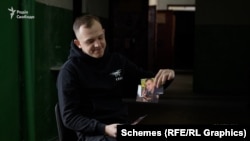
Among other things, former prisoners who spoke to Schemes recounted being beaten repeatedly on the soles of the feet until they were unable to walk -- a form of violence frequently reported by inmates in Russia -- and forced to crawl on the floor “like a seal,” without using their legs.
“The tiles there were sharp. People kept cutting themselves on them, and the wounds would start to fester. And there was no medical treatment at all there,” said Dmytro Khylyuk, a journalist who was taken by Russian soldiers at gunpoint when they occupied his village outside Kyiv in the first weeks of the full-scale war.
The jailers at the prison in Pakino subjected both soldiers and civilians to physical and psychological torture, and younger inmates were singled out for the worst abuse, said Khylyuk, who was released in August 2025 after three years in custody.

To the young prisoners, the jailers would say, “‘Oh, you’re young, healthy.... And you were an athlete? We’ll break you,’” Khylyuk told Schemes.
David Pradchenko, a marine infantryman who was captured during the Russian siege of the Donetsk region city of Mariupol and was taken to IK-7 in October 2022, said interrogations by Russian investigators or the Federal Security Service (FSB) were frequent.
“Someone from the Investigative Committee or the FSB would come and take you to a room. You come in, they say: ‘Stand on a stretcher against the wall’ and off they went to beat you with a taser," said the soldier.
Pradchenko said a cellmate, 23-year-old fellow marine, Pavlo Polyoviy, was driven to suicide by abuse and lack of treatment for a severe stress-induced rash. “He chose the moment when everyone fell asleep…. And then he threw a sheet over the crossbar and hanged himself,” he said.
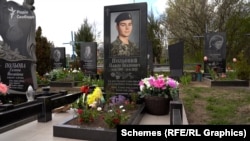
Polyoviy had asked for medicine, but the prison doctor mockingly dismissed the pleas, saying, “What do you have here? I don’t see anything here,” Pradchenko said.
In interviews and on-line communications with Schemes, dozens of former IK-7 inmates said the doctor withheld treatment and subjected prisoners to forced nudity, threats of rape, and other sexual abuse, including making them pose in humiliating positions or simulate sex with one another.
“He could come up and say: ‘What are you, you f***ing idiot, I’ll f*** you right now.’ You say you’re itching, and he’d say: ‘Show me your dick, show me your ass,’” Pradchenko said.
“There was a prisoner in Pakino…a young officer,” Khylyuk told Schemes. “He had some spots on his genitals. And [the doctor] says: ‘Show me, take off your panties. Oh, what a nice head on your penis…. You have very nice balls.’”
“There was a guy in the cell with me, and [the doctor] teased, ‘Maybe you two will become a couple?’ He also said, ‘Let me give you some Vaseline, and I’ll watch,’” said Ihor Shyshko, 43, a special forces officer who was a businessman before the full-scale invasion and spent the latter part of his 801 days in Russian custody at IK-7.

In addition to daily beatings, electric shocks, and poor nutrition, Shyshko said he and 14 cellmates were kept naked for a month and that the doctor who dealt with them most often frequently forced inmates to take “sun baths” in the nude outdoors.
The same doctor once “used a stick -- and no one changed this stick -- to look at my throat. I had a big inflammation there. And then he says, ‘Now I'm going to treat you,’ and he pushed hard with this stick,” Shyshko said. “Then in the first-aid station he made us lie on top of each other…. And he watched all this…. There they were, five or six people, watching, laughing. He says: ‘From a medical point of view, I'm looking at what angle would be best.’”
Numerous former prisoners who did not want their names published gave similar accounts to Schemes.
The prisoners gave the doctor various nicknames, including "Doctor Death," "Doctor Dung," and "Sandal," as he wore sandals in summer and winter. But his most common nickname was “Konoval,” which means farrier but is used to describe a doctor who is a quack.
None of the former prisoners knew the doctor’s last name. Schemes, using information gleaned from prisoners, law enforcement officers, social media posts, official documents, and other sources, identified him as Vyacheslav Cherdantsev.


Schemes also drew on its experience determining the identity of another Russian prison doctor in an award-winning investigation, also conducted with OCCRP, in 2025.
Like that doctor, known to former inmates of IK-10 in Russia’s Mordovia region as “Dr. Evil,” Cherdantsev is employed by a branch of the Russian Federal Penitentiary Service’s medical and sanitary unit that serves the region where the prison is located.
Cherdantsev did not respond to multiple phone calls and messages seeking comment. The Federal Penitentiary Service and the administration of the Pakino prison also did not respond to requests for comment.
On July 10, a day after the Schemes report on the joint investigation with OCCRP was published, Ukrainian authorities issued an official notice informing Cherdantsev, in absentia, that he is suspected of “cruel treatment in the form of torture and committing other violations of the laws and customs of war.”
The notice, which also names two other prison employees and a Russian inmate, says they “used physical and psychological violence” and “committed other actions aimed at abusing human dignity, in particular, humiliating and insulting treatment of several Ukrainian servicemen."
Prisoners were forced to “touch each other’s intimate parts and imitate homosexual sexual acts, in some cases while completely naked,” it says.
In response to an earlier query from Schemes, the Ukrainian Prosecutor-General’s Office said that “war crimes” documented at the Pakino prison included “torture, inhuman treatment, outrages upon human dignity, in particular, insulting and degrading treatment, rape, and other forms of sexual violence."