



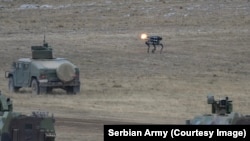

Two weeks after Serbia opened a factory producing Chinese-designed robots, the Serbian military has shown armed quadruped robots operating alongside soldiers in a major military exercise.
The September 13 use of the robots came after Serbian President Aleksandar Vucic vowed on August 29 that armed Chinese-designed robots serving in Belgrade's military would be seen "within 15 days" of the opening of the robot factory in Sabac, western Serbia.
The armed quadrupeds resemble the D1 Max Pro, an industrial robot made by Chinese company AgiBot, which is a partner in the Sabac factory. But it remains unclear whether the robots shown at the exercise were assembled in Serbia. The Serbian military did not respond to a question from RFE/RL on where the robot dogs were produced.
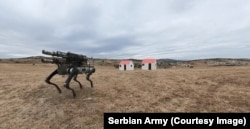
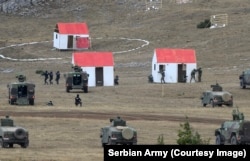
The quadrapeds from the Victor 2026 military exercise in southwestern Serbia were reportedly armed with Yugoslav-designed Wasp anti-tank missiles, automatic rifles, and 40mm grenade launchers. The images show the quadrupeds firing an automatic weapon and entering a dummy building as soldiers swarm alongside.
With the Sabac robotics factory aiming to produce 3,000 humanoid and quadruped robots annually, the military exercise images have raised the specter of armies of killer robot dogs emerging from the Balkans. But that appears unlikely anytime soon, according to observers.
"Serbia will likely encounter the same issues that have prompted militaries to reconsider their adoption of robot dogs," Jared Keller, a US-based weapons technology expert, told RFE/RL. "Compared to other unmanned platforms, quadrupeds still require significant development" to overcome issues around reliability and range, he added.
Ukraine's military received widespread publicity after posting about the use of robot dogs by its soldiers in August 2024. But in the two years since, the robots have rarely been seen on the battlefield. Over the same period, wheeled ground drones have been widely adopted by frontline troops.
A representative from Brave1, the Ukrainian initiative behind many of the country's battlefield innovations, told RFE/RL that wheeled drones "may be preferable [over quadruped robots] for some missions because of their payload, endurance, and because they can be used for long-range missions."
Brave1 did not directly respond to a question about whether quadruped robots had been phased out of Ukraine's war effort, but said that "legged platforms may offer advantages in difficult terrain or around obstacles."
A wheeled Ukrainian Spider ground drone used in the country's military weighs 50 kilograms but is capable of carrying a payload of a 100 kilograms. In comparison, an advanced quadruped robot weighing the same as the spider is able to carry just 10 kilograms. Belgrade has claimed its "robodog" has a maximum payload of 50 kilograms.
Robot dogs are far more mechanically complex than wheeled drones, with around 12 individual motors needed in each quadruped, along with a complex suite of sensors. Such mechanical complexity drains batteries, increases the chances of breakdowns, and adds to the cost of the technology. Advanced quadrupeds cost tens of thousand of dollars and would be easy targets for cheap first-person-view attack drones.

Serbia's unveiling of the killer quadruped technology comes amid Belgrade's increasing incorporation of advanced Chinese weapons systems into its military's arsenal, including missile systems and aerial drones. Nearly 60 percent of Serbia's weapons imports from 2020-2024 were from China.
Both the European Union and the United States have hinted at increasing unease over what Beijing and Belgrade refer to as their "steel friendship." A US State Department spokesperson told RFE/RL's Balkan Service that "Serbia's future economic opportunities will depend largely on the investments, policy decisions, and partnership choices it makes today." The spokesperson further called for Belgrade to choose "trusted sources and suppliers of AI equipment and technology" and to choose "reliable partners like the United States."
Keller says Serbia's public display of killer quadrupeds may be more about geopolitical optics than real-world battle strategy.
"Middle-tier leaders frequently trot out advanced weaponry to telegraph technological prowess, even when those systems are not often backed up by the defined tactics and doctrine that are the foundation for real-world operations," he said.

