



News
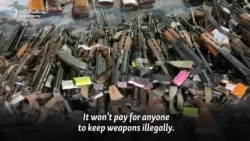
Serbs Surrender 13,500 Pieces Of Unregistered Weapons After Mass Shootings
People in Serbia have handed over some 13,500 unregistered weapons and explosive devices to police in an amnesty following two mass shootings this month, President Aleksandar Vucic said on May 14. The authorities have told citizens to give up illegal weapons by June 8 or face prison sentences, after 17 people -- many of them children -- were killed and 21 wounded in the two attacks in early May. "I am proud of this action and the results. It is necessary and important for the greater security of our citizens," Vucic said. To read the original story by RFE/RL's Balkan Service, click here.

More News
- By Reuters
Ukraine's First Lady Meets With South Korean President
Ukraine's first lady, Olena Zelenska, met with South Korean President Yoon Suk-yeol as a special presidential envoy, South Korea's presidential office said on May 16. Zelenska is visiting South Korea to participate in a media conference. In an interview with South Korea's Yonhap news agency published on May 16, Zelenska expressed a willingness to invite Yoon to her country, saying such a visit would be "very supportive" to Ukrainians. South Korea, a major producer of artillery shells, has said it was not providing lethal weapons to Ukraine, citing its relations with Russia.
CIA Urges Russians Frustrated By War To Share Information
The U.S. Central Intelligence Agency (CIA) has released a video containing instructions for Russians disappointed or angry about the Kremlin's war on Ukraine and life under President Vladimir Putin on how to share valuable information with U.S. intelligence anonymously and securely. "The CIA wants to know the truth about Russia, and we are looking for reliable people who can tell us this truth," the video on Telegram says. "Your information may be more valuable than you think." The video has also been shared on other social media, including YouTube, Twitter, Instagram, and Facebook. To read the original story by RFE/RL's Ukrainian Service, click here.
- By RFE/RL
Amnesty Says Executions, Led By Iran, Skyrocketed Last Year
Executions around the world rose to their highest number in five years in 2022, with Iran driving the spike, offsetting hopes raised by the abolition of capital punishment in six countries, among them Kazakhstan, according to Amnesty International.
In its annual report on the death penalty released on May 16, the rights group said that "disturbingly," 90 percent of the world's 883 confirmed executions outside China were carried out by just three of the 20 countries known to have carried out capital punishment last year.
All three were in the Middle East, led by Iran, which saw executions soar to 576 in 2022 -- a year marked by massive nationwide protests in the country over deteriorating living conditions and the government's suppression of basic human rights -- from 314 the previous year.
Iran was followed by Saudi Arabia, where executions tripled from 65 in 2021 to 196 in 2022 -- the highest recorded for that country by Amnesty in 30 years -- while Egypt executed 24 individuals.
Amnesty said that given the opaque data from several countries that have the death penalty, figures on the use of capital punishment are minimum figures and "the true overall numbers are likely to be higher."
As in previous years, Amnesty did not include executions in China in its figures, even though Beijing implements capital punishment more than any other country. It says that the true extent of the usage of the death penalty there is unclear because the data is considered a state secret. Nonetheless, the report said executions were believed to be in the thousands.
"Countries in the Middle East and North Africa region violated international law as they ramped up executions in 2022, revealing a callous disregard for human life," said Agnes Callamard, Amnesty International's secretary-general.
"The number of individuals deprived of their lives rose dramatically across the region; Saudi Arabia executed a staggering 81 people in a single day. Most recently, in a desperate attempt to end the popular uprising, Iran executed people simply for exercising their right to protest," she added.
Iran has been wracked by unrest that have posed the greatest threat to the Islamic republic's cleric leadership since the revolution that brought it to power in 1979.
Rights groups have accused Tehran of using executions to "instill fear" among the public to help quell protests that gained momentum following the September 16 death of Mahsa Amini, who was in police custody for an alleged hijab violation when she died.
The Amnesty report noted that executions resumed in five countries last year, including Afghanistan, while the recorded number of people executed for drug-related offenses more than doubled in 2022 compared to 2021.
Drug-related executions are in violation of international human rights law, which states that executions should only be carried out for the "most serious crimes" -- crimes that involve intentional killing.
"In a cruel twist, close to 40 percent of all known executions were for drug-related offenses. Importantly, it's often those from disadvantaged backgrounds that are disproportionately affected by this callous punishment," Callamard said.
"It's time for governments and the UN to up the pressure on those responsible for these blatant human rights violations and ensure international safeguards are put in place," she added.
Despite the jump in executions, Amnesty said it saw "a glimmer of hope" as six countries abolished the death penalty either fully or partially.
Kazakhstan, Papua New Guinea, Sierra Leone, and the Central African Republic abolished the death penalty for all crimes last year, while Equatorial Guinea and Zambia abolished the death penalty for ordinary crimes only.
As of December 2022, 112 countries had abolished the death penalty for all crimes and nine countries had abolished the death penalty for ordinary crimes only, Amnesty said.
Afghanistan, Bangladesh, Belarus, China, Egypt, Iran, Iraq, Japan, Kuwait, Myanmar, North Korea, State of Palestine, Saudi Arabia, Singapore, Somalia, South Sudan, Syria, the United States, Vietnam, and Yemen all carried out executions in 2022, Amnesty said in the report.
Kyiv Targeted By 'Exceptionally' Heavy Air Attack, Authorities Say
Russia launched an "exceptionally dense" series of overnight drone strikes on Kyiv that were largely repelled by the Ukrainian air defenses, officials said early on May 16, as Moscow appeared to step up its air attacks on multiple locations in the eastern region of Donetsk, where the heaviest fighting has been taking place for months.
The uptick in Russian air activity came amid expectations of a long-anticipated Ukrainian counteroffensive as Ukrainian President Volodymyr Zelenskiy completed a European tour that resulted in more pledges for military backing from allies in Rome, Berlin, Paris, and London.
Live Briefing: Russia's Invasion Of Ukraine
RFE/RL's Live Briefing gives you all of the latest developments on Russia's full-scale invasion, Kyiv's counteroffensives, Western military aid, global reaction, and the plight of civilians. For all of RFE/RL's coverage of the war in Ukraine, click here.
Serhiy Popko, the head of the capital's military administration, said the drone attack -- the eighth targeting Kyiv since the start of this month -- was "exceptional in its density," involving the maximum number of drones "in the shortest period of time."
Popko said that the attack was unsuccessful, with most of the drones "identified and destroyed" by air defenses.
Kyiv Mayor Vitali Klitschko wrote on Telegram that three people were wounded during the attack.
Separately, Russia overnight launched at least 18 missiles, mostly from the air, on various targets in Ukraine, but all of them were shot down by Ukraine's air defenses. the Air Force Command reported on May 16.
It said the attack was three-pronged, coming from the north, south, and east and started at 3:30 a.m. local time.
Along the front line in Donetsk, 48 air attacks were registered over the past 24 hours, the General Staff of the Ukrainian military said in its daily report on May 16.
The military said that Bakhmut, Avdiyivka, and Maryinka continued to be the theater of the fiercest fighting in Donetsk, where 49 combat operations took place over the past 48 hours.
On May 15, four civilians were killed in a Russian missile attack on an Avdiyivka hospital, regional Governor Pavlo Kyrylenko said.
Zelenskiy on May 15 said in a video recorded on the train as he traveled back to Kyiv that he was returning with new defense packages, including "more ammunition, stronger weapons for the front, more protection for our people, more political support."
Zelenskiy and British Prime Minister Rishi Sunak discussed in London on May 15 a fighter jet coalition that would train Ukrainian pilots on modern warplanes, which he said was a very important because Ukraine currently cannot control the sky.
Ukraine has previously raised the idea of a fighter jet coalition and pressed the United States to join.
Zelenskiy said after his visits with European leader he felt "extremely positive" about the chances of forming the coalition and said there would be "important decisions" in the near future.
In his nightly video address, Zelenskiy said Britain and Poland had agreed to join the coalition.
"Britain -- yes. Poland -- yes. And I am sure France and other partners will join," he said in the video.
French President Emmanuel Macron said later in an interview that France was open to training Ukrainian fighter jet pilots in France and that those training programs could start right away.
Most Western countries, including the United States, have resisted Ukraine's requests for fighter jets over concerns about escalating the war.
With reporting by Reuters and AP
- By Reuters
Russia Charges Former U.S. Consulate Employee With Covert Collaboration With Foreigners
Russia's Federal Security Service (FSB) has charged a former employee of the U.S. Consulate in the far eastern city of Vladivostok with illegal covert collaboration with foreigners, the state news agency TASS reported on May 15. TASS quoted a law enforcement agency source as saying Robert Shonov had been detained in Vladivostok "after interrogation" and was being held in Moscow's Lefortovo prison. The U.S. Embassy in Moscow said it was aware of the reports but had "nothing further to share at this time."
Ukraine Supreme Court Head Detained For Taking $2.7 Million Bribe
The head of Ukraine's Supreme Court, Vsevolod Knyazev, has been detained for allegedly taking a bribe. The National Anti-Corruption Bureau of Ukraine (NABU) said on May 16 investigators and the Specialized Anti-Corruption Prosecutor's Office (SAP) "exposed large-scale corruption in the Supreme Court." Presidential adviser Serhiy Leshchenko said Knyazev was detained while receiving a $2.7 million bribe. Knyazev has been the head of the Supreme Court since December 2021. The court said details on the situation will follow later in the day. There was no immediate comment from Knyazev. To read the original story by Current Time, click here.
- By Reuters
U.S. Sees More Indications of 'Burgeoning Defense Relationship' Between Russia, Iran
The United States is seeing more indications that Russia and Iran are expanding a defense partnership in a way that will help Moscow prolong its war in Ukraine, the White House said on May 15.
Russia is looking to purchase more advanced drones from Iran, while at the same time Iran is looking to buy "billions of dollars of military equipment" from Russia, including aircraft and other military hardware that increase the security threat to Iran's neighbors, said White House National Security Council spokesman John Kirby.
"This is about a burgeoning defense relationship...that goes both ways," said Kirby, adding that Washington is exploring more sanctions on Iran.
"We are using the tools at our disposal to expose and disrupt these activities, and we are prepared to do more," Kirby told reporters.
Drones are the primary military help Iran is providing to Russia, which is seeking to acquire advanced level types, he said.
Iran announced two months ago that it reached a deal to buy advanced Su-35 fighter planes from Russia. Iranian state media said Iran had asked a number of countries to explore the possibility of selling it fighter jets, and Russia had given a positive response to the request. Details of the deal were not disclosed.
Russian President Vladimir Putin met with Iranian Supreme Leader Ayatollah Ali Khamenei in Tehran last July, stressing closer ties between their two countries in the face of Western sanctions over the war in Ukraine.
Iran has acknowledged sending drones to Russia but says they were sent before Russia launched its full-scale invasion of Ukraine last year. Moscow denies that its forces use Iranian-built drones in Ukraine, although many have been shot down and recovered there.
Iran's air force has only a few dozen strike aircraft, including Russian jets and aging U.S. models acquired before the Iranian revolution of 1979.
With reporting by Reuters, AFP, and AP
Families Of Three Iranian Detainees Lead Protests As Execution Fears Grow
Relatives and supporters of three detained Iranian protesters have rallied outside the prison in Isfahan where they are being held in a desperate bid to halt their possible executions.
Majid Kazemi, Saleh Mirhashemi, and Saeid Yaqoubi were implicated in an incident on November 16, 2022, during which two Basij paramilitary force members and a law enforcement officer were fatally shot in the central Iranian city of Isfahan.
The clash occurred at the height of widespread protests sparked by the death of 22-year-old Mahsa Amini last September while she was in police custody for allegedly breaking Islamic hijab rules.
Family and supporters of the trio on May 14 warned authorities of the Islamic republic that if the executions are carried out, unrest would grow. Late into the night they chanted slogans such as "This is the last message: If you execute, it will be the day of uprising."
Videos surfaced online showing Isfahan residents joining the protest with their vehicles, blasting their horns and creating roadblocks around the central prison in a show of solidarity with the detainees.
Mohammad Hashemi, a cousin of Kazemi, said on Twitter that based on the information he had received, the three protesters could be executed as early as May 15. As of evening on May 15, It was not clear whether the detainees had been executed.
The Daadban Legal Advisory Center has reported that the three have maintained their innocence despite forced confessions broadcast on the Islamic Republic Television.
Amnesty International issued a warning on May 12 that the three detainees face an "imminent risk of execution" following the Supreme Court's confirmation of their execution sentences.
It added that Kazemi, in an audio file sent from Isfahan Central Prison, had spoken of being subjected to torture and repeated violence since his arrest as authorities tried to extract forced confessions.
Iran has seen a surge in executions in recent months, a trend that has drawn widespread domestic and international condemnation.
The High Commissioner for Human Rights Volker Turk on May 9 called the statistics "frightening" and demanded a halt to executions by the Islamic republic. He said Iran has executed an average of 10 people per week this year.
Human rights activists say authorities in Iran are using the executions to try to "instill fear" in society rather than to combat crime.
Written by Ardeshir Tayebi based on an original story in Persian by RFE/RL's Radio Farda
Iran Arrests Eight For Leading Strike Over Wages At Key Gas Site
Iranian authorities have arrested eight people for allegedly leading a workers' strike over wages at a key gas site in the south of the country, local media reported on May 14.
The deputy local governor, Akbar Pourat, reported the arrest of the eight labor activists in the South Pars region. The Islamic Revolutionary Guards Corps (IRGC) allegedly apprehended the individuals, whom Pourat called "rioters and strike leaders."
Some 40,000 people are employed at the South Pars/North Dome megafield, the largest known gas reserve in the world, which Iran shares with Qatar.
The arrests come at a time when the rate of wage increase for workers and employees lags behind the country's soaring inflation rate, which officially stood at 46.5 percent at the end of March. Wage growth is estimated at only half the rate of inflation, leading to increased discontent among the workforce.
Pourat claimed the labor strikes were organized and supported by networks outside the country, though he gave no evidence to back up the accusation. Throughout the current social and economic unrest rattling the country, Iranian authorities' have tried to blame foreign influences for the dissent.
Iran's economy has been ravaged by U.S. economic sanctions, leading to a surge of occupational protests in several cities. A report from Iran's Labor Ministry indicated a significant increase in the country's poverty line, growing 50 percent in 2021 compared to the previous year.
Currently, the South Pars projects employ about 40,000 people. Sakhavat Asadi, the managing director of the Pars Energy Special Economic Zone, recently threatened that striking workers would be replaced.
Unrest has rattled Iran since last summer in response to declining living standards, wage arrears, and a lack of welfare support. Labor law in Iran does not recognize the right of workers to form independent unions.
Adding to the dissent, the death in September of 22-year-old Mahsa Amini in police custody for allegedly wearing a head scarf improperly breathed new life into the demonstrations, which officials across the country have tried to quell with harsh measures.
The activist HRANA news agency says more than 500 people have been killed during the unrest, including 71 minors, as security forces try to stifle widespread dissent.
Thousands have been arrested in the clampdown, with the judiciary handing down harsh sentences -- including the death penalty -- to protesters.
Written by Ardeshir Tayebi based on an original story in Persian by RFE/RL's Radio Farda
Putin Orders Moscow Arts Museum To Hand Over Ancient Icon To Orthodox Church
Russian President Vladimir Putin has ordered Moscow’s state-run Tretyakov Gallery Arts Museum to hand over the country's Trinity icon, by medieval painter Andrei Rublyov, to the Russian Orthodox Church. The church said on May 15 that the decision was made after "multiple requests by believers." Last year, the arts museum gave the icon to the church to use in a religious event. The move was criticized by the museum's curators, who said the icon was damaged in 61 places when it was returned. To read the original story by RFE/RL's Russian Service, click here.
Presidential Plane Bought By Tajikistan From Mexico For $92 Million Arrives In Dushanbe
A presidential plane bought by Tajikistan from Mexico last month for $92 million has arrived in Dushanbe. Nomadic Aviation Group in the United States said on May 14 that the plane left the city of San Bernardino that day. Data from the Flight Radar website showed the plane, a Boeing 787-8 Dreamliner, arrived in the Tajik capital on May 15. Mexican President Andres Manuel Lopez Obrador announced that the plane he inherited from his predecessor was sold to the poor Central Asian country in April. Tajikistan has not commented on the purchase yet. To read the original story by RFE/RL's Tajik Service, click here.
Bulgaria's Chief Prosecutor Refuses To Resign, Denounces 'Trash' In Parliament
Bulgarian chief prosecutor Ivan Geshev has refused to step down, tearing up his resignation letter on national television and attacking unnamed rivals in parliament as "political trash."
"I will finish my mandate," the 52-year-old Geshev told reporters on May 15. "I am not afraid."
Geshev's actions came amid rising pressure for him to resign following allegations by opponents that an explosion near his car earlier this month described as an assassination attempt was staged.
Prosecutors from the Supreme Judicial Council subsequently launched dismissal procedures against Geshev for "damaging the image of the justice system" by disseminating allegedly false information and meddling with the investigation into the May 1 blast near his vehicle.
Prime Minister nominee Mariya Gabriel from the center-right GERB party, which recently won a narrow victory in an extraordinary election, said last week that her future justice minister would initiate proceedings for Geshev's dismissal.
Geshev, who has not commented on the incident involving his car, said on May 15 that he was being attacked by "the political mafia, oligarchy, and organized crime," and claimed former Prime Minister Boyko Borisov was behind the pressure for him to resign. Borisov, who leads GERB, has denied the allegation.
Geshev, who has served as chief prosecutor since late 2019 and is slated to remain for a seven-year term, said he has worked "only and exclusively" for Bulgaria and the security of Bulgarian citizens, but that upon his return from the United States on May 14 he had been advised by an unidentified individual to tender his resignation by the morning of May 15.
He claimed his family was mentioned and that he was told if he did not resign, videos against him would be published.
Geshev also said that last month he had received an offer, which he was told came from Borisov, to start a political career or to take an ambassadorship in Israel or Turkey. Borisov has denied making such an offer and said he was not in a position to do so.
Bulgarian media and prosecution officials have said Geshev and his family narrowly escaped when an explosive blew up near his car on a remote road.
But Interior Minister Ivan Demerdzhiev and Borislav Sarafov -- a Geshev deputy who also heads the country's National Investigation Service -- said Geshev was traveling alone at the time of the explosion and that his armored SUV did not sustain any damage.
On May 15, Geshev demanded Sarafov resign, saying that if his deputy refuses he will file a request with the Supreme Judicial Council to have him removed.
Observers have suggested that supporters of Geshev within GERB may have turned against him following the May 1 incident. The GERB party is currently in talks to form a coalition government that could end a lengthy political stalemate that has resulted in five general elections in two years.
President Rumen Radev on May 15 handed Gabriel the first exploratory mandate to form a government. Under the constitution Gabriel has seven days to propose the Council of Ministers. If she is unable to form a government, Radev will hand the mandate to the second-largest parliamentary group, the pro-European We Continue the Change-Democratic Bulgaria coalition.
With reporting by AFP
Siberian Court Sends Man Suspected Of Setting Military Plane On Fire To Pretrial Detention
A Siberian court has sent to pretrial detention a man suspected of setting an out-of-service Su-24 military plane on fire at the Novosibirsk Aviation Plant in early May. The Lenin district court in Novosibirsk ruled on May 15 that Viktor Skorobogatov must stay in pretrial detention until at last July 12 on a charge of arson aimed at destroying an industrial facility and damaging Russia’s defense capability. Since Russia launched its ongoing invasion of Ukraine in February 2022, hundreds of arson attacks have been reported, mostly targeting military conscription centers. To read the original story by RFE/RL's Siberia.Realities, click here.
Russian Artist Sentenced For Creating Giant Snow Sculpture Of Poop In St. Petersburg
Russian artist Ivan Volkov told RFE/RL on May 15 that he has been sentenced to five months of "correctional work" for creating a snow sculpture in January 2022 in the form of a giant feces near the Field of Mars in the city of St. Petersburg, where those who died in the 1917 Russian Revolution are buried. Volkov was charged with desecrating a burial place after he created the 5-meter-long snow sculpture, painted it brown, and drew yellow around it. "Correctional work" in Russia means the garnishing of significant amounts of the convicted persons' monthly salary by the state. To read the original story by RFE/RL's North.Realities. click here.
- By RFE/RL
Ukrainian Tycoon Dmytro Firtash Suspected Of Embezzlement
The Security Service of Ukraine (SBU) said on May 15 that Dmytro Firtash, a powerful tycoon indicted by the United States for corruption, along with managers of companies under his control had been served with "notices of suspicion" of embezzlement.
According to the SBU, the damage Ukraine's State Treasury suffered from the embezzlement activities allegedly committed by Firtash’s group in Ukraine's gas transit system are estimated at up to 18 billion hryvnyas ($484 million) between 2016 and 2022 as part of a "large-scale scheme."
Regional gas suppliers owned by the 58-year-old allegedly paid the state operator of the Ukrainian pipeline network for only around 30 percent of the gas taken, the SBU said.
"Effectively we are talking about the embezzlement of money from ordinary Ukrainians who paid their utility bills," the statement said.
Group DF, one of the companies under Firtash’s control, said it “firmly and categorically” denies all allegations.
Group DF said in a statement that recent series of searches, criminal cases, and the dissemination of “groundless suspicions and accusations by the SBU lack any legal foundation.”
Firtash, once an ally of ousted Russia-friendly President Viktor Yanukovych, resides in Austria. He is wanted in the United States for bribery and racketeering charges in India. The United States has asked Austrian authorities to extradite him. He has denied wrongdoing and has fought extradition.
Ukraine has sought to reduce the political influence that some businessmen have enjoyed since the collapse of the Soviet Union. The European Union has also made tackling corruption a priority for Kyiv as it tries to join the bloc.
Ukraine imposed sanctions on Firtash in June 2022, accusing him of selling titanium products that Kyiv said ended up being used by Russian military enterprises. Firtash at the time denied the allegations.
The sanctions against Firtash and his Group DF include an asset freeze, ban on capital withdrawal, revocation of licenses, restriction of resource transit, and other restrictions.
With reporting by Reuters and AFP
Representative Of Pro-Russia Party Wins Election For Regional Leader In Moldova's Gagauzia
Evghenia Gutul of the pro-Russia Shor party has won the regional leader election in Moldova's Gagauzia autonomous region. Gagauzia's Central Election Commission said on May 15 that the 37-year-old Gutul beat her 36-year-old rival, Grigori Uzun, of the Socialist Party in a runoff held on May 14. The head of the Shor party, Ilan Shor, is currently in Israel evading arrest. Last month, a court of appeals in Chisinau doubled the original 7 1/2-year sentence that Shor was handed for his involvement in the theft of funds from three of Moldova's largest banks. To read the original story by RFE/RL's Moldovan Service, click here.
Belarusian Opposition Says Be 'Prepared' Amid Rumors That Lukashenka Is Ill
Self-exiled Belarusian opposition leader Svyatlana Tsikhanouskaya has called on the Belarusian public and international community to "be prepared for every scenario" as Minsk and state media have avoided coverage of rumors that Belarusian leader Alyaksandr Lukashenka is ill.
"There are many rumors about the dictator Lukashenka's health," Tsikhanouskaya, a prominent Lukashenka critic and political opponent, wrote on Twitter on May 15. "For us it means only one thing: we should be well prepared for every scenario. To turn Belarus on the path to democracy and to prevent Russia from interfering. We need the international community to be proactive and fast."
The comments by Tsikhanouskaya, who has claimed that Lukashenka stole victory from her in Belarus's presidential election in 2020, come as speculation has risen that the long-serving authoritarian leader is ill.
Meanwhile, the BelTA state news agency in Belarus reported on May 15 that Lukashenka is visiting the central command point of the country's air forces, where is being briefed on the operations of anti-aircraft defense units.
The Telegram channel of Lukashenka’s press service, Pul Pervogo, also reported on Lukashenka's visit to the air force central command point and published a photo of him listening to a report of a military officer on a road surrounded by a thick forest. In the still photo, his left hand appears to be bandaged similarly to how it was last week when he was one of the few leaders in attendance for Russia's Victory Day parade in Moscow. Lukashenka looked unwell at that appearance.
More than two hours later, Pul Pervogo Telegram channel issued a video showing Lukashenka sitting in a room filled with military personnel talking about Belarusian troops being in alert mode after several Russian military aircraft crashed in the Bryansk region near the Ukrainian border last weekend. Lukashenka's voice on the video sounded husky and tired.
Lukashenka has not been seen in public since May 9, when he attended Victory Day celebrations in Moscow and Minsk but skipped a lunch hosted by his close ally, Russian President Vladimir Putin.
On May 14, he did not appear at a ceremony in the Belarusian capital to mark the country's National Flag, Coat of Arms, and Anthem Day. Belarusian Prime Minister Raman Halouchanka read a speech on Lukashenka's behalf during the festivities.
The Crisis In Belarus
Read our ongoing coverage as Belarusian strongman Alyaksandr Lukashenka continues his brutal crackdown on NGOs, activists, and independent media following the August 2020 presidential election, widely seen as fraudulent.
Lukashenka, 68, has also failed to attend other public events over the past three weeks, but there has been no official statement regarding his health or the reasons for his absences. Lukashenka's press service has said only that he continues to work "with documents."
On May 15, Kremlin spokesman Dmitry Peskov said that it is best to follow official statements from the Belarusian authorities regarding rumors of Lukashenka's ill health.
But Belarusian state media appears to be avoiding the topic, reporting mostly about Lukashenka's previous activities. In a report about National Flag, Coat of Arms, and Anthem Day, the state TV channel ANT featured snippets from Lukashenka's address to the Security Council on February 28.
On May 15, the state TV channel BT-1 did not cover Lukashenka's rumored illness and ran segments on the opening of a trade facility in Moscow and the results of the Turkish presidential election.
Other state TV programs limited images of Lukashenka to his trip to Moscow on May 9, while the state news agency BelTA featured an article on his "symbolic week," including his laying of a wreath at the Victory Day monument in Minsk following his return from Moscow and his positive reply to an invitation to attend a UN event in September.
Outside media that cover Belarus, meanwhile, reported on May 13 that Lukashenka had arrived at the Republican Clinical Medical Center in Minsk. Roads to the hospital were reportedly blocked as his motorcade approached, and security forces stood along the route.
Lukashenka has been in power since 1994. He was handed a fifth consecutive term in office by Belarus's election commission following the 2020 election, leading to mass protests and claims by Tsikhanouskaya and other opposition leaders that the election was rigged.
Lukashenka's security forces went on to brutally crack down on the mass protests for months, jailing opposition figures and driving others, including Tsikhanouskaya, into exile.
The authoritarian leader subsequently backed Putin in Russia's war against Ukraine, allowing Russian forces to use Belarusian territory as a staging ground for Russia's intervention.
With reporting by BelTA and Pul Pervogo
Five More Belarusian Activists Face Trials Amid Crackdown On Dissent
Four more activists have gone on trial in Minsk on charges of inciting hatred as authoritarian ruler Alyaksandr Lukashenka's regime continues its crackdown on dissent.
The Minsk City Court started all four trials on May 15, with human rights watchdogs calling the cases politically motivated.
The Crisis In Belarus
Read our ongoing coverage as Belarusian strongman Alyaksandr Lukashenka continues his brutal crackdown on NGOs, activists, and independent media following the August 2020 presidential election, widely seen as fraudulent.
Judge Tatsyana Falkouskaya is trying former lawyer Alyaksey Barodka, who faces up to 12 years in prison if found guilty of "inciting racial, ethnic, religious, or other social hatred or discord."
In another courtroom at the building, Judge Anzhela Kastsyukevich will preside over the trial of Alyaksandr Kandratsyuk, a former employee at the Genetics Institute of the Academy of Sciences of Belarus. He was arrested in September and charged with insulting Lukashenka, insulting a law enforcement officer, and inciting hatred.
Two other trials are starting on the same day in Minsk as well, for Alyaksandr Zhandarau and Ivan Puzdrou, who were charged with insulting authorities and inciting hatred.
Also on May 15, a court in the northeastern city of Vitsebsk started the trial of musician and art manager Uladzimer Bulauski.
Bulauski was arrested in December and charged with "repetitive violation of regulations for holding public events." Before that, he was arrested several times and sentenced to weeks in jail for holding protest rallies.
Hundreds of people have been handed prison terms in the unrest sparked by the August 2020 presidential election, in which Lukashenka claimed victory while rights activists and opposition politicians said the poll was rigged.
Belarus witnessed unprecedented protests over the election results that lasted for several months.
Thousands were detained, and there have been credible reports of torture and ill-treatment of detainees by security forces. Several people have died during the crackdown.
The 68-year-old Lukashenka has leaned heavily on Russian support amid Western sanctions while punishing the opposition and arresting or forcing abroad many of its leaders.
The United States, the European Union, and several other countries have refused to recognize Lukashenka's self-declared victory.
Tajikistan Extradites Ossetian Wife Of Islamic State Recruiter To Russia
Tajikistan has extradited Madina Bandarenko, the Ossetian wife of a notorious recruiter for the Islamic State extremist group in Tajikistan, to Russia along with her four children.
Bandarenko is accused by Russia of cooperating with and belonging to the Islamic State group and is being held in a prison in Russia's North Ossetia region, according to her mother, Oksana Jeylieva.
Bandarenko is the wife of Parviz Saidrahmonov (aka Abu Dovud), who was sentenced to 21 years in prison in November on terrorism charges in Dushanbe.
Saidrahmonov, who was extradited to Tajikistan from Turkey, was accused of recruiting more than 200 people to fight in Syria and Iraq and was alleged to be behind multiple terrorist activities in Tajikistan, Russia, and Sweden.
He was sentenced on charges of organizing a terrorist group, extremism, and recruiting mercenaries to fight in a foreign country. Saidrahmonov was a migrant worker in Russia when he left in 2014 for Iraq, where he joined the ranks of the Islamic State group.
Swedish investigators say Saidrahmonov was an accomplice of Rakhmat Akilov, an Uzbek man who drove a hijacked truck down a busy pedestrian street in Stockholm on April 7, 2017, killing five people and injuring 10 others.
Akilov, a rejected asylum seeker in Sweden before the attack, was sentenced to life in prison in June 2018.
Saidrahmonov was later captured by Syrian authorities and in mid-2020 disappeared from a prison in the Syrian town of Afrin when Tajikistan was working on his extradition to Dushanbe.
Tajik authorities, who took Saidrahmonov into custody in September, consider him to be "one of the most dangerous recruiters of the Islamic State."
Dushanbe estimates that about 2,000 Tajik citizens joined Islamic State in Iraq and Syria in 2013-15. Hundreds of them were killed in clashes in the Middle East. Some of those who returned to Tajikistan were either sentenced to lengthy prison terms or received amnesty.
Zelenskiy Returns From European Tour With Weapons Pledges, Hope For Fighter Jet Coalition
Ukrainian President Volodymyr Zelenskiy has returned to Ukraine from a European tour with more pledges for military backing from allies in Rome, Berlin, Paris, and London.
Live Briefing: Russia's Invasion Of Ukraine
RFE/RL's Live Briefing gives you all of the latest developments on Russia's full-scale invasion, Kyiv's counteroffensives, Western military aid, global reaction, and the plight of civilians. For all of RFE/RL's coverage of the war in Ukraine, click here.
Zelenskiy said on May 15 in a video recorded on the train as he traveled back to Kyiv that he was returning with new defense packages, including "more ammunition, stronger weapons for the front, more protection for our people, more political support."
His press service said on his last stop in London, Zelenskiy and British Prime Minister Rishi Sunak discussed a fighter jet coalition, which Zelenskiy said was very important because Ukraine currently cannot control the sky in its defense against invading Russian forces.
Ukraine has previously raised the idea of a fighter jet coalition and pressed the United States to join.
Zelenskiy said after his visits with European leader he felt "extremely positive" about the chances of forming the coalition and said there would be "important decisions" in the near future.
In his nightly video address, Zelenskiy said Britain and Poland had agreed to join the coalition, which would train Ukrainian pilots on modern Western aircraft.
"Britain -- yes. Poland -- yes. And I am sure France and other partners will join," he said in the video.
French President Emmanuel Macron said later in an interview that France is open to training Ukrainian fighter jet pilots in France and that those training programs could start right away.
Macron told France's TF1 television that he had not discussed sending warplanes to Ukraine with Zelenskiy. Other Western countries, including the United States, have resisted Ukraine's requests for fighter jets over concerns about escalating the war.
The Ukrainian president visited London on May 15, Berlin and Paris on May 14, and Rome on May 13. Berlin pledged a new 2.7 billion-euro ($3 billion) defense package – the biggest since Russia’s invasion of Ukraine in February 2022 -- a day before his arrival.
Sunak pledged "hundreds" of air-defense missiles and long-range attack drones, building on Britain's announcement last week that it would be the first country to start supplying Ukraine with long-range cruise missiles.
"This is a crucial moment in Ukraine's resistance to a terrible war of aggression they did not choose or provoke," Sunak said in a statement. "We must not let them down."
The Kremlin said it took an "extremely negative" view of Britain's decision to supply long-range missiles and other military equipment to Ukraine, but that it will not change the outcome of the war.
Zelenskiy said in all his talks with European leaders he discussed his peace formula of a complete withdrawal of Russian troops from the territory of Ukraine, which has been defending itself against the full-scale Russian invasion with massive Western help. A major Ukrainian counteroffensive has been expected for some time.
A top Ukrainian commander said earlier on May 15 that his ground forces had shown that they can succeed under difficult conditions in their effort to beat back Russian forces in the eastern city of Bakhmut.
"The defense of Bakhmut continues and recent days have shown that Ukraine can move forward and counter the Russian forces there, Colonel-General Oleksandr Syrskiy told Ukraine's Media Military Center Telegram channel on May 15.
"The advance of our troops along the Bakhmut direction -- that is the first successful offensive operation in the city's defense," Syrskiy said.
Syrskiy added that the ground forces he commands are fighting with fewer resources than Russia's military forces and fighters from the private Wagner paramilitary group who have spearheaded the Kremlin's efforts to take the city in Ukraine's Donetsk region in recent months.
"The last few days have shown that we can move forward and destroy the enemy even in such extremely difficult conditions," he added. "The operation to defend Bakhmut continues. All necessary decisions for the defense have been made."
The Ukrainian military described Bakhmut and Maryinka as being at the "epicenter of hostilities." Donetsk regional governor Pavlo Kyrylenko said on May 15 that four people were killed when a Russian missile attack struck a hospital in Avdiyivka.
Zelenskiy later spoke by video address to the Copenhagen Democracy Summit, appealing to NATO to make a "positive political decision" on Kyiv's membership bid at a July summit.
Zelenskiy's European tour opened a week of intense diplomatic activity on the Ukraine crisis, including a Council of Europe summit and a G7 gathering in Japan, and resulted in promises of increased assistance from France and Germany.
WATCH: Despite making gains in the eastern city of Bakhmut, Ukrainian troops say they continue to face intense artillery strikes from Russian forces who fire up to 500 shells a day. Current Time's Andriy Kuzakov reported from near Bakhmut on May 6 on the fighting and efforts to treat the wounded.
Amid speculation over whether Ukraine has already begun its long-expected counteroffensive, much attention has been paid to reported rifts between Wagner chief Yevgeny Prigozhin and the Russian military and defense officials.
On May 14, The Washington Post cited leaked U.S. intelligence documents in reporting that Prigozhin's Wagner mercenary force, which has borne the brunt of the bloody fighting in Bakhmut for months, offered in January to reveal the positions of Russian troops to the Ukrainian government in exchange for withdrawing Wagner forces from the city.
Kyiv rejected the offer, according to the U.S. daily, which said that Prigozhin's offer came through his contacts with Ukrainian intelligence. Washington has not commented on the report, which was based on secret U.S. documents leaked on the group-chat platform Discord.
Prigozhin, a close ally of Russian President Vladimir Putin, previously publicly threatened to withdraw his forces from Bakhmut and surrounding regions unless they received additional ammunition.
In a rare admission of casualties among its military command, the Russian Defense Ministry said on May 14 that two of its military commanders were killed trying to repel Ukrainian attacks in eastern Ukraine.
It also said Ukrainian forces had waged attacks in the north and south of Bakhmut over the previous 24 hours, but had not broken through.
Neither Ukrainian nor Russian forces have succeeded in taking full control of the city after months of fighting that has caused heavy casualties on both sides.
Kyiv has dismissed suggestions by Prigozhin and others that its counteroffensive has officially begun.
With reporting by Reuters
- By Reuters
Top Chinese Envoy To Visit Ukraine, Russia On 'Peace' Mission
A top Chinese envoy will begin a tour of Ukraine, Russia, and other European cities on May 15 in a trip Beijing says is aimed at discussing a "political settlement" to the Ukraine crisis. Li Hui, China's special representative for Eurasian affairs and a former ambassador to Russia, will also visit Poland, France, and Germany on the trip, the Foreign Ministry announced, without providing a detailed schedule. He is the most senior Chinese official to visit Ukraine since Russia invaded in February 2022. To read the original story by Reuters, click here.
- By AFP
Armenia, Azerbaijan Leaders Meet In Brussels As Tensions Simmer
Armenia and Azerbaijan's leaders met on May 14 for talks in Brussels amid heightened tensions on the tense border between the two countries over control of a contested enclave. The EU welcomed the meetings as a positive step toward clinching a durable peace agreement. The talks between Armenian Prime Minister Nikol Pashinian and Azerbaijani President Ilham Aliyev were hosted by European Council President Charles Michel. Michel held bilateral talks with Pashinian on May 13 and with Aliyev on May 14. Neither leader commented after the meetings. The talks come after fresh clashes erupted on the border between the two Caucasus countries.
- By AFP
Iran Arrests Eight Over Workers' Strike At Southern Gas Field
Iranian authorities have arrested eight people for "leading" a workers' strike at a key gas site in the south of the country, local media reported on May 14. "Eight main leaders of the workers' strike in the South Pars projects have been arrested by the intelligence services," Akbar Pourat, the deputy local governor, was quoted as saying by Tasnim news agency. Some 40,000 people are employed at the South Pars/North Dome mega-field, the largest known gas reserve in the world, which Iran shares with Qatar.
Belarusian Leader Skips Official Event Amid Rumors Of Hospitalization
Belarus's authoritarian leader, Alyaksandr Lukashenka, on May 14 failed to attend events to mark the National Flag, Coat of Arms, and Anthem Day amid rumors of ill-health.
Prime Minister Raman Halouchanka read a speech on Lukashenka's behalf at the events in Minsk.
It is the latest in a series of public events in the past three weeks that Lukashenka has failed to attend, but there has been no official statement on the health of the 68-year-old. An unconfirmed report on May 13 said he was taken to a hospital in Minsk.
Lukashenka attended the May 9 Victory Day celebrations in Moscow, where he looked unwell, and a bandage was visible on his right hand.
A member of the Russian State Duma was quoted by Russian media on May 14 as saying that Lukashenka was ill, but it's nothing out of the ordinary and not COVID.
"Despite the fact that the man fell ill, he considered it his duty to come to Moscow, and then in the evening of the same day he held events in Minsk. He probably needs some rest, that's all," said Konstantin Zatulin, first deputy head of the Russian State Duma Committee on Commonwealth of Independent States Affairs, according to the Russian publication Podyom.
Zatulin told Podyom that he knows what Lukashenka is suffering from but did not reveal the diagnosis.
Lukashenka's press service has not commented specifically about any illness, but said he continues to work "with documents."
News reports on the evening of May 13 said Lukashenka arrived at Republican Clinical Medical Center in Minsk. Roads to the hospital were blocked as his motorcade approached, and security forces stood along the route.
Lukashenka has been in power since 1994. The country's election commission declared him the winner of the 2020 election, but the results were disputed amid the widely held belief that the contest was rigged and that the true winner was opposition politician Svyatlana Tsikhanouskaya.
Lukashenka's regime brutally cracked down on mass protests against the outcome in the months that followed, jailing opposition figures and driving others into exile.
The authoritarian leader subsequently backed Russian President Vladimir Putin in Russia's war against Ukraine, allowing Russian forces to use Belarusian territory as a staging ground for Russia's intervention.
- By AFP
Iran Summons Iraqi Envoy Over Kurdish Opposition Groups
Iran has summoned Iraq's ambassador to protest the presence of Iranian opposition groups at an official ceremony in Iraq's autonomous Kurdish region, media reported on May 14. Quoting the Foreign Ministry, the ISNA news agency said that during the May 13 meeting Tehran expressed its "strong objection" to the invitation of members of "separatist groups" to the ceremony, "contrary to the recent security agreement between the Islamic republic and Iraq." Iran uses the words "separatist groups" to describe Kurdish factions opposed to the Iranian government, and considers them to be "terrorist" organizations.
Editors' Picks
Top Trending
'Panicking For Real': In Anticipation Of A Counteroffensive, Russia Moves Thousands Of People From Their Homes In Southern Ukraine
2Russia Acknowledges Retreat North Of Bakhmut After Major Advance By Ukrainian Troops
3Wagner Mercenary Chief Prigozhin Says Ukraine's Counteroffensive Is Under Way
4Multiple Russian Jets, Helicopters Reportedly Crash Near Ukrainian Border
5Erdogan Could Lose The Election In Turkey. It Would Be A Blow To Putin.
6Zelenskiy Returns From European Tour With Weapons Pledges, Hope For Fighter Jet Coalition
7Britain Confirms Supplying Ukraine With Long-Range Missiles As Moscow Fumes
8Belarusian Opposition Says Be 'Prepared' Amid Rumors That Lukashenka Is Ill
9Sanctioned Russian Cargo Ship Loaded With Weapons After Docking In South Africa, U.S. Ambassador Says
10Detained Ukrainian Industrialist, Suspected Of Collaboration, Requests Transfer To Russia
Subscribe