




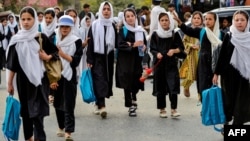
A lack of rights, falling wages, deteriorating living conditions: Five years of Taliban rule have brought changes to Afghanistan, but not the ones many Afghans hoped for.
Though roadside bombs and violent clashes between warring factions have largely subsided, the country faces a profound economic crisis, a severe humanitarian emergency that has left millions of people in need of aid, and near-total international isolation over the Taliban’s human rights record, particularly its systematic erasure of women and girls from public life.
For a lot of Afghans, hope may not be completely lost, but it has taken a major hit.
“I’ve been driving a taxi in Kabul for 20 years, but over the past five years, I have seen problems that I had never experienced before,” a cab driver told RFE/RL of the financial hardship he has experienced under the Taliban.
“All I want is to earn a halal living and put food on the table,” the man in his mid-40s said near his taxi, which is almost the same age.
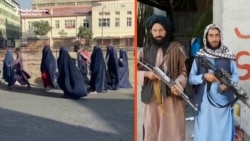

When they seized power in August 2021 as international forces withdrew, the Taliban inherited a structurally fragile economy heavily dependent on inflows of foreign aid.
But that has all but dried up as Taliban policies, especially the almost total isolation of females from public life outside their homes, halted the flow of funds.
Afghans from large business owners to retailers, transporters, and daily wage laborers now complain about falling earnings and shrinking economic opportunities under the Taliban.
'Medieval Ideas Of Governance'
An April 2025 World Bank report said that “poverty, food insecurity, and malnutrition remain pressing challenges” in Taliban-ruled Afghanistan where high unemployment and restrictions on women continue to strain livelihoods.
With girls’ secondary-school enrollment at just 3 percent, the World Bank report says a “generation of young women faces a future of poverty and dependence.”
“The Taliban are using medieval ideas of governance to rule a country which faces complex 21st century challenges,” said Michael Semple, a professor at Queens University Belfast.
The Taliban has restored relative calm after decades of conflict.
Bomb blasts and security concerns have eased, but analysts say the regime has done little to address its major challenge -- establishing economic stability and ensuring good governance to improve living standards.

The Taliban has abolished all democratic institutions and advisory authorities, centralizing decision-making around its reclusive chief Mullah Hebatullah, who has issued a stream of edicts -- many relating to girls and women -- without setting out any comprehensive plan or road map to ensure good governance and economic prosperity.
The center of decision-making has largely shifted from the capital, Kabul, to the remote southern province of Kandahar, the birthplace of the Taliban movement in the mid-1990s.
At the same time, the predominantly ethnic-Pashtun Taliban, whose roots lie largely in southern and southeastern Afghanistan, has concentrated power at all levels among its own senior leaders, commanders, and members.
“The most important challenge for the Taliban is that they have no model of governance,” said Washington-based Afghan analyst Mushtaq Rahim, who was involved with various governmental and nongovernmental projects regarding good governance in Kabul before August 2021.
“They are running Afghanistan on purely traditional lines which is not in line with international norms,” Rahim told RFE/RL, adding that the primary reason for sticking to the traditional system of governance is that the "Taliban have neither the capacity nor the capability to do so themselves, while they don't accept help from the outside.”
That lack of governance, coupled with growing economic insecurity, has raised concerns among some that Afghanistan could return to being a cauldron of insecurity.
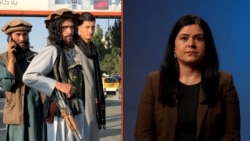

London-based Afghan analyst Sami Yousafzai believes that over the past five years, the Taliban have alienated ordinary Afghans “who feel like strangers in their own land.”
“With their purely rural background, the Taliban care more about group loyalty and far less about national unity,” Yousafzai told RFE/RL.
Semple said he too believes “the population is alienated,” with the Taliban blocking "every effort to start a political process which could open the way to a more inclusive system.”
Ominously, Semple said, at least three groups have recently announced armed resistance against the Taliban in Badakhshan, a resource-rich province in Afghanistan’s northeast that borders Tajikistan, Pakistan, and China.
“Armed resistance is growing,” he said, pointing out that many provinces are also reporting crime waves and that the Taliban itself is conducting “summary executions and enforced disappearances.”
“The main thing prolonging the Taliban rule is the absence of an effective resistance able to mobilize people on the ground,” he said.
International Outreach
As it grapples with these challenges at home, the Taliban has also begun trying to make inroads into the international community, a push analysts say is likely tied at least in part to efforts to attract foreign aid and investment and stabilize the economy.
Afghanistan's gross domestic product in 2020 reached around $20 billion, when international forces were still stationed in the country and the government was bolstered by inflows of foreign funds.
That plummeted to just above $14 billion in 2021, according to the World Bank, though it has managed to rebound slightly -- buoyed by remittances from abroad -- even as living standards for ordinary Afghans continue to worsen.
Russia is the only country that has formally recognized the Taliban government, which has also managed to develop closer contacts with China, India, the United Arab Emirates, and some Central Asian nations.

In a sign of its growing international outreach efforts, a Taliban delegation traveled to Brussels in June for unprecedented, closed-door technical talks with the European Commission and representatives from 15 EU member states. The visit saw discussions on migration, the deportation of rejected Afghan asylum seekers, and consular cooperation.
The European Policy Center called the controversial trip a "creeping normalization" while the Taliban hailed it as a "historic" step toward building trust and establishing a broader diplomatic presence, even though aid wasn't on the agenda and no European Union country appears ready to officially recognize the Taliban's de facto authority.
Meanwhile, analysts say the Taliban will try to continue to block every effort to start a political process that could open the way to a more inclusive system in an effort to hang on to power.
“I think that there is every chance that the Taliban emirates will be overthrown, but I suspect that the force that will overthrow it is not yet in the field,” Semple said.

