




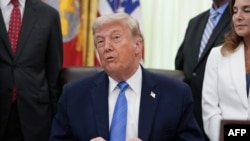
US armed forces launched a second night of air strikes on Iran late on June 10, just hours after President Donald Trump warned Tehran it would be hit "very hard" if a deal aimed at ending more than three months of war is not finalized.
US Central Command said in a statement that its forces began launching additional "self-defense strikes against multiple targets in Iran at the Commander in Chief’s direction."
"The strikes are in response to Iran’s unwarranted and continued aggression," it added.
Several Iranian news outlets, including state broadcaster IRIB, reported loud explosions in cities around the country.
A day earlier, US air strikes rocked several sites in Iran in response its downing of a US Army Apache helicopter in the Strait of Hormuz. Iran then launched strikes at US bases in the region in a tit-for-tat attack.
Trump told reporters during the day on June 10 that "we hit them hard yesterday, and we're going to hit them again hard today."

Before the renewed attacks, Iranian President Masud Pezeshkian said his country would stand firm against any pressure and said threats by Trump were a sign of Washington's desperation.
Trump, speaking to reporters, also claimed that the United States has been taking oil out of Iran.
"I'm just announcing today for the first time, but we've been taking out millions of barrels of oil, millions of barrels every night," Trump said, adding that Iran "just figured it out."
On the negotiations with Iran, Trump added: "We want a deal that is meaningful, we want a deal that works. We were really close to a deal, but they keep tapping us along, they keep playing us for suckers."
Trump said Iran has already agreed to not develop a nuclear weapon -- one of Washington's core demands -- but the agreement still needs to be signed.
Earlier on June 10, the UN nuclear watchdog's 35-nation board of governors approved a US-backed resolution demanding Iran declare its remaining stockpile of enriched uranium and allow inspectors into the country.
Iran's ambassador to Austria, Reza Najafi, told AFP that the resolution was "counterproductive" and an obstacle to talks with Washington.
At a Security Council meeting about the Middle East, UN chief Antonio Guterres suggested that an imperfect cease-fire was better than a return to full-scale war.
"We should not minimize the risks of a lesser fire becoming full fire, or in another word: full war," he said.
Earlier, Trump said Iran's military has been "completely defeated," warning Tehran would "pay the price" for taking "too long to negotiate a deal" with Washington.
Tehran and Washington have been locked in negotiations since April 8, when a cease-fire halted the US-Israeli bombing campaign against Iran.
But several thorny issues have stood in the way of an agreement, including the fate of Iran's enriched uranium, Israel's ongoing war against Hezbollah in Lebanon, and Tehran's demand for Washington to release its frozen funds held abroad.

