




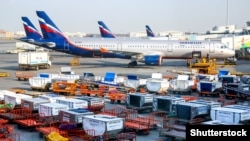
Two days after Ukrainian President Volodymyr Zelenskyy warned civilian airlines of the dangers of using Russian airspace, numerous flight cancellations, airport closures, and other disruptions were reported in the country.
Ukraine's increasingly bold drone campaign against Russia has been causing problems like this for some time and it was not clear that anything specific had changed. But Zelenskyy's hint that Kyiv was about to up the ante has raised the question of just how difficult it can make things for Russia.
“We are not talking now about the temporary disruption of operations, but about blocking them 24/7. In other words, the strategy is to make these airports unusable,” Valeriy Romanenko, from Ukraine's Museum of Aviation, told RFE/RL's Ukrainian Service.
“Such an operation is possible; it is realistic. It would divert a large number of Russian air defense assets, while on our side it would be carried out using small drones,” he added.
'Completely Dangerous'
The backdrop to this was Zelenskyy's nightly video address on September 1.
"Today, we want to warn every airline that uses Russian airspace, every insurer, everyone who still uses key Russian airports: The Russian sky is becoming completely dangerous," he said.
Following Zelenskyy’s warning, Ukraine formally notified the International Civil Aviation Organization (ICAO) on September 2, warning of what it described as growing risks to civil aviation in Russian airspace.
This was underlined by events on September 3.
Moscow’s Vnukovo Airport temporarily suspended operations, while the other major airports serving the city, Sheremetyevo and Domededovo, also announced restrictions. Moscow Mayor Sergei Sobyanin said 548 Ukrainian drones flew toward the Moscow region between September 2 and 3.
The same day, Russia’s Transport Ministry said it had provided foreign airlines with clarifications on safety measures at Russian airports and in Russian airspace following requests from carriers.
Transport Minister Andrei Nikitin said Russia was working with the Defense Ministry and National Guard to minimize the impact.
“I believe that we will not allow any significant disruption to civil aviation,” he said.
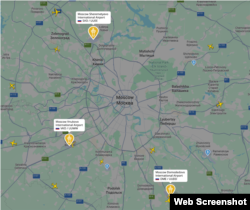
But Flightradar24 data showed four Russian airports among the world’s five most disrupted on September 3.
New Targets
Mass Ukrainian drone attacks have caused mass disruption at Russian airports before, but it has not been sustained for a protracted period of time. Romanenko suggested that increasing the pain levels without attacking civilian aircraft -- something Zelenskyy has explicitly ruled out and which could be a war crime -- could involve additional measures.
“The targets will be Russia’s air-traffic-control infrastructure: control towers, automated landing systems at airports, glide-path equipment, and radar systems for air-traffic control. These are the systems that ensure flight safety. These systems will be struck,” he predicted.

Alexander Lanetsky, CEO of Friendly Avia Support, an aircraft brokerage in Lithuania, told Current Time that shutting down Moscow's airspace would impact aviation across the country, the world's largest by surface area.
“If the Moscow aviation hub were paralyzed for a week, the entire country would absolutely feel it. Constant drone activity in this area would lead to no-fly zones being declared, and the operation of airports, and indeed the entire aviation sector in this region, would be paralyzed,” he said.
On September 3, flight data suggested much of the disruption related to domestic flights. This is economically painful in a country spanning 11 time zones -- and underlines the cost of Russia's war to ordinary passengers.
Much of Russia's international traffic, particularly to Europe, has long been canceled due to Western sanctions following its full-scale invasion of Ukraine in 2022.
But there are still many flights to other countries, with Turkey, Uzbekistan, the United Arab Emirates, China, and Egypt accounting for 72 percent of Russia’s international passenger traffic, according to data from the Association of Tour Operators of Russia (ATOR), an industry umbrella group.
“When deciding whether or not to fly to Russia, these airlines will assess the threats, because the loss of an aircraft in Russian airspace would be solely the responsibility of Russia and the respective airline,” Bohdan Dolintse, an aviation and defense technology expert, told RFE/RL.



