




German, French ministers in Kyiv to revive peace deal:
The German and French foreign ministers are in Ukraine to shore up a 2015 peace deal amid continuing fighting between government forces and separatists in the country's east.
Frank-Walter Steinmeier and Jean-Marc Ayrault held talks with Ukrainian President Petro Poroshenko in Kyiv on September 14 to discuss ways to secure a durable cease-fire and implement the political provisions of the February 2015 Minsk agreement, which was brokered by Berlin and Paris.
On September 13, the leaders of the Russia-backed separatists in Donetsk and Luhansk regions declared a unilateral cease-fire starting midnight on September 14, and Steinmeier said Kyiv agreed to observe the truce.
Ayrault said an agreement between Kyiv and separatists to withdraw their forces in three areas of eastern Ukraine could be signed next week.
The two sides earlier agreed to abide by a cease-fire to coincide with the start of the school year on September 1, which failed to completely stop the fighting that has already killed more than 9,500 people since April 2014. (AP, Reuters)
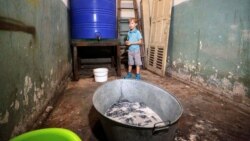
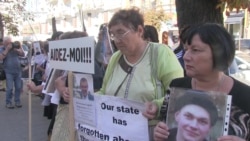
Protestors picketed the German and French embassies in Kyiv, as the two countries' foreign ministers arrived in Ukraine to try to revive peace talks with Russia-backed separatists. (RFE/RL's Ukrainian Service)

Prosecutor cites "criminal probe" into Ukraine's top cop:
By Christopher Miller
KYIV -- Ukrainian Prosecutor-General Yuriy Lutsenko has announced that his office has opened a criminal probe of Interior Minister Arsen Avakov, raising the specter of another public blow to a fractious ruling coalition.
But while the September 14 statement was likely to erode confidence at home and abroad in the country's center-right government, which has been accused of foot-dragging on cleaning up rampant corruption and nepotism, its effect on Avakov was less clear.
The NGO activist whose complaint reportedly sparked the prosecutor-general's announcement said that as far as he knew, it was up to a special anticorruption prosecutor -- not Lutsenko's office -- to pursue the accusation.
In a televised interview with Channel 24, Lutsenko cited a letter of complaint from Vitaliy Shabunin, head of the Kyiv-based Anticorruption Action Center, saying, "I receive more than a dozen letters from people, including Shabunin, whose letter was the premise for an inquiry into -- you won't believe it -- Interior Minister Avakov."
Shabunin subsequently told RFE/RL that anticorruption investigations into any minister's actions fall under the jurisdiction of the National Anticorruption Bureau of Ukraine (NABU). Moreover, he said, he never sent any letter to Lutsenko about Avakov.
"Whatever letter and investigation Lutsenko is talking about is a mystery to me," Shabunin said.
Avakov is a member of the national populist People's Front party, which governs alongside Lutsenko's party, the president's Petro Poroshenko Bloc.
The People's Front has long advocated tougher action against Russia-backed separatists who are fighting government forces in Ukraine's eastern Donetsk and Luhansk regions, earning it the nickname "party of war" in some circles. Some of its most prominent members have pushed for measures that include declaring martial law and labeled as "collaborators and terrorists" some journalists who have reported on the conflict.
Since taking power after the Euromaidan unrest that sent pro-Moscow President Viktor Yanukovych fleeing to Russia in 2014, the Poroshenko Bloc and People's Front have grappled for the upper hand.
Avakov has gained clout as he survived one cabinet reshuffle after another. He was reappointed to the job in April after cabinet changes that accompanied the exit of fellow People's Front member Arseniy Yatsenyuk as prime minister in favor of Poroshenko ally Volodymyr Hroysman.
Shabunin said his anticorruption center brought to NABU's attention a case involving 18 hectares of land near the northeastern city of Kharkiv that is thought to be owned by Avakov's family.
Lutsenko's spokeswoman, Larisa Sargan, in a Facebook post downplayed suspicions that Lutsenko was in any way targeting Avakov. "The charges against the current interior minister could be interpreted as a matter of the imagination that cannot be grounds for prosecution of the minister," she said.
Sargan suggested the anticorruption center might be seeking to drive a wedge between the country's law enforcement authorities with its allegations, adding, "The [Prosecutor-General's Office] and the Interior Ministry are aware that they have a common enemy -- crime and corruption -- against which they are fighting."
Avakov has been singled out by Poroshenko allies in the past.
On August 24, Serhiy Kaplin, a Poroshenko Bloc lawmaker, introduced a bill calling for Avakov's dismissal based on perceived failures to safeguard Ukrainians or lead the fight against rising crime.
The two-year fight against Moscow-backed separatists since Russia forcibly annexed Crimea has sapped precious resources from Kyiv and left swaths of territory in Donetsk and Luhansk outside Ukrainian government control, increasing Ukrainian dependence on international loans and support.