



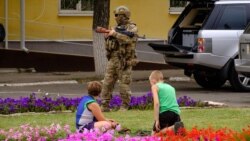
Merkel: NATO, West must protect principle of territorial integrity:
By RFE/RL
MUNICH, Germany -- German Chancellor Angela Merkel says that Western states must protect the principle of territorial integrity and NATO needs to strengthen its eastern flank following Russia's interference in Ukraine.
Speaking at the Munich Security Conference on February 18, Merkel said that territorial integrity is a crucial foundation of the post-World War II order.
She said there was "great anxiety" about the situation in eastern Ukraine, where a war between Russia-backed separatists and government forces continues nearly three years after it erupted following Moscow's seizure of Crimea.
Those Russian actions "highlighted" the importance of NATO, she said, and made clear it needed to bolster its strength on its eastern flank.
Merkel said she was committed to seeking a political solution to the conflict in eastern Ukraine and supported the 2015 Minsk agreement, and she was "against throwing something out that may still be useful."
She added that she was committed to meeting NATO's goal of each member spending 2 percent of gross domestic product (GDP) on defense.
Merkel said she wanted good relations with Russia and believes it is in the common interest of Russia and the West to fight international terrorism.
She also said that Western countries had a "responsibility to bear" in accepting refugees and tackling the root causes leading people to flee their countries.
Merkel called for countries to work together, saying they must do so if they are to be strong.
"Will we be able to act in concert, or will we fall back into parochial policies...? Let us stand together and make the world a better place," she said.
We are now closing the live blog for today, but we'll be back again tomorrow morning to follow all the latest developments. Until then, you can keep up with all our other Ukraine coverage here.
And here's another late item from RFE/RL's news desk:
UNICEF Says 1 Million Children In Eastern Ukraine Require Urgent Aid
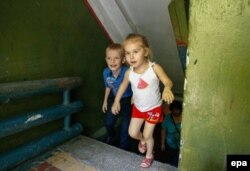
The United Nations says the number of children in urgent need of humanitarian aid in eastern Ukraine has nearly doubled during the past year to 1 million.
The UN's agency for children, UNICEF, said in a report on February 17 that the crisis is the result of the "steady deterioration" of life in eastern Ukraine, where an estimated 1.7 million people have been internally displaced by the volatile conflict in the region.
More than 9,750 people have been killed since fighting broke out in eastern Ukraine in March 2014 between Russia-backed separatists and Ukrainian government forces.
UNICEF said many families have lost their sources of income, social benefits, and access to health care at a time when the cost of living has increased substantially.
"This is an invisible emergency -- a crisis most of the world has forgotten,' said Giovanna Barberis, the UNICEF representative in Ukraine.
"Children in eastern Ukraine have been living under the constant threat of unpredictable fighting and shelling for the past three years," Barberis said. "Their schools have been destroyed, they have been forced from their homes, and their access to basic commodities like heat and water has been cut off."
The UN organization said the situation is "particularly grave" for an estimated 200,000 children living within 15 kilometers from each side of the so-called "contact line" in eastern Ukraine.
The contact line divides areas controlled by the government and nongovernment forces, and it is where fighting is the fiercest.
UNICEF once again calls for all sides to immediately recommit to the cease-fire signed in Minsk in 2015 and to respect international humanitarian law, including allowing unrestricted humanitarian access.
It urged the sides to allow unrestricted access for groups that provide humanitarian assistance.
"After three horrific years, children in eastern Ukraine urgently need lasting peace so that their unnecessary suffering ends," Barberis said.
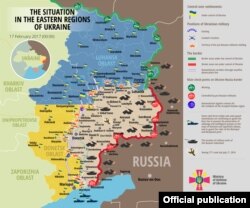
Here is today's map of the latest situation in the Donbas conflict zone, according to the Ukrainian Defense Ministry:
Here's another item from RFE/RL's news desk:
Russia Detains Ukrainian Man With Ties To Crimea Blockade Activists
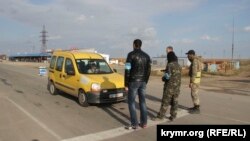
Russian authorities say they have detained a Ukrainian member of a Crimean-Tatar activist group that has led a blockade of the annexed peninsula.
The Federal Security Service (FSB), Russia’s main security agency, said on February 17 that Seit-Ibragim Zaitullaev attempted to "illegally" cross into Crimea, which Moscow seized and annexed from Ukraine in 2014.
An FSB statement cited by Russian state news agencies claimed it found evidence that Zaitullaev belongs to a Crimean-Tatar organization called Asker, which has spearheaded a civilian-led blockade along the border with the Moscow-controlled peninsula.
There was no immediate comment from the Ukrainian government.
Lenur Islyamov, the leader of Asker, confirmed to RFE/RL Russian Service reporter Anton Naumlyuk that Zaitullaev was previously a member of the organization but said he had left the group two months ago.
Russia seized control of Crimea from Ukraine in March 2014 after sending in troops to secure key facilities and staging a referendum dismissed as illegitimate by Ukraine, the United States, and more than 100 countries in the United Nations General Assembly.
Russia has since made it a criminal offense to question Russia's territorial integrity within what the government claims are its borders.
Rights watchdogs and Western governments have accused Moscow of carrying out a broad crackdown on independent media and dissent in Crimea.
The FSB statement said Zaitullaev faces charges of "illegally crossing the border of the Russian Federation."
The statment claimed Zaitullaev told investigators that Asker "prepares specialists for acts of sabotage in Crimea," Russia’s state-run TASS news agency reported.
That language echoes allegations against at least five Ukrainian citizens arrested by Russian law-enforcement agencies in Crimea in November.
The FSB described them as suspected members of a Ukrainian "saboteur group."
Ukraine's Defense Ministry called those allegations "another fabrication of the Russian secret services aimed at justifying its own repressive measures against local residents and [discrediting] Ukraine [in] the international arena."