




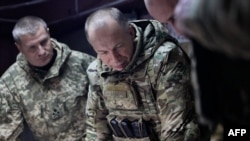
President Volodymyr Zelenskyy pushed out Ukraine’s top general nearly a week after he sacked Mykhaylo Fedorov as defense minister, who had openly clashed with the general in a major fight over strategy in the war against Russia.
The sacking of General Oleksandr Syrskiy, announced late on July 21, followed days of speculation that the man known by many soldiers as the “Butcher of Bakhmut” was fighting for his position as the head of Ukraine’s command.
Major General Mykhaylo Drapatiy, who heads Ukraine’s land forces, will take over from Syrskiy, Zelenskyy said in a post on Telegram.
“We all have one desire - victory over the enemy and the achievement of such conditions at the front and in pressure on Russia that would allow us to force Russia to peace,” he said.
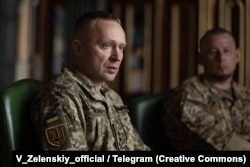
In a post on Facebook, Drapatiy, 43, acknowledged the move: "Serving Ukraine has always been an honor for me, and during the war for independence, it means absolute responsibility. I am grateful to... Syrskiy, for his consistent work in strengthening the Ukrainian army."
In a statement released about 10 hours after the announcement of his removal, Syrskiy defended his tenure as commander, and pointed to some of the reforms he oversaw.
I said it before and I will repeat it today: my job is war. Positions change, but this principle does not. Whatever my status, I will serve Ukraine until victory," he said in a post to Telegram.
The announcement capped a whirlwind week for Zelenskyy and for the entire government and military command with Russia's full-scale invasion now well into its fifth year.
It also comes with nascent optimism for Ukraine's military efforts, with its forces battling Russian troops to a near-standstill in many places across the 1,100-kilometer frontline.
"Drapatiy is an excellent choice, one of the most highly respected leaders among the new generation of Ukrainian officers," said John Hardie, deputy director, Russia Program, Foundation for the Defense of Democracies.
"I'm hopeful his appointment will both boost morale and help tackle challenges facing the Ukrainian military, particularly when it comes to command culture — a problem Drapatiy has experienced firsthand."

Fedorov, a tech-minded defense minister whose embrace of drone warfare innovation for many signaled a break from old-school military thinking, was pushed out on July 15, roughly six months after his appointment.
Zelenskyy nominated the head of the domestic security agency, Major General Yevhen Khmara, as Fedorov's replacement, a move seen as partly mollifying the criticism the president drew for the abrupt ouster.
Fedorov's sacking sparked days of public protests in Kyiv and elsewhere, a sign of his support in the wider public, as well as a sign of Ukrainians' engagement in the often-opaque government decision-making.
Many Ukrainians, who credited Fedorov with the new thinking that had helped forces score a string of successful air strikes inside Russia, were angered over the move.
Fedorov’s embrace of drone innovations helped fuel a campaign that has targeted Russian oil refineries, and led to widespread outages of a gasoline inside Russia, angering drivers and average Russians.
But Fedorov, 35, also clashed with a more entrenched military establishment, including top commanders like Syrskiy, many of whom were trained in what was seen as old-school thinking.

After the announcement of his ouster, Fedorov called out Syrskiy by name, accusing him of stonewalling some of the reforms that Fedorov was pushing.
Appointed commander-in-chief two years into Russia’s all-out invasion, Syrskiy, 60, took over also at a time of roiling politics.
His immediate predecessor was General Valeriy Zaluzhniy, who was respected for his decisions in helping thwart the initial Russian invasion in February 2022.
Zaluzhniy spoke publicly, and critically, about some military decisions, and he was pushed out, made ambassador to Britain.
Syrskiy was also afforded credit for the Ukrainian successes in those early days, as well as the counteroffensive that recaptured swathes of the Kharkiv region later that year.
But his decision to hold the Donbas city of Bakhmut for many months in 2023 was seen by some rank-and-file soldiers as a needless political decision that cost valuable lives. He acquired the nickname “The Butcher” or “The Bakhmut Butcher.”
After being pushed out, Fedorov mounted an unusual public defense of his tenure. He also called out Syrskiy essentially calling him an obstacle to the reforms that Fedorov thought were necessary.
"We ran into a situation where all the initiatives we proposed began to be blocked,” Fedorov complained.
“And Syrskiy, despite all the problems we've discussed today, is unprepared to openly discuss them face to face. Instead, he's willing to hold private meetings, weave intrigues..."
In the days that followed, Syrskiy also mounted his own defense, apologizing publicly to Fedorov.
“I’m not at war with the ministry. I’m at war with Russia,” Syrskiy wrote. “In the army, you don’t get to choose who you serve with. In the army, you follow orders and do your job.”
“There is an idea more important than any surname: Ukraine is bigger than Fedorov, Syrskiy, and any of us,” he wrote in an article published on a Ukrainian military blog. “Reducing this war to a confrontation between two people is the greatest service we can do to the enemy.”
Drapatiy is a well-regarded officer among Ukraine’s rank-and-file, and officer corps. He was among those speaking out in support of Fedorov in the days after Zelenskyy ousted him.
For many Ukrainians, Drapatiy is respected for his decision to tender his resignation in June 2025 after a Russian ballistic missile hit a training ground, killing 12 Ukrainian soldiers.
That attack was seen as a breach of command protocol, since officers had been warned against holding training ceremonies that might be targeted by Russian missiles.
Mykola Byelyeskov, a political analyst at government-affiliated National Institute for Strategic Studies, described Drapatiy as professional and respected among ranks as a decent officer who helped to stabilize the front in Kharkiv in May 2024 and later, in Pokrovsk in December 2024.
“Now it’s about the team: especially who is to be Chief of General Staff,” he told RFE/RL. “Plus no matter the popularity, management of war will be a challenge given manpower problems, unfinished corps reforms, and a deficit of skilled people at different levels."
“But Zelensky did a step to end confrontation with people who wanted change and associated problems with Syrskiy,” Byelyeskov said.