


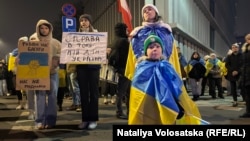
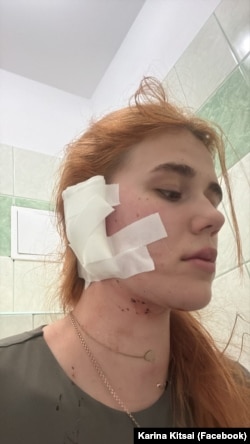
LVIV -- Shortly before she and her boyfriend were brutally beaten on the streets of the Polish city of Wroclaw, a Ukrainian woman named Anastasia Kitsay was inside a shop buying coffee.
When another man cut in front of her at the register to buy a beer, Kitsay pointed out there was a line, Kitsay’s mother, Karyna, said. The man responded “Are you in Ukraine?” and called her a “Ukrainian rag,” as they argued and the man left the store, Karyna told RFE/RL's Ukrainian Service.
Moments later, the man and two others pummeled and kicked Kitsay’s Ukrainian boyfriend, Maksym, as he stood by his car, while also punching Kitsay. The fight, which took place on July 26, was captured on video and circulated widely in Ukrainian and Polish social media.

Both were hospitalized. Two of the men pleaded not guilty to charges of ethnically motivated assault during a July 29 appearance in a Wroclaw court. The city’s mayor condemned the incident: "There is not and will not be tolerance in our city for violence motivated by hatred, xenophobia, or national prejudice."
Since the start of Russia’s all-out invasion in February 2022, Poland has taken in more Ukrainian refugees than any other European country except for Germany: nearly 1 million Ukrainian had refugee status in Poland as of April, according to United Nations figures.
Both the current government in Warsaw and its predecessor have embraced the defense of neighboring Ukraine as a national-security priority.
The Ukrainian population has also help jolt Poland’s already humming economy. About 1 million are classified as labor migrants, according to Ukraine’s ambassador to Poland.
But Ukrainians report growing tensions and resentment from some Poles, who have questioned the depth and duration of taxpayer-funded support for the refugees.
Polish police have reported a 30 percent increase in hate crime attacks on Ukrainians over the past six months , according to the newspaper Rzeczpospolita.

'Speak Polish in Poland!'
Kitsay is not a refugee. She said she's lived in Poland for nearly a decade; her daughter Anastasia moved in 2019.
But Natalya Melynk is. After the start of the war, she moved from the western Ukrainian region of Zhytomyr to Plock, a city west of Warsaw.
On June 27, she said her 15-year-old son and his Ukrainian friend were returning home on a bus when another passenger heard them speaking Ukrainian.
"'Poland’s for Poles,'" she said the man told them. “The children were silent, then he said to my son again: "'You hear me? Poland’s for Poles. Speak Polish in Poland.'"
Melnyk said her son speaks Polish well, and he replied that they were speaking Ukrainian because his friend was Ukrainian.
"In response, the man started shouting: 'Get off the bus. Get out of the country.'" she told Current Time.
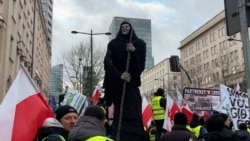
After her son said they would get off the bus at his stop, Melnyk said the man lunged at her son, and struck his friend. Another passenger told the yelling man to get off the bus. At the following stop, the man “literally threw the children off the bus,” she said.
Police officers investigated but did not classify the attack as a hate crime until Melnyk complained. As of July 29, the man has not been identified yet, she said.
The rise in reported hate crimes comes as public surveys show Poles becoming less supportive of Ukrainian refugees.
A survey conducted earlier this month by the Center for Public Opinion Research found that 52 percent of Poles opposed accepting any more Ukrainian war refugees; 42 percent said they were in favor.
That figure is down sharply from 2022, just after the start of Russia's full-scale invasion, when 94 percent of Poles said they were in support of accepting Ukrainian war refugees.
The survey also showed that a majority of Poles, steeped in memories of the Nazi-Soviet invasion in 1939 and decades of dominance by the Soviet Union, support restricting free access to health care for Ukrainians, who until recently were not required to pay into the national health insurance system.
Historical Grievance
The increase in anti-Ukrainian sentiment also comes at a time of strained relations between Warsaw and Kyiv, over a historical grievance dating back decades.
In May, Ukrainian President Volodymyr Zelenskyy announced he would be honoring a military unit battling Russian troops with a designation named after the Ukrainian Insurgent Army.
Poland says the group massacred some 100,000 Poles during World War II, in a region that today borders Ukraine. At the time, the region was under German control.
Poland has designated the killings the Volhynian Massacre, and the country's parliament has declared it was a genocide.
Ukraine rejects that designation, saying Ukrainians faced hatred from Poles as well, and thousands were killed in reprisals. Ukrainian have termed the events the Volyn Tragedy.
Many Ukrainians hail the Ukrainian Insurgent Army as freedom fighters -- a perception that has widened as the country tries to fight off a Russian invasion 35 years after it won independence from Moscow as the Soviet Union collapsed.
Zelenskyy’s honorific designation kicked off a small firestorm of outrage inside Poland.
President Karol Nawrocki, a populist historian who is the former director of a World War II museum, last month announced he was stripping Zelenskyy of Poland’s highest state honor.
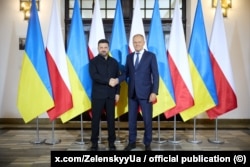
Zelenskyy then returned his award to Poland, as did three of his predecessors as president.
"Discussions around the politics of memory… have once again become a subject of widespread public debate in Poland," said Mateusz Kamionka, a political scientist and expert in Polish-Ukrainian relations at the Jagiellonian University in Krakow.
He said economic and social factors are also influencing shifts in public sentiment, including the rising cost of living as well as a belief that public assistance to Ukrainians is too generous and should be more limited.
“Speaking Ukrainian (or Russian) on the street is becoming a problem," said Alexei Cheplyansky, a Polish journalist. "Poles can't distinguish between Russian and Ukrainian. Recently, a Belarusian athlete was attacked with shouts of 'Go back to Ukraine!'"
Right-wing political parties are also seeking to capitalize on Polish grievances or resentment, he said.
“It's starting to spill over from the Internet into real life," he added.