





One beetroot, five potatoes, an onion, a zucchini, a tomato, and a little barley: "We're preparing our last borshch," a resident of Russian-occupied Oleshky wrote to the southern city's relocated Ukrainian administration.
"We eat once a day," another message read. "We'll die this autumn for sure. I'm dying already, weakening with each day."
These dire reports are among the few sources of information about conditions in Oleshky, which Russian forces captured early in the full-scale invasion of Ukraine that Moscow launched in February 2022. Later that year, it effectively became a frontline city after Ukraine retook the regional capital, Kherson, less than 10 kilometers away on the other side of the Dnieper River.
With Russia's all-out war in its fifth year, Oleshky now lies largely in ruins and is ringed by land mines, trapping residents in a war zone that is cut off from the outside world. Menaced by "endless drones, fires," the town feels "like a horror movie," one local wrote.
Ukrainian officials and volunteers told RFE/RL that people in Oleshky are essentially being held hostage to Russia's military goals in the region, providing Moscow's forces with a human shield for their stronghold in Ukraine's occupied south. At the very least, Russia appears determined to hold on to the territory it controls in Kherson, one of four Ukrainian regions President Vladimir Putin in 2022 baselessly claimed belong to Russia.
With little to no food, drinking water, medicine, or electricity, facing a "total blockade" and stark exposure to Russian drones, the situation in Oleshky is no longer just "critical," Ukrainian volunteer Iryna-Ester Vratareva told RFE/RL. "It is hell."
Oleshky's Endless 'Horrors'
Once home to around 24,000 people, Oleshky's population has dwindled due to a combination of flight and death caused by Russia's war and one of its consequences: severe flooding following the destruction of the massive Kakhovka dam on the Dnieper in 2023, which Ukraine blamed on Russia. Moscow's forces were in control of the dam at the time.
The breach unleashed floodwaters across the Kherson region, almost completely submerging Oleshky and, according to Ukrainian estimations, leaving at least 500 people dead and thousands more missing in the city.
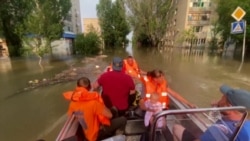

Vratareva, a spokesperson for the Ukrainian civic organization Humanity, which says it has rescued more than 7,000 people from Russian-occupied areas, said fewer than 2,000 people remained in Oleshky by the end of September, including around 50 children.
Now, with their "homes destroyed, property wiped out," documents lost, and little chance of escape, and little chance of obtaining legal status in Russia, many are facing another "horror," she said -- they're starving.
"The hunger has reached such a scale that, in the best-case scenario, a person can eat a clear soup and a few spoons of some kind of porridge in a day," Vratareva said on September 22. "If they have any left."
She added that the Oleshky residents she spoke to expect their food supplies to run out in October. "They have been left completely without food, without medicine, without access to medical assistance, without fire engines, and, of course, without money."
According to Ukrainian authorities, the last time supplies were delivered to the town from the Russian side was around four months ago.
The head of the Oleshky military administration, Tetyana Hasanenko, said that "there have even been documented cases of people eating dogs," while in a separate interview in April, she also described the reverse: "I have a photo showing dogs eating the body of a deceased person."
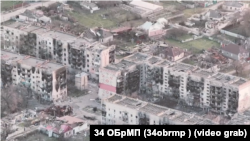
Ukrainian journalist Maria Semenchenko, who grew up in Oleshky, said her relatives there had described collecting rainwater and melting snow for household use.
"I know of confirmed cases of people hunting pheasants or even catching pigeons," she told RFE/RL.
With a fifth wartime winter approaching, Ukrainian officials say time is running out for those remaining in Oleshky, where Hasanenko said "people are counting the hours and days, hoping this situation will somehow be resolved."
Last winter, elderly people "froze" in their apartments and houses, where temperatures dropped as low as 3 degrees Celsius, volunteer and Oleshky native Ksenia Archypova said in April.
While there is no official information on deaths during that period, Archypova said that "when they still had the strength to walk, they would reach the hospital utterly exhausted: they had nothing to eat."
Reportedly left without electricity or fuel for its generator, the local hospital remains open. But its basement is being used to store the bodies of the dead, Hasanenko said.
Human Shield. Inhumane Conditions.
According to Ukraine's human rights ombudsman, Dmytro Lubinets, Kyiv has sought to establish a humanitarian corridor linking Oleshky with government-held territory since the spring, but that Moscow has not agreed. In mid-September, he said at least 358 people needed immediate evacuation from Oleshky.
"If you remember just one thing from this meeting, remember Oleshky. Hear their cry for help," Ukrainian Foreign Minister Andriy Sybiha said in a September 23 speech at the UN General Assembly in New York. "Demand that Russia open humanitarian corridors."
The Kremlin has acknowledged "problems" with food and medicine deliveries to Oleshky but has blamed the "critical" situation there on Ukraine, claiming that Ukrainian forces threaten supply routes. "Our military continues to work to resolve this situation," spokesman Dmitry Peskov said on September 21.
However, Ukrainian officials and volunteers say that the Russian military has been disrupting humanitarian efforts, sometimes violently, and has imposed hard-line rule in Oleshky.
"According to our information, several people who received food were detained, beaten, and thrown into a basement [by Russian forces]," said Oleksandr Prokudin, head of the Kherson region military administration. He said there have also been cases of sexual violence against aid recipients.
It was unclear whether he was referring to a specific aid delivery. In a recent operation, Ukraine used multiple heavy drones to drop food and other supplies that the military said were delivered to about 100 households in Oleshky.

Yuriy Boyechko, CEO of the US-based humanitarian aid organization Hope for Ukraine, said in an e-mailed comment that Russian forces "intentionally shoot down" drones Ukraine uses to drop supplies into the area.
When humanitarian aid from Russia was still being delivered to Oleshky last year, at least five people were killed in shelling while waiting in line to receive it, Archypova said, citing accounts from local residents.
She described the shelling as one of several similar "provocations," saying: "People were standing in line for it starting at two or three in the morning... And then the shelling began."
Providing no further details, Vratareva also said she has "evidence" of instances in which Russian forces had intentionally targeted Oleshky residents with drones. RFE/RL cannot independently verify the claims.
Pointing to cases in which she said residents have risked their lives crossing minefields to escape, Vratareva asserted that Ukrainian efforts to deliver food to Oleshky, as well as any potential international efforts, would now amount to "simply prolonging the agony."
Military experts, meanwhile, say Oleshky is an important staging ground for Russian attacks on the Ukrainian-held portion of the Kherson region, including the city of Kherson, and other parts of southern Ukraine.
The residents of Oleshky, including the elderly, the sick, and others with limited mobility, have been "turned into a human shield," Vratareva said. "The correct and only thing that can really be done is humanitarian assistance that enables evacuation. Only evacuation."
She added that she had "never seen such a total trap. Everywhere else, there were at least some tiny chances of getting out. Oleshky offers no such chances."



